
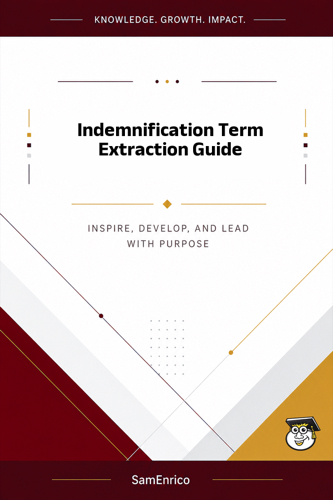
Indemnification Term Extraction Guide
Use chain-of-thought prompting to parse cross-inde
by Enos Troy
Use chain-of-thought prompting to parse cross-indemnity, cap exceptions, and survival periods.
Formats
About this book
Free sample
Chapter 1: Five Hidden Bones--–- Every indemnity clause is a skeleton. Most contract readers see only a jumble of legal bones—a tibia here, a skull there—and mistake the pile for a living creature. But once you learn to name the bones and see how they connect, the skeleton becomes predictable, even beautiful. This chapter gives you the skeleton key.Let us start with a confession. Before I learned to extract indemnity terms systematically, I lost a negotiation badly.
Not because the other side was smarter, but because I misread a single clause. The trigger said “arising from,” but I thought it meant “directly caused by.” The cap was $500,000, but I missed an exception for IP infringement. The survival period was six months, but I assumed claims filed after that were still valid if the underlying event happened earlier. Every single error from the introduction—confusing cross-indemnity parties, misapplying cap exceptions, miscalculating survival—I committed in one afternoon. The company I represented paid $1.7 million that it should not have paid.
That was the day I stopped reading indemnity clauses and started extracting them.This chapter deconstructs the indemnity clause into its five core components. Think of these as the five bones of a skeleton: the skull (trigger), the spine (loss definition), the pelvis (indemnitor/indemnitee), the ribs (cap), and the clock (survival). Each bone has a specific shape and function. When you learn to palpate each one, you can diagnose a broken clause before it breaks you.The Skull: Trigger The trigger is the event that activates the entire indemnity obligation. Without a triggered event, the indemnity clause is a sleeping dog.
With a trigger, it wakes up and bites. The most common triggers are negligence, breach of contract, willful misconduct, or specified events such as intellectual property infringement. But the trigger is never just a noun; it always comes wrapped in language that defines causation.Let me give you an example. “Party A shall indemnify Party B for losses arising from Party A’s negligence.” The trigger is “negligence,” but the word “arising from” tells you how closely connected the…
This is the end of the free sample. Get the eBook to keep going. Buy now
Contents
- Chapter 1
- Chapter 2
- Chapter 3
- Chapter 4
- Chapter 5
- Chapter 6
- Chapter 7
- Chapter 8
- Chapter 9
- Chapter 10
- Chapter 11
- Chapter 12
Details
- Author
- Enos Troy
- Publisher
- SamEnrico
- Language
- English
- Genre
- Non-Fiction, AI Operator, Liability Analysis
- Released
- 2026-06-10
- Pages (approx.)
- 144
- Available as
- eBook, Audiobook

Read better in the ZLOADR app
Your eBooks on your phone or tablet. Sign in with your SamEnrico account and start reading.
More by Enos Troy
 The Breath Candle AnalogyEnos Troy$11.99
 Event Planner Crisis GuideEnos Troy$11.99
 Progressive Peace ScriptEnos Troy$11.99
 Diver's Bioluminescent ArtEnos Troy$11.99
 Emotion Regulation for HSPEnos Troy$11.99
 Campus Assault SurvivorEnos Troy$11.99
 Rewiring Retirement IdentityEnos Troy$11.99
 Egyptian Music GuideEnos Troy$11.99
 The Lion of the Punjab: Ranjit Singh's Rise to Power (1799-1839)Enos Troy$11.99
 The Last Ride of the Pony Express: A Gallop Through History’s Fastest MailEnos Troy$11.99
 Black Sunday: The Storm That Broke the PlainsEnos Troy$11.99
 Program Management FundamentalsEnos Troy$11.99