
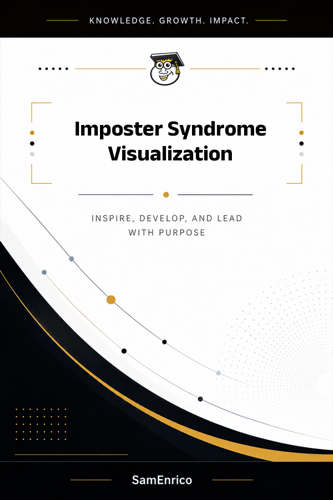
Non-FictionSelf-HelpVisualization
Imposter Syndrome Visualization eBook
Use mental rehearsal to build authentic confidence
Use mental rehearsal to build authentic confidence with this practical guide.
Formats
Free sample
Chapter 1: The Rehearsal Gap...–- Sarah had done everything right. She had the MBA from a top-tier school. She had the ten years of experience. She had the title—Senior Director of Strategy—that she had worked nights and weekends to earn. And yet, as she stood outside the conference room door fifteen minutes before her quarterly presentation to the executive team, her heart was hammering so hard she could feel it in her throat.
Her palms were slick. Her mouth was dry. And the voice in her head—the one she had been trying to ignore for three years—was whispering the same four words: You are about to be exposed.She had prepared for this moment. God, had she prepared. For the past seventy-two hours, she had barely slept.
She had rewritten her slide deck four times. She had anticipated every possible question and scripted answers for each one. She had practiced her opening line in the mirror until her lips were numb. By any objective measure, Sarah was over-prepared. And yet, standing there in the hallway, she felt less ready than ever.When they called her in, she walked to the front of the room, clicked to her first slide, and opened her mouth.
What came out was not the confident, poised opening she had rehearsed. It was thinner. Faster. She watched the executive team’s faces as they glanced at each other, and in that glance, she saw confirmation of everything she feared: they knew. They could see right through her.
She was a fraud, and this was the moment it all came crashing down.The presentation wasn’t a disaster. Objectively, it was fine. She hit her key points. She answered the questions. But when it was over, she didn’t feel proud.
She felt relief. The kind of hollow, exhausted relief you feel when you’ve survived something dangerous. She walked back to her office, shut the door, and sat in silence for ten minutes, trying to convince herself that she hadn’t just failed. But the voice was already back, louder than before: You got lucky this time. Next time, they’ll figure it out.Sarah’s story is not unusual.
In fact, it is so common that it has a name. We call it imposter syndrome—the persistent, gnawing belief that your success is undeserved, that you have somehow fooled everyone around you, and that at any moment, you will be discovered as the fraud you secretly believe yourself to be. First identified by psychologists Pauline Clance and Suzanne Imes in 1978, imposter syndrome was originally studied in high-achieving women. Subsequent research has shown that it affects people across genders, industries, and levels of seniority. It does not discriminate.
It does not care about your résumé, your degrees, or your performance reviews. In fact, imposter syndrome has a cruel irony baked into its core: the more you achieve, the more convinced you become that you don’t deserve any of it.The numbers are staggering. A 2019 study published in the International Journal of Behavioral Science found that nearly 70 percent of people experience imposter feelings at some point in their careers. Among first-generation professionals—those who are the first in their families to hold a white-collar job—that number jumps to 82 percent. In fields like medicine, academia, and technology, prevalence rates regularly exceed 60 percent.
And here is the most unsettling finding: imposter syndrome is more common among high achievers than among low performers. The people who are most likely to feel like frauds are the people who have the most evidence that they are not.If you picked up this book, there is a very good chance that you recognize something of yourself in Sarah. Perhaps you have felt it before a big presentation, a job interview, a performance review, or even a casual conversation with a colleague who seems to have it all figured out. Perhaps you have spent hours over-preparing for something that others seemed to handle with ease. Perhaps you have dismissed your accomplishments as "luck" or "timing" or "people being nice." Perhaps you have lived in quiet terror that someone will ask the one question you cannot answer, and the whole house of cards will collapse.If any of this resonates, I want you to hear something that may feel difficult to believe: The problem is not that you lack confidence.
The problem is that you have been rehearsing the wrong script.That sentence is the central argument of this book. It is not a platitude. It is not a motivational poster. It is a neurological fact, supported by decades of research in cognitive neuroscience, sports psychology, and performance science. And understanding it will change everything about how you approach imposter syndrome.The Hidden Rehearsal No One Talks About Let us return to Sarah for a moment.
In the seventy-two hours before her presentation, what was she actually doing? On the surface, she was preparing: building slides, scripting answers, practicing her opening line. But beneath the surface, something else was happening. Every time she imagined walking into that conference room, she did not see herself succeeding. She saw herself being questioned.
She saw skeptical faces. She saw herself stumbling over words. She saw the executive team exchanging glances that she interpreted as judgment.She was rehearsing. But she was rehearsing disaster.This is the fundamental insight that most books on imposter syndrome miss. They focus on what you think—your cognitive distortions, your negative self-talk, your irrational beliefs.
And those things matter. But they are downstream of something more fundamental: what you visualize. The human brain does not distinguish sharply between a vividly imagined experience and a real one. When you imagine something with enough sensory detail—the sight of the room, the sound of your voice, the feeling of your heart rate increasing—your brain activates many of the same neural pathways as if the event were actually happening. This is not mysticism.
This is neuroplasticity, and it is one of the most well-replicated findings in modern neuroscience.Neuroscientists have known for decades that mental rehearsal changes the brain. In one famous study, researchers divided participants into two groups and asked them to practice a simple five-finger piano exercise. One group practiced physically for two hours a day. The other group sat in front of the piano and imagined practicing—they saw their fingers moving, heard the notes, felt the keys—but never actually touched the instrument. After five days, both groups showed measurable changes in the motor cortex.
The group that practiced only in their minds had rewired their brains almost as much as the group that practiced physically. The only difference was the absence of muscle fatigue.This is the Mental Gym, and it is open to everyone. You do not need special equipment. You do not need a quiet room or a meditation cushion. You need only your imagination and a few minutes of focused attention.
But here is the catch: the Mental Gym does not care what you rehearse. It only cares that you rehearse. If you spend your mental rehearsal time imagining disaster—the hostile question, the skeptical face, the moment of freezing—you are…
This is the end of the free sample. Get the eBook to keep going. Buy now
About this book
Details
- Author
- Mcrae Theodora
- Publisher
- SamEnrico
- Language
- English
- Genre
- Non-Fiction, Self-Help, Visualization
- Released
- 2026-06-06
- Pages (approx.)
- 139
- Available as
- eBook, Audiobook

Read better in the ZLOADR app
Your eBooks on your phone or tablet. Sign in with your SamEnrico account and start reading.
More by Mcrae Theodora
 Instagram Subscriptions RevenueMcrae Theodora$11.99
 Serverless Security ReviewMcrae Theodora$11.99
 Naloxone Accessible Kit GuideMcrae Theodora$11.99
 The Food Addiction Medication GuideMcrae Theodora$11.99
 The Blood Ruby Heist: A Dog's Hunt for Europe's Most Stolen GemMcrae Theodora$11.99
 Construction SupervisorMcrae Theodora$11.99
 GA4 and Firebase IntegrationMcrae Theodora$12.99
 How to Become a Composition-roll Maker And CutterMcrae Theodora$11.99
 Understanding Primary Ciliary Dyskinesia, 2Mcrae Theodora$17.99
You may also like
 Hong Kong Handover 1997Dunn Johnnie$11.99
 Zumba For Postnatal Recovery CourseNeal Christian$11.99
 Zumba for BeginnersLadner Nikia$11.99
 YouTube Comment Mining GuideHumes Pandora$12.99
 Worry Box MeditationCarlin Rudy$11.99
 Workplace Stress MeditationNguyen Lynn$11.99
 Workplace Stress and Sleep RepairHawley Ivory$11.99
 Workplace Perfectionism CureDelaney Jeffry$11.99
 Workplace Injustice Anger GuideWallen Isabelle$11.99
 Work Addiction and Burnout LinkGreenwood Ester$11.99
 Women in Yoga and WellnessBeattie Galina$11.99
 Women in Stand Up ComedyChun Evangeline$11.99