
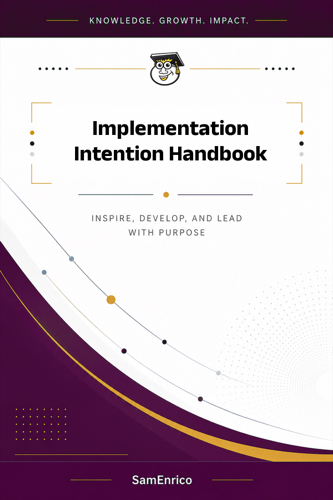
Non-FictionSelf-HelpHabit Formation
Implementation Intention Handbook eBook
Use if then planning to overcome obstacles with th
by Medley Wen
Use if then planning to overcome obstacles with this practical goal achievement guide.
Formats
Free sample
Chapter 1: The Broken Promise...--–- Every January, millions of people make the same pledge to themselves. They will exercise more. They will save money. They will finally write that book, launch that business, or learn that language. They feel the surge of motivation, the clarity of purpose, the certainty that this time will be different.
And every February, perhaps earlier, they find themselves back where they started. The gym membership collects dust. The savings account remains untouched. The manuscript still exists only as a blank document titled "Chapter 1." The question that haunts them—that haunts all of us—is not a lack of desire. It is not a lack of intelligence or effort.
It is something far more fundamental, far more frustrating, and far more universal: Why do we so reliably fail to do the very things we genuinely want to do?This is the question that launched a revolution in the science of human behavior. And the answer, as you will discover in this chapter—and throughout this handbook—is not that you lack willpower, or that you are lazy, or that you are fundamentally broken. The answer is that you have been relying on a flawed model of human motivation. You have believed, as almost everyone does, that wanting something badly enough is sufficient to produce action. You have trusted that your future self will somehow be more motivated, more disciplined, and more organized than your present self.
And that trust, repeated across thousands of decisions every year, is exactly why good intentions so consistently fail to translate into real-world results.The Anatomy of a Broken Promise Consider a simple experiment conducted by researchers at a university gym. They approached hundreds of students who had explicitly stated a goal: to exercise more frequently. The researchers divided these highly motivated students into two groups. Both groups received the same information about the benefits of exercise. Both groups expressed the same level of commitment.
Both groups had access to the same facilities. The only difference was a tiny, almost trivial intervention delivered to just one of the groups.To that group, the researchers asked a simple question: "When and where will you exercise this week?" The students answered with specific details: "I will exercise on Monday and Wednesday after my 10 AM class at the campus gym." That was it. No motivational speech. No rewards. No punishment.
Just a simple specification of when and where.The results were dramatic. Among the group that received no additional instruction, only about one in three followed through on their exercise intentions. Among the group that had specified when and where, nearly three in four actually exercised. A single question—asking people to specify the concrete circumstances of their intended action—more than doubled the rate of follow-through.This experiment, conducted by Peter Gollwitzer and his colleagues in the late 1990s, reveals something profound about the human mind. It tells us that the gap between intention and action is not primarily a gap in motivation.
Both groups wanted to exercise. Both groups intended to exercise. Both groups believed they would exercise. The difference was that one group had inadvertently created what psychologists now call an implementation intention—a specific plan that links a future situation to a predetermined response. The other group had only a goal intention: a general desire without a concrete trigger.This gap between what we intend and what we actually do has been documented across dozens of domains, hundreds of studies, and thousands of participants.
It is the single most consistent finding in the psychology of self-regulation. Smokers who want to quit still light up. Students who intend to study still procrastinate. Drivers who know the dangers of texting still glance at their phones. Couples who value kind communication still escalate arguments.
The list is endless because the mechanism is universal: good intentions, by themselves, are astonishingly weak predictors of actual behavior.Why Your Brain Ignores Your Best Intentions To understand why intentions so often fail, you need to understand a fundamental feature of how your brain processes information. The human mind is not a single, unified decision-maker. It is a collection of competing systems, each with its own priorities, its own timeline, and its own access to your limited attention and energy.The first system, which psychologists sometimes call the deliberative system, is slow, conscious, and rational. This is the part of your mind that sets goals, evaluates options, and makes plans for the future. It thinks in terms of why: why you should exercise, why you should save money, why you should be patient with your children.
The deliberative system operates on the timescale of minutes and hours. It is the voice in your head that makes New Year's resolutions.The second system, often called the automatic system, is fast, unconscious, and associative. This is the part of your mind that reacts to immediate cues, follows established habits, and conserves mental energy whenever possible. It thinks in terms of what and where and when: what is happening right now, where am I, what have I done in this situation before. The automatic system operates on the timescale of milliseconds and seconds.
It is the voice that reaches for your phone when you feel a vibration, or bites your nails when you feel anxious, or opens the refrigerator when you walk into the kitchen.The critical insight—and this is where most self-help advice gets it exactly wrong—is that the deliberative system is not in charge. It is not the CEO of your brain. It is more like a well-meaning advisor who occasionally sends memos to the automatic system, hoping that those memos will be read and implemented. But the automatic system, which runs your actual behavior for the vast majority of your waking hours, does not read memos. It responds to triggers.
It executes patterns. It follows the paths of least resistance that have been worn smooth by repetition and context.This is why you can sincerely intend to exercise after work, and then, when 5 PM arrives, find yourself on the couch with no memory of having made a decision to skip the gym. Your deliberative system made a plan. Your automatic system, faced with the immediate cue of your tired body and your comfortable couch, executed a different plan—the plan it has executed hundreds of times before. No conscious choice was involved.
You did not decide to fail. Your automatic system simply did what automatic systems do: it responded to the most salient cues in your environment using the most well-rehearsed responses in your behavioral repertoire.The Myth of Unlimited Willpower You might be thinking, at this point, that the solution is simply to exert more willpower. If the automatic system is lazy and habitual, surely you can override it with conscious effort. Surely you can just try harder.This belief—that willpower is the master key to behavior change—is one of the most pervasive and damaging myths in modern culture. It is perpetuated by motivational speakers, by Hollywood movies, and by the survivors' bias of people who succeeded through sheer force of effort and assume that everyone else could do the same.
But the scientific evidence tells a very different story.In a series of landmark experiments, the psychologist Roy Baumeister demonstrated that…
This is the end of the free sample. Get the eBook to keep going. Buy now
About this book
Details
- Author
- Medley Wen
- Publisher
- SamEnrico
- Language
- English
- Genre
- Non-Fiction, Self-Help, Habit Formation
- Released
- 2026-06-06
- Pages (approx.)
- 144
- Available as
- eBook, Audiobook

Read better in the ZLOADR app
Your eBooks on your phone or tablet. Sign in with your SamEnrico account and start reading.
More by Medley Wen
 Cat Phobia TreatmentMedley Wen$11.99
 Sleep Journal Combined PracticeMedley Wen$11.99
 Assertiveness and Self EsteemMedley Wen$11.99
 Pain Management Without Alcohol GuideMedley Wen$11.99
 The Last Ride of the Flying Scotsman: A Steam Engine’s Final JourneyMedley Wen$11.99
 Understanding Inguinal HerniaMedley Wen$17.99
 Secondhand Resale Market GuideMedley Wen$12.99
 Visibility Imposter ToolkitMedley Wen$12.99
 Claim ExaminerMedley Wen$11.99
 How to Become a Jewel-bearing GrinderMedley Wen$11.99
You may also like
 Hong Kong Handover 1997Dunn Johnnie$11.99
 Zumba For Postnatal Recovery CourseNeal Christian$11.99
 Zumba for BeginnersLadner Nikia$11.99
 YouTube Comment Mining GuideHumes Pandora$12.99
 Worry Box MeditationCarlin Rudy$11.99
 Workplace Stress MeditationNguyen Lynn$11.99
 Workplace Stress and Sleep RepairHawley Ivory$11.99
 Workplace Perfectionism CureDelaney Jeffry$11.99
 Workplace Injustice Anger GuideWallen Isabelle$11.99
 Work Addiction and Burnout LinkGreenwood Ester$11.99
 Women in Yoga and WellnessBeattie Galina$11.99
 Women in Stand Up ComedyChun Evangeline$11.99