
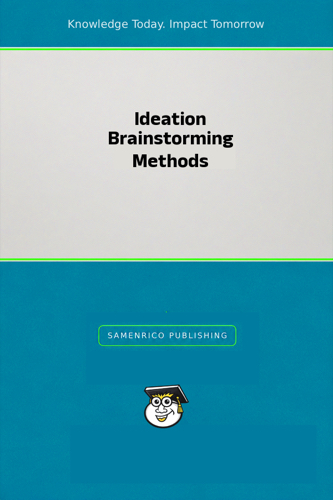
Ideation Brainstorming Methods Audiobook
Teaches quantity over quality, building on others'
Teaches quantity over quality, building on others' ideas, and deferring judgment.
Formats
Free sample
Chapter 1: The Edison Lie...--–- The man who allegedly invented the lightbulb did not, in fact, invent the lightbulb. He did not work alone. He did not experience a sudden, dramatic moment of inspiration. And the story you have been told about creativity—the one where a solitary genius sits in a quiet room until a thunderbolt strikes—is not just misleading. It is actively making you worse at generating ideas.This chapter dismantles the single most damaging myth about innovation: the belief that breakthroughs come from isolated "lightbulb moments." In its place, you will learn the real engine of creativity—a messy, social, volume-driven process that has been hidden behind the romanticized stories we tell about geniuses.
By the end of this chapter, you will understand why the first fifty ideas you generate are statistically worthless, why your instinct to judge ideas early is biologically hardwired but professionally disastrous, and how to completely redefine what success looks like in an ideation session. You will also run your first "Tempo 30" exercise—thirty ideas in thirty minutes—and discover firsthand that quantity is not the enemy of quality. Quantity is the only path to quality.The Invention That Wasn't: What Really Happened at Menlo Park On New Year's Eve 1879, Thomas Edison staged a public demonstration of his new electric light at his laboratory in Menlo Park, New Jersey. The crowd that gathered in the freezing cold saw a small bulb glow with a steady, warm light for several hours. Newspapers across the country ran breathless headlines: "Edison Invents the Lightbulb." The lone genius had done it again.Here is what the newspapers did not report.Edison employed more than twenty assistants at Menlo Park—machinists, glassblowers, chemists, and mathematicians.
He did not work alone in a quiet attic. He worked in a large, noisy, collaborative workshop where ideas were shouted across benches, failures were documented on shared chalkboards, and no single person could claim sole credit for any breakthrough. The lightbulb itself was the product of hundreds of failed experiments conducted by multiple people over several years. The successful filament—carbonized bamboo—was not Edison's idea at all. It came from a British inventor named Joseph Swan, who had been working on the same problem simultaneously and had actually demonstrated a working lamp the year before.
Edison did not invent the lightbulb. He perfected it, scaled it, and—most importantly—built an entire electrical system around it. And…
This is the end of the free sample. Get the Audiobook to keep going. Buy now
About this book
Details
- Author
- Kowalski Shena
- Publisher
- SamEnrico
- Language
- English
- Genre
- Non-Fiction, Self-Help, Ideation
- Released
- 2026-06-08
- Pages (approx.)
- 130
- Available as
- eBook, Audiobook

Listen in the VoxFlicks app
Audiobooks and audio dramas wherever you go. Sign in with your SamEnrico account and press play.
More by Kowalski Shena
 Postpartum Weight Loss Realistic GuideKowalski Shena$11.99
 Lost Child DreamsKowalski Shena$11.99
 ABCDE Method Priority SystemKowalski Shena$11.99
 Bipolar Dark TherapyKowalski Shena$11.99
 Transcendental Meditation for Remote WorkersKowalski Shena$11.99
 Tea Bag Microplastic GuideKowalski Shena$11.99
 Sheppard Case Coroner DisputeKowalski Shena$11.99
 Dream Recall Enhancement CourseKowalski Shena$11.99
 The Great Balloon Race: How a Tiny Town Saved the World’s First Space RaceKowalski Shena$11.99
 The Last Blockbuster: When Video Stores Refused to DieKowalski Shena$11.99
 Frozen Ambition: The Forgotten Arctic Voyages of Juan PizarroKowalski Shena$11.99
 The Dancer's Guide to Two-stepKowalski Shena$11.99
You may also like
 Hong Kong Handover 1997Dunn Johnnie$11.99
 Zumba For Postnatal Recovery CourseNeal Christian$11.99
 Zumba for BeginnersLadner Nikia$11.99
 YouTube Comment Mining GuideHumes Pandora$12.99
 Worry Box MeditationCarlin Rudy$11.99
 Workplace Stress MeditationNguyen Lynn$11.99
 Workplace Stress and Sleep RepairHawley Ivory$11.99
 Workplace Perfectionism CureDelaney Jeffry$11.99
 Workplace Injustice Anger GuideWallen Isabelle$11.99
 Work Addiction and Burnout LinkGreenwood Ester$11.99
 Women in Yoga and WellnessBeattie Galina$11.99
 Women in Stand Up ComedyChun Evangeline$11.99