
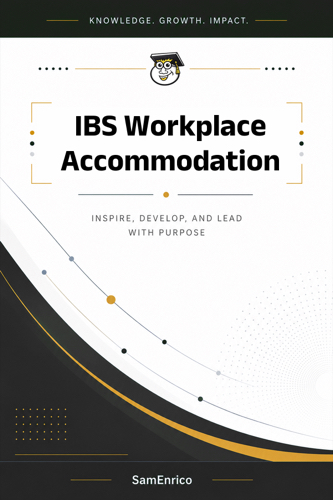
Non-FictionHealth & WellnessWorkplace
IBS Workplace Accommodation eBook
Request flexible schedules, bathroom access, and r
Request flexible schedules, bathroom access, and remote work for symptom management.
Formats
Free sample
Chapter 1: The Silent Epidemic--–- Jamie was twenty-seven minutes into her quarterly performance review when the first cramp hit. She had prepared for this meeting for two weeks—talking points printed, metrics color-coded, a list of her accomplishments neatly bullet-pointed. Her manager, Mr. Thompson, was mid-sentence about "initiative" and "leadership potential" when Jamie felt the familiar, dreaded sensation: a low, twisting pressure in her lower abdomen that meant she had approximately three to five minutes to find a restroom. She had already used her two fifteen-minute breaks for the morning.
The company policy was clear—breaks were scheduled, tracked, and approved. Jamie uncrossed her legs, crossed them again, and smiled. She nodded along as Mr. Thompson spoke, her mind no longer on her career trajectory but on a single, urgent question: Is the bathroom on this floor closer than the one downstairs? By minute thirty-four, she wasn't hearing a word he said.
By minute forty-one, she was calculating whether the emergency exit was a viable route. She made it to the restroom—barely—and sat on the cold tile floor for ten minutes, shaking, ashamed, and certain that her manager had noticed her abrupt departure. When she returned, Mr. Thompson had moved on to the next employee's review. No one asked where she had gone.
No one had to. The smell followed her back to her desk.This is not a story about a weak person. This is not a story about poor planning, lack of discipline, or an overactive imagination. This is the story of approximately forty million Americans—and hundreds of millions worldwide—who live with Irritable Bowel Syndrome (IBS), a functional gastrointestinal disorder that affects the large intestine and causes symptoms including abdominal pain, cramping, bloating, gas, diarrhea, constipation, or a devastating combination of both. And yet, despite its staggering prevalence, IBS remains one of the most silenced, stigmatized, and professionally damaging conditions in the modern workplace.
You can talk about your allergies at the office potluck. You can mention your bad back when you decline to lift boxes. You can even discuss your anxiety or depression with increasing openness, thanks to years of mental health advocacy. But try saying the word "diarrhea" in a staff meeting. Try explaining to your boss that you need to work from home because your colon has declared war on your digestive system.
Try requesting a desk closer to the bathroom without feeling like you have just confessed to something shameful.The silence around IBS is not a coincidence. It is the product of a culture that has deemed certain bodily functions unmentionable, a legal system that requires employees to prove their suffering before receiving help, and a deep, internalized shame that convinces millions of people that their symptoms are somehow their fault. This book exists to break that silence. This chapter, specifically, exists to convince you of one foundational truth before we go any further: You are not broken. The workplace is simply not designed for you—yet.The Numbers That Demand Attention Let us begin with the data, because data has no shame.
According to the American College of Gastroenterology, IBS affects between 10 and 15 percent of the global adult population. In the United States alone, that translates to thirty to forty-five million people—more than the populations of Texas and Florida combined. IBS is the most commonly diagnosed gastrointestinal condition in the world, accounting for up to twelve percent of all primary care visits and nearly half of all referrals to gastroenterologists. Women are approximately twice as likely as men to be diagnosed with IBS, though research suggests this may reflect differences in healthcare-seeking behavior rather than true prevalence. The condition is most commonly diagnosed in people under the age of fifty, meaning it disproportionately affects prime working-age adults.These numbers are not abstract statistics.
They are your colleagues in the next cubicle. They are your manager in the Monday morning meeting. They are the person who always declines the free pizza and brings their own lunch in a plain container. They are the employee who seems to vanish from their desk at exactly the same time every day, returning looking slightly pale and refusing to make eye contact. And because the shame surrounding IBS is so profound, most of these people will never tell a single coworker about their condition.
They will suffer in silence, invent excuses, and absorb the productivity losses as personal failures rather than medical realities.The economic impact of IBS is staggering. A 2021 study published in the journal Clinical Gastroenterology and Hepatology estimated that IBS costs the US economy approximately thirty billion dollars annually in direct medical expenses, lost productivity, and absenteeism. But absenteeism—the simple act of calling in sick—is only part of the story. The larger and more insidious cost is presenteeism: showing up to work physically while being mentally and functionally compromised. Research consistently shows that employees with IBS lose more productive time due to presenteeism than due to absenteeism by a factor of nearly three to one.
In other words, most people with IBS drag themselves to work despite their symptoms, then spend hours of each day managing pain, hiding discomfort, worrying about bathroom access, and performing the exhausting emotional labor of pretending to be fine. By the time they actually take a sick day, they are already running on fumes.Consider the math. If ten percent of your office has IBS—a conservative estimate, given the prevalence data—then in a company of one hundred people, ten employees are silently struggling. If each of those employees loses just two hours of productive time per week to symptom management, anxiety, and presenteeism, that is twenty hours per week of lost productivity for the company. Over a year, that is more than one thousand hours—the equivalent of a part-time employee doing absolutely nothing.
And this calculation excludes the cost of turnover when talented employees eventually quit because they cannot tolerate the lack of accommodation.The Vicious Cycle That Traps You If you are reading this book, you already know the cycle. But let us name it explicitly, because naming something is the first step to breaking it. The cycle works like this:Step One: Fear. You have a job you care about, or at least need. You have deadlines, meetings, presentations, and performance reviews.
And you have a body that has proven itself unreliable. At any moment, without warning, your digestive system may demand immediate attention. This unpredictability creates a low-grade, ever-present fear. You fear the long commute without a restroom. You fear the window seat in a meeting.
You fear the lunch that triggers a reaction. You fear the open-plan office where everyone can see you leave your desk for the fifth time that morning.Step Two: Anxiety. Fear begets anxiety. Your brain, trying to protect you, begins scanning for threats. Where is the nearest bathroom?
How long has it been since I last went? What if I need to go during the presentation? What if someone notices? What if they say something? This anxiety is not a personality flaw.
It is a physiological response to a real and repeated threat. Your amygdala—the brain's fear center—has learned to associate the…
This is the end of the free sample. Get the eBook to keep going. Buy now
About this book
Details
- Author
- Doherty Leola
- Publisher
- SamEnrico
- Language
- English
- Genre
- Non-Fiction, Health & Wellness, Workplace
- Released
- 2026-06-10
- Pages (approx.)
- 126
- Available as
- eBook, Audiobook

Read better in the ZLOADR app
Your eBooks on your phone or tablet. Sign in with your SamEnrico account and start reading.
More by Doherty Leola
 Peripheral Route PersuasionDoherty Leola$11.99
 Discussing Abortion Decision GuideDoherty Leola$11.99
 The Time Boxing TechniqueDoherty Leola$11.99
 The Rapid Refocus Technique HandbookDoherty Leola$11.99
 Tai Chi for Chronic Pain ManagementDoherty Leola$11.99
 Phobia Release ScriptsDoherty Leola$11.99
 The Burnout Prevention PlanDoherty Leola$11.99
 Sleep Deprivation Road AngerDoherty Leola$11.99
 The Siege of Eger: Hungary's Last Stand Against the Ottoman JuggernautDoherty Leola$11.99
 The Double Helix Conspiracy: How the Human Genome Was Almost Lost to HistoryDoherty Leola$11.99
 Blood in the Boardroom: The Untold War of the Corporate TitansDoherty Leola$11.99
 Understanding Ankyloblepharon Ectodermal Defects Cleft Lip PalateDoherty Leola$17.99
You may also like
 Hong Kong Handover 1997Dunn Johnnie$11.99
 Zumba For Postnatal Recovery CourseNeal Christian$11.99
 Zumba for BeginnersLadner Nikia$11.99
 YouTube Comment Mining GuideHumes Pandora$12.99
 Worry Box MeditationCarlin Rudy$11.99
 Workplace Stress MeditationNguyen Lynn$11.99
 Workplace Stress and Sleep RepairHawley Ivory$11.99
 Workplace Perfectionism CureDelaney Jeffry$11.99
 Workplace Injustice Anger GuideWallen Isabelle$11.99
 Work Addiction and Burnout LinkGreenwood Ester$11.99
 Women in Yoga and WellnessBeattie Galina$11.99
 Women in Stand Up ComedyChun Evangeline$11.99