
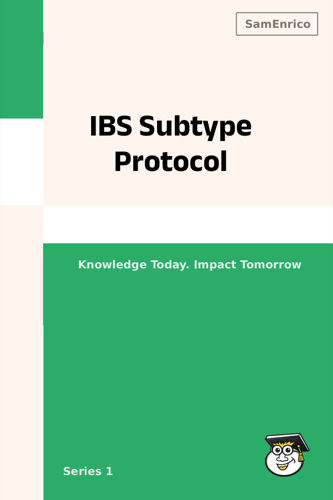
IBS Subtype Protocol eBook
Teaches different management for IBS D, C, M, and
Teaches different management for IBS D, C, M, and U subtypes.
Formats
Free sample
Chapter 1: The Diagnostic Trap--–- Sarah had done everything right. For three years, she had followed the low FODMAP diet religiously, keeping a detailed food diary, weighing her portions, and avoiding garlic and onion like a food allergy. She had tried the probiotics her gastroenterologist recommended, completed eight weeks of gut-directed hypnotherapy, and learned to meditate. Yet here she was again, curled up on her bathroom floor at 2:00 AM, sweat beading on her forehead, her abdomen knotted with pain. The diarrhea had struck without warning, as it always did, and she had barely made it home from dinner with friends.The frustrating part—the part that made her want to throw her food diary across the room—was that she had eaten a "safe" meal.
Grilled chicken, white rice, and a small side of steamed carrots. Nothing on the forbidden list. Nothing that should have triggered her. And yet, her gut had betrayed her anyway.Sarah's story is not unusual. In fact, it is the most common complaint heard in gastroenterology clinics, IBS support groups, and online forums.
Patients try the recommended protocols, follow the prescribed diets, and still suffer. Not because they are doing anything wrong, but because they are following the wrong map for their specific type of IBS.This chapter will expose a difficult truth that most doctors do not have time to explain and most IBS books do not want to admit: the standard approach to treating IBS as a single condition is fundamentally flawed. What works for one patient can actively harm another. And until you understand your specific subtype, you will continue to waste time, money, and hope on treatments that were never designed for your body.The One-Size-Fits-Nobody Myth The medical system has a dirty little secret when it comes to IBS. Despite the fact that the Rome IV criteria—the international standard for diagnosing functional gastrointestinal disorders—clearly distinguishes between four subtypes, most treatment guidelines and popular resources continue to treat IBS as if it were a single entity.
Patients receive the same diet recommendations, the same supplement lists, and the same medication prescriptions regardless of whether they suffer from explosive diarrhea or debilitating constipation.To understand why this is so problematic, consider a simple analogy. Imagine you went to a mechanic and said, "My car is making a noise." Without any further information, the mechanic hands you a wrench and says, "Here, try this." That would be absurd. The noise could be coming from the engine, the brakes, the transmission, or a loose coin in the cupholder. Each cause requires a completely different solution.IBS is no different. The symptom of "abdominal pain with altered bowel habits" can arise from at least four distinct physiological mechanisms.
In IBS-D, the colon contracts too quickly and is hypersensitive to bile acids and serotonin. In IBS-C, the colon moves too slowly and the pelvic floor muscles may fail to relax. In IBS-M, the patient experiences a chaotic mixture of both, often triggered by food chemicals rather than FODMAPs. In IBS-U, the primary driver is often visceral hypersensitivity—pain without any meaningful change in bowel function.Yet most resources present a single low FODMAP food list, a single set of supplement recommendations, and a single gut-brain protocol. This is not just unhelpful.
It is actively dangerous.The Low FODMAP Trap The low FODMAP diet is arguably the most well-researched dietary intervention for IBS. Developed by researchers at Monash University in Australia, it has helped thousands of patients identify and avoid fermentable carbohydrates that trigger symptoms. The evidence is clear: approximately 50 to 70 percent of IBS patients experience significant symptom improvement on a low FODMAP diet.But here is the catch that no one tells you. That 50 to 70 percent statistic includes all subtypes combined. When you separate the data, a troubling pattern emerges.
Patients with IBS-D and IBS-M with diarrhea-predominance tend to respond well. Patients with IBS-C often respond poorly, and in some cases, their symptoms worsen.Why would a diet that helps so many people make constipation worse? The answer lies in the mechanism of action. Low FODMAP diets work by reducing the amount of fermentable carbohydrates that reach the large intestine. In a healthy gut, these carbohydrates serve as prebiotics—food for beneficial bacteria that produce short-chain fatty acids, which nourish the colonic lining and promote regular bowel movements.
In IBS-D, the fermentation process happens too quickly and produces excessive gas and water, leading to diarrhea. Reducing fermentable carbohydrates slows this process down.But in IBS-C, the problem is the opposite. The colon is sluggish. It needs stimulation. When you remove fermentable carbohydrates from the diet of an IBS-C patient, you are removing the very fuel that helps propel stool through the large intestine.
The result is slower transit, harder stools, and worsening constipation.A 2018 study published in the journal Neurogastroenterology and Motility followed 112 IBS-C patients who attempted a low FODMAP diet. Only 31 percent reported significant improvement in constipation symptoms, while 22 percent reported worsening of their baseline constipation. The remaining patients experienced no change. Contrast this with IBS-D patients in the same study, where 68 percent reported improvement in diarrhea symptoms.This does not mean that low FODMAP has no role in IBS-C. For patients whose constipation is accompanied by severe bloating and gas, a modified low FODMAP approach—combined with strategic reintroduction of prebiotic fibers—can be beneficial.
But the standard approach of eliminating high FODMAP foods for six weeks and then slowly reintroducing them often backfires for constipation-predominant patients.The Imodium Mistake If the low FODMAP trap is subtle, the Imodium mistake is catastrophic and immediate. Imodium (loperamide) is an over-the-counter antidiarrheal medication that works by slowing down the movement of the intestines. For a patient with pure IBS-D who wakes up with urgent, watery diarrhea, a single 2 mg tablet can be lifesaving.But for a patient with IBS-M—the mixed subtype—loperamide is a gamble that often backfires spectacularly.Consider the case of James, a 34-year-old accountant who came to my clinic after what he described as "the worst week of my life." James had been diagnosed with IBS-M three years earlier. His typical pattern was two to three days of loose stools, followed by one to two days of constipation, with intermittent abdominal pain throughout. During a particularly stressful tax season, James experienced three consecutive days of diarrhea.
Desperate for relief, he took loperamide after each loose stool, following the package instructions.By day four, James had not had a bowel movement in 36 hours. By day five, he was severely constipated, with hard, pellet-like stools and significant abdominal distension. By day six, he was taking stimulant laxatives to counteract the loperamide, which triggered another round of diarrhea. He spent the seventh day in a cycle of laxatives and antidiarrheals, unable to leave his house.What James did not understand—and what no one had explained to him—was that loperamide stays in the system for 12 to 24 hours. By taking it repeatedly over three days, he had effectively turned off his colonic motility for nearly a week.
His mixed subtype, which normally alternated naturally, was pushed into a severe constipation phase that then rebounded into diarrhea when he overcorrected with laxatives.The correct approach…
This is the end of the free sample. Get the eBook to keep going. Buy now
About this book
Details
- Author
- Sommer Patrina
- Publisher
- SamEnrico
- Language
- English
- Genre
- Non-Fiction, Health & Wellness, Digestive Health
- Released
- 2026-06-05
- Pages (approx.)
- 149
- Available as
- eBook, Audiobook

Read better in the ZLOADR app
Your eBooks on your phone or tablet. Sign in with your SamEnrico account and start reading.
More by Sommer Patrina
 Parent Child Anger GuideSommer Patrina$11.99
 Gacy Trial Transcript AnalysisSommer Patrina$11.99
 Cannabis Use Disorder in the Justice SystemSommer Patrina$11.99
 Bhagwan Bakery OperationSommer Patrina$11.99
 Stolen Car Getaway PatternSommer Patrina$11.99
 Caregiver Crisis ResourcesSommer Patrina$11.99
 Evening Wind Down RoutineSommer Patrina$11.99
 The First Fingerprint: The Case That Changed Forensics ForeverSommer Patrina$11.99
 The Poisoned Veil: The Untold Story of Egypt's Black WidowSommer Patrina$11.99
 Understanding Niemann-pick DiseaseSommer Patrina$11.99
 How to Start a Alcoholic Beverages Exporter (wholesale) Business (Beginners Guide)Sommer Patrina$11.99
 A Collector's Handbook to the Citroën 15 Légère (20Sommer Patrina$11.99
You may also like
 Postpartum Constipation GuideMccollum Katlyn$11.99
 Postpartum Constipation ReliefDerr Romona$11.99
 Lactose Intolerance Relief GuideMchenry Carmelita$11.99
 Lactose Intolerance GuideGilbert Elena$11.99
 Fiber Types and BenefitsMora Deidre$11.99
 Diarrhea Management GuidePridgen Kerstin$11.99
 Keto Constipation Relief GuideShore Wes$11.99
 Constipation Relief ExercisesHardwick Dreama$11.99
 Chloride And DigestionThornburg Shawanda$11.99
 The Microbiome ResetSimms Isaiah$11.99
 Low FODMAP Meal PrepRoberge Codi$11.99
 Ginger Oil Digestion GuideMusser Marietta$11.99