
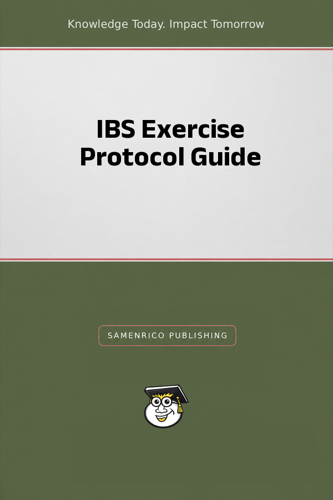
IBS Exercise Protocol Guide eBook
Use moderate physical activity to improve motility
Use moderate physical activity to improve motility without triggering symptoms.
Formats
Free sample
Chapter 1: The Motility Paradox--–- The first time Sarah tried to go for a run after her IBS diagnosis, she made it exactly seven minutes before sprinting back to her apartment, not because she was out of breath, but because her body had betrayed her in the most humiliating way possible. She had done everything her doctor suggested: she ate a bland breakfast two hours beforehand, she hydrated slowly, she chose a route with a public restroom halfway through. None of it mattered. The moment her feet hit the pavement with any real force, a deep, cramping wave rolled through her lower abdomen, and within ninety seconds, she was facing the urgent, undeniable reality that she had approximately forty-five seconds to find a toilet. That was three years ago.
Since then, Sarah has tried yoga (too slow, still triggered urgency), swimming (felt safe but couldn't find a pool near her office), and eventually, nothing at all. She now tells herself that exercise just is not for people like her. Her body, she has concluded, is broken in a way that makes movement fundamentally incompatible with dignity.Sarah is not broken, and neither are you. But Sarah, like millions of people with Irritable Bowel Syndrome, has fallen victim to what this chapter will call the Motility Paradox: the cruel irony that the very activity prescribed to improve digestive health often triggers the most severe gastrointestinal symptoms. Doctors, dietitians, and even well-meaning fitness influencers repeat the same mantra—"exercise helps IBS"—without explaining the specific mechanisms that determine whether a given workout will soothe your gut or send it into a tailspin.
The result is a population of patients who try exercise, fail catastrophically, and then retreat into a sedentary life that only worsens their underlying condition. Physical inactivity leads to slower colonic transit, which worsens constipation; deconditioning raises baseline stress hormones, which worsens diarrhea; and the resulting isolation often deepens the anxiety that drives the entire IBS cycle.This chapter exists to break that cycle before it begins. You will learn exactly why your last workout failed, the physiological distinction between helpful and harmful movement, and a simple framework for determining whether your past flare-ups were caused by mechanical impact or a stress response. By the end of this chapter, you will understand that your gut is not an enemy to be feared but a muscle to be understood—and like any muscle, it responds to specific inputs in predictable ways. The key is learning which inputs to give it.The Fundamental Contradiction To understand why exercise triggers IBS symptoms in so many patients, we must first understand what the colon actually does during physical activity.
The human colon is not a passive tube; it is a muscular organ lined with smooth muscle that contracts in rhythmic, wave-like patterns called peristalsis. These waves push fecal matter from the cecum (where the small intestine empties) through the ascending, transverse, descending, and sigmoid colon, eventually reaching the rectum for elimination. In a healthy digestive system, this process operates like a slow, reliable conveyor belt, moving contents at a rate that allows for water absorption and bacterial fermentation without causing discomfort.Here is the contradiction. Exercise affects this conveyor belt in two completely opposite ways depending on intensity, duration, and individual physiology. Low-to-moderate intensity exercise—think walking at a comfortable pace, gentle cycling, swimming—has been shown in multiple clinical trials to accelerate colonic transit time in people with constipation while having no adverse effects on people with normal or rapid transit.
This is the mechanical motility that doctors refer to when they prescribe exercise for IBS. But high-intensity exercise, sudden bursts of activity, or prolonged endurance efforts trigger a different physiological cascade entirely: the sympathetic nervous system's "fight or flight" response. When your brain perceives physical exertion as a threat—whether because you are sprinting, lifting heavy weights, or even just anxious about exercising—it diverts blood flow away from the gastrointestinal tract and toward the skeletal muscles. The colon receives less oxygen and less blood volume. In response, it does not simply slow down.
It spasms.Those spasms are what Sarah felt seven minutes into her run. They are the hallmark of stress-induced hyperactivity: rapid, disorganized, non-propulsive contractions that trap gas, create sharp pains, and often trigger the sudden urge to defecate. The cruel irony is that the very mechanism designed to protect your body during danger—shunting blood to muscles so you can flee a predator—has been hijacked by modern exercise. Your colon cannot tell the difference between running from a lion and running on a treadmill. It only knows that your heart rate has spiked, your breathing has become rapid, and your muscles are demanding oxygen.
Its job, evolutionarily speaking, is to empty its contents to lighten the load and redirect energy. Hence the urgency.Top 10 Exercise Triggers for IBS Symptoms Understanding the Motility Paradox requires a granular look at what actually triggers symptoms during exercise. Based on a synthesis of clinical literature and patient-reported outcomes, here are the ten most common triggers, ranked from most to least frequently reported, along with the physiological mechanism behind each.Trigger 1: High-Impact Jostling. Running, jumping rope, high-impact aerobics, and even vigorous downhill walking create mechanical forces that physically agitate the colon. The ascending and transverse colon are not securely anchored; they are suspended by mesentery, a fold of tissue that allows for movement.
Repeated jostling can cause these segments to pull on nerve-rich attachments, triggering pain and spasms. This is why many IBS patients report that walking on a treadmill is fine but running outdoors is impossible.Trigger 2: Pre-Workout Anxiety. The anticipation of exercise—especially for patients who have previously experienced symptoms during movement—activates the amygdala and hypothalamus before the first footstep is taken. Cortisol and adrenaline begin circulating, and the gut receives the "prepare for danger" signal before any physical exertion occurs. This is why many patients report symptoms that begin the moment they put on workout clothes, not ten minutes into the session.Trigger 3: Dehydration.
Intense or prolonged exercise leads to fluid loss through sweat. The colon's primary job is water absorption; when systemic dehydration occurs, the colon extracts even more water from fecal matter, leading to hardened stools that are difficult to pass. In patients with constipation-predominant IBS, this can trigger painful bloating and incomplete evacuation. In diarrhea-predominant patients, dehydration can paradoxically trigger urgency as the colon attempts to expel concentrated irritants.Trigger 4: Adrenaline Spikes. Any activity that causes a sudden surge in heart rate—sprinting, heavy lifting, competitive sports—releases large quantities of epinephrine.
Epinephrine binds to beta-adrenergic receptors in the colon, which in most people causes relaxation. But in IBS patients with visceral hypersensitivity, this relaxation is often followed by a rebound contraction that is stronger and more disorganized than the original peristaltic wave. The result is cramping that can last for hours after exercise ends.Trigger 5: Intra-Abdominal Pressure. Heavy lifting, crunches, planks, and any exercise that requires the Valsalva maneuver (holding your breath while straining) dramatically increases pressure inside the abdominal cavity. This pressure directly compresses the colon, which can force gas through narrow flexures (causing sharp pain) or trigger the gastrocolic reflex prematurely (causing…
This is the end of the free sample. Get the eBook to keep going. Buy now
About this book
Details
- Author
- Justus Sunday
- Publisher
- SamEnrico
- Language
- English
- Genre
- Non-Fiction, Health & Wellness, Exercise
- Released
- 2026-06-10
- Pages (approx.)
- 150
- Available as
- eBook, Audiobook

Read better in the ZLOADR app
Your eBooks on your phone or tablet. Sign in with your SamEnrico account and start reading.
More by Justus Sunday
 Message Sidedness GuideJustus Sunday$11.99
 Parent Guide to Teen Self EsteemJustus Sunday$11.99
 The Rolling Time Block SystemJustus Sunday$11.99
 Talking About Bedroom Preferences GuideJustus Sunday$11.99
 Email Distraction Control CourseJustus Sunday$11.99
 The Benefits Keeper GuideJustus Sunday$11.99
 Accident Scene Emotional ControlJustus Sunday$11.99
 Gait Retraining for Hip OsteoarthritisJustus Sunday$11.99
 The Scandal That Shook the Ton: The Duke, the Duel, and the Disappearing DiamondJustus Sunday$11.99
 Qubit Frontier: The Race to Build the World's First Quantum InternetJustus Sunday$11.99
 The Arctic Express: How a Single Storm Changed Bird Migration ForeverJustus Sunday$11.99
 The Complete Guide to the Official Mayo Clinic PlanJustus Sunday$11.99
You may also like
 The IBS Exercise GuideWadsworth Jordan$11.99
 The Winter Exercise SAD GuideLoomis Thanh$11.99
 Endometriosis and ExerciseWhitman Dusty$11.99
 Exercise For GADChilders Terica$11.99
 The Cardio Exercise ED GuideRivas Ressie$11.99
 Shift Work Exercise Timing GuideSlocum Jona$11.99
 Menopause Exercise PrescriptionHolder Delmer$11.99
 Exercise as Antidepressant GuideStaley Yuri$11.99
 The Exercise Adrenal GuideCloud Ethelene$11.99
 Mediterranean and ExerciseGarvin Annamae$11.99
 IBS Exercise Guidelines HandbookBolin Alisia$11.99
 Winter Exercise for MoodNew Leeanna$11.99