
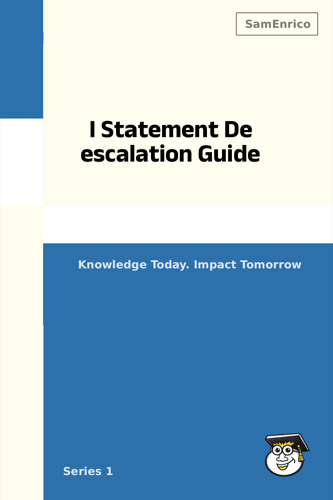
Non-FictionSelf-HelpI Statements
I Statement De escalation Guide eBook
Express your perspective without blame using I fee
Express your perspective without blame using I feel statements to reduce conflict.
Formats
Free sample
Chapter 1: The Blame Trap--–- The argument was over a dirty spoon. Not a betrayal, not a bankruptcy, not a broken promise—a spoon. And yet, ten minutes later, two grown adults were not speaking to each other, one was crying in the bathroom, and the other was silently fuming on the couch, convinced they had married the wrong person. How does a spoon do that? The answer is that the spoon was never the problem.
The spoon was just the spark that ignited a much larger fire: the Blame Loop.This book is about de-escalation, but before you can lower the temperature of any conflict, you have to understand why conflicts explode in the first place. And the answer, rooted in neuroscience, is surprisingly simple: human beings are not designed to hear blame. We are wired to defend against it like a physical attack. When you say, “You left the spoon in the sink,” the person on the receiving end does not hear a request for cleanliness. They hear a threat.
And their brain responds accordingly.This chapter will take you inside that moment of ignition. You will learn why traditional arguments are structurally doomed to fail, what happens inside your skull during the first six seconds of a conflict, and how the simple shift from a Blame Loop to a Feedback Loop can transform not just your arguments, but your relationships. More importantly, this chapter plants the first seed of a theme that will return in Chapter 12: the person you most need to de-escalate may be yourself.The Radical Premise: Arguments Are Designed to Fail Let us start with a provocative statement: most arguments are not communication failures. They are design failures. We have been taught that arguing is a normal, healthy part of relationships—and it can be.
But the way we typically argue follows a predictable, destructive script that virtually guarantees escalation.Here is that script. Person A notices something they do not like. Person A says, “You did X.” Person B hears, “You are bad.” Person B defends themselves by explaining why X was justified. Person A feels unheard and repeats the accusation louder. Person B feels attacked and counterattacks.
Within sixty seconds, the original topic is gone, replaced by a meta-argument about who is more hurt, who is more defensive, and who started it.This is what I call the Blame Loop. It has four stages:Observation (contaminated by judgment): “You never take out the trash.” Notice this is not a neutral observation. It contains a word—“never”—that is statistically impossible but emotionally powerful.Defensiveness: “That is not true! I took it out on Tuesday!”Escalation: “Oh, great, one time in a month. You are so focused on being right that you can’t even hear me.”Repair failure: One person storms out, the other shuts down, and the issue is left unresolved until it re-emerges, worse than before, the next week.The Blame Loop is not a bug in human communication.
It is a feature of how our brains process threat. And until you understand that feature, you will keep triggering it, over and over, wondering why your perfectly reasonable complaint turned into World War Three.The Neuroscience of Blame: Your Amygdala Does Not Speak English To understand why the Blame Loop is so powerful, we need to take a brief detour into the brain. Do not worry—this is not a medical textbook. But understanding three key brain structures will change how you see every argument you have ever had.The first is the amygdala. These two small, almond-shaped clusters of neurons are your brain’s threat detection system.
They are constantly scanning your environment for danger—not just physical danger, but social danger. Criticism, rejection, blame, and exclusion are all processed by the amygdala as threats to your survival. Why? Because for most of human history, being rejected by your tribe meant death. Your brain has not caught up with modern life.
When your partner says, “You never listen,” your amygdala does not hear a complaint about listening. It hears, “You are going to be cast out. Defend yourself now.”The second structure is the prefrontal cortex (PFC), the rational part of your brain responsible for logic, planning, empathy, and impulse control. The PFC is your ally in de-escalation. But it has a problem: it is slow.
When the amygdala detects a threat, it hijacks the brain in what neuroscientists call an amygdala hijack. This takes approximately six to ten seconds. During that window, blood flow is redirected away from the PFC and toward the survival centers of the brain. You literally cannot think clearly. Your IQ drops by ten to fifteen points.
Complex reasoning becomes impossible. This is why smart people say incredibly stupid things during arguments. Their PFC has been temporarily shut down.The third structure is the hypothalamus, which triggers the release of stress hormones—cortisol and adrenaline. These hormones prepare your body for fight, flight, or freeze. Your heart rate increases.
Your breathing becomes shallow. Your muscles tense. You are now biologically ready for combat. And combat is exactly what you get.Here is the cruel irony: the Blame Loop is self-reinforcing. Your accusation triggers their amygdala hijack.
Their defensiveness triggers your amygdala hijack. You are now two people with offline prefrontal cortexes, flooded with stress hormones, biologically primed for battle, trying to solve a problem that requires nuance, empathy, and collaboration. It is like trying to perform brain surgery during an earthquake.The “You” Statement: A Biological Weapon Let us get specific. The primary weapon in the Blame Loop is the “You” statement. These are sentences that begin with “You” followed by a judgment, accusation, or generalization.
Examples include:“You are so selfish.”“You never help around here.”“You always interrupt me.”“You don’t care about my feelings.”“You are just like your mother.”Each of these statements, from a linguistic perspective, has the same structure: “You” + [negative trait or absolute behavior]. Each of them, from a neurological perspective, has the same effect: immediate amygdala activation.Why are “You” statements so triggering? Because they conflate behavior with identity. “You left the dishes out” is a statement about a behavior. It might be true or false, but it is specific.
“You are lazy” is a statement about identity. It says, “Your very nature is flawed.” The brain treats an attack on identity as an existential threat because, in evolutionary terms, it is. If your tribe believes you are lazy, they may stop sharing food with you. Your brain cannot afford to ignore that accusation.This is why “You” statements never work as intended. You say, “You are so selfish,” hoping they will think, “Oh, you are right, I have been selfish.
Let me change.” But that never happens. What actually happens is they think, “I am not selfish! Let me list all the times I was generous.” And now you are arguing about the list, not about the original behavior.The Feedback Loop: An Alternative Architecture If the Blame Loop is a trap, the Feedback Loop is the escape route. It has four stages as well, but they look fundamentally different:Neutral Observation (the video camera test)…
This is the end of the free sample. Get the eBook to keep going. Buy now
About this book
Details
- Author
- Vickers Terica
- Publisher
- SamEnrico
- Language
- English
- Genre
- Non-Fiction, Self-Help, I Statements
- Released
- 2026-06-06
- Pages (approx.)
- 153
- Available as
- eBook, Audiobook

Read better in the ZLOADR app
Your eBooks on your phone or tablet. Sign in with your SamEnrico account and start reading.
More by Vickers Terica
 Senior Cancer Survivor Self Esteem GuideVickers Terica$11.99
 The Breath and Body Scan FusionVickers Terica$11.99
 Uber Comfort vs XVickers Terica$11.99
 The Spanish Non Lucrative Visa GuideVickers Terica$11.99
 The Djinn’s Bargain: A Sultan’s Last WishVickers Terica$11.99
 Guestroom AttendantVickers Terica$11.99
 Understanding Lung Agenesis Heart Defect Thumb AnomaliesVickers Terica$17.99
 How to Become a Last ChalkerVickers Terica$11.99
 Executive Summary Mistakes To AvoidVickers Terica$12.99
 Argentina Lithium Mining GuideVickers Terica$12.99
You may also like
 Hong Kong Handover 1997Dunn Johnnie$11.99
 Zumba For Postnatal Recovery CourseNeal Christian$11.99
 Zumba for BeginnersLadner Nikia$11.99
 YouTube Comment Mining GuideHumes Pandora$12.99
 Worry Box MeditationCarlin Rudy$11.99
 Workplace Stress MeditationNguyen Lynn$11.99
 Workplace Stress and Sleep RepairHawley Ivory$11.99
 Workplace Perfectionism CureDelaney Jeffry$11.99
 Workplace Injustice Anger GuideWallen Isabelle$11.99
 Work Addiction and Burnout LinkGreenwood Ester$11.99
 Women in Yoga and WellnessBeattie Galina$11.99
 Women in Stand Up ComedyChun Evangeline$11.99