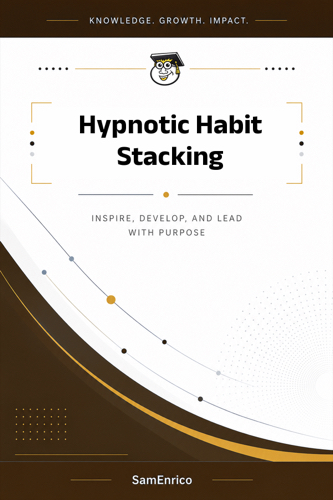
Hypnotic Habit Stacking
Attaches new habits to existing triggers.
Attaches new habits to existing triggers.
Formats
About this book
Free sample
Chapter 1: The Autopilot Trap--–- Every morning, without exception, you wake up and brush your teeth. You do not deliberate. You do not consult a pros and cons list. You do not feel a surge of virtuous discipline. You simply wake up, walk to the bathroom, and brush.
The movement is fluid, automatic, almost invisible. Now consider the habit you actually want to build—the one that has survived eighteen different planners, three New Year's resolutions, and a growing collection of unused workout clothes. That habit feels nothing like brushing your teeth. That habit feels like a negotiation. Every single day, you wake up and argue with yourself.
Should I meditate? Should I write? Should I exercise? And every single day, the argument exhausts you before you begin.The question this book will answer is brutally simple: Why does brushing your teeth feel like nothing, while your most important habits feel like everything? The answer is not willpower.
The answer is not motivation. The answer is not character. The answer is a single, overlooked neurological fact that the entire self-help industry has managed to miss: Your brain does not distinguish between a good habit and a bad habit. It distinguishes between automatic behaviors and non-automatic behaviors.The moment you understand that distinction, the entire game changes.The Paradox of Trying Let us begin with a paradox that will sound familiar to anyone who has ever failed to meditate for the forty-seventh time. The more you consciously try to build a habit, the less likely it is to stick.
This is not an opinion. This is a finding from decades of research into motor learning, automaticity, and the neuroscience of routine. When you try to meditate—when you actively, effortfully, consciously attempt to sit still and breathe—you are engaging a part of your brain that was never designed for repetition. You are asking your prefrontal cortex, the seat of analytical thought and deliberate decision-making, to do something it fundamentally hates: repeat the same action over and over without novelty or reward.Your prefrontal cortex is a hunter. It evolved to solve novel problems…
This is the end of the free sample. Get the eBook to keep going. Buy now
Contents
- Chapter 1
- Chapter 2
- Chapter 3
- Chapter 4
- Chapter 5
- Chapter 6
- Chapter 7
- Chapter 8
- Chapter 9
- Chapter 10
- Chapter 11
- Chapter 12
Details
- Author
- Guzman Loretta
- Publisher
- SamEnrico
- Language
- English
- Genre
- Non-Fiction, Self-Help, Habit Stacking
- Released
- 2026-06-08
- Pages (approx.)
- 123
- Available as
- eBook, Audiobook

Read better in the ZLOADR app
Your eBooks on your phone or tablet. Sign in with your SamEnrico account and start reading.
More by Guzman Loretta
 Self Hypnosis Anchoring GuideGuzman Loretta$11.99
 Compulsive Spending ForgivenessGuzman Loretta$11.99
 The Postpartum Sleep GuideGuzman Loretta$11.99
 Cancer Caregiver Anticipatory GriefGuzman Loretta$11.99
 Advanced Multi Palace SystemGuzman Loretta$11.99
 Menopause Insomnia Medication GuideGuzman Loretta$11.99
 Nonverbal Cues for NegotiatorsGuzman Loretta$11.99
 Rio's Shadow Wars: The Untold Battle for Complexo do AlemãoGuzman Loretta$11.99
 The Devil’s Rebellion: The 1927 Prison Uprising of El Salvador’s IzalcoGuzman Loretta$11.99
 Masked Palm Civets: Asian CivetGuzman Loretta$11.99
 How to Produce PenetrationGuzman Loretta$11.99
 How to Produce Cross-country SkisGuzman Loretta$11.99