
Non-FictionSelf-HelpSimulation Training
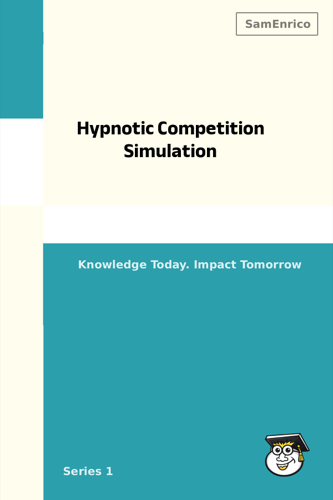
Hypnotic Competition Simulation eBook
Practice game winning moments in hypnosis to reduc
by Bolt Rashad
Practice game winning moments in hypnosis to reduce novelty on competition day.
Formats
Free sample
Chapter 1: The Neural Cage...–- The arena held seventeen thousand people, but for Greg Norman in 1996, the only sound was the catastrophic silence of his own brain turning against him. Six strokes ahead at the Masters, the greatest golfer of his era walked to the tenth tee and proceeded to lose by five. He had practiced that swing fifty thousand times. His muscles knew exactly what to do. And yet, when the pressure hit its zenith, his conscious mind reached into the machinery of his automatic game and jammed every gear.
This is not a story about weakness. It is a story about neural competition—and the surprising key to unlocking the automatic champion inside you.The Universal Experience of Choking Every performer knows this moment. The free throw that clanks off the rim during a tied championship game. The piano recital where fingers freeze above the keys. The CEO whose carefully rehearsed presentation evaporates into stammering silence.
The chess master who blunders a winning position in the final minute of regulation.We call it "choking," but that word implies a moral failure—a weakness of character or will. The research tells a different story. Choking is not the absence of skill. It is the presence of the wrong kind of attention at the worst possible moment.Consider the evidence. A study of professional basketball players found that free throw accuracy dropped by nearly 10 percent in the final two minutes of close games—not because the players forgot how to shoot, but because they began thinking about how to shoot.
Another study of competitive golfers showed that when researchers asked players to consciously attend to the mechanics of their putting stroke, performance collapsed immediately, even among tour professionals. The same players, when distracted by a simple counting task, putted flawlessly.This is the paradox that will haunt every page of this book: thinking about what you know how to do makes you worse at doing it.The problem is not that you lack skill. The problem is that under pressure, your brain shifts from automatic execution to conscious control—and those two systems were never designed to work together in real time.The Two Brains Inside Your Head To understand why choking happens, you must first understand that you do not have one brain. You have two.The explicit system resides primarily in your prefrontal cortex—the wrinkled outer layer of your brain just behind your forehead. This is your conscious mind.
It is slow, deliberate, rule-based, and energy-intensive. It is the system you use when you learn a new skill for the first time: "Okay, I need to keep my elbow straight, follow through, release at the top..." The explicit system is verbal. It talks to you in full sentences. It is the voice that says, "Don't mess this up."The implicit system operates through the striatum, the cerebellum, and deep motor circuits. This is your automatic brain.
It is fast, effortless, and entirely non-verbal. It does not use words. It uses patterns, sequences, and felt senses. The implicit system is what takes over after you have practiced a skill enough that it becomes "second nature." When you tie your shoes without looking, walk without thinking, or catch a ball that comes out of nowhere—that is your implicit system at work. It is silent.
It is fast. And it is extraordinarily reliable.These two systems evolved for different purposes. The explicit system is for novelty and problem-solving. When you encounter a situation you have never seen before, your conscious mind steps in to analyze, plan, and execute deliberate actions. The implicit system is for repetition.
When you have done something a thousand times, your automatic brain creates a procedural memory—a "how-to" script that runs without conscious oversight.Here is the problem: these two systems compete.When the explicit system tries to take over a skill that belongs to the implicit system, the result is not enhancement—it is interference. The conscious mind is too slow for fast actions. It introduces noise into smooth sequences. It second-guesses decisions that were already made. This internal competition is the neurological signature of choking.The Neuroscience of Internal Competition Brain imaging studies have made this visible.
In a now-classic experiment, researchers asked skilled typists to perform their craft while undergoing functional MRI scans. When the typists typed normally, their striatum—the implicit system—showed strong activation while their prefrontal cortex remained quiet. But when researchers told the typists to consciously attend to the specific finger movements required for each letter, the pattern reversed. The prefrontal cortex lit up. The striatum dimmed.
And typing speed dropped by half while errors quadrupled.The same pattern appears across every domain. A study of professional musicians found that when they performed in high-stakes auditions, those who reported the most "conscious monitoring" of their finger positions made the most errors. A study of baseball hitters showed that when batters were asked to "focus on the mechanics of your swing" during live pitching, their reaction times slowed by nearly 200 milliseconds—an eternity when facing a 95-mile-per-hour fastball.The research is unambiguous: when you try to control what you already know how to do, you break it.But here is where most performance advice goes wrong. The standard solution to choking is "just relax" or "trust your training." These phrases are well-intentioned but useless because they address the symptom, not the cause. Telling someone not to think about their swing is like telling someone not to think about a polar bear.
The instruction itself activates the very system you are trying to quiet.You cannot will yourself into automaticity. You cannot consciously decide to stop being conscious.What you need is a different approach entirely—one that works with the architecture of your brain rather than against it.Why "Just Relax" Fails Let us be precise about why standard advice fails. When an athlete chokes, the explicit system (prefrontal cortex) has hijacked a skill that belongs to the implicit system (striatum). The standard advice—"relax, don't think, just let it happen"—is itself a conscious instruction. The athlete must think about not thinking.
This creates a paradoxical state where the explicit system remains active precisely because it is trying to deactivate itself.Think of it this way. Your explicit system is like a back-seat driver. When you are driving on a familiar road, the back-seat driver is silent. But when pressure mounts, that back-seat driver grabs the wheel. You cannot solve this by telling the back-seat driver to "just relax." That is still the back-seat driver talking to itself.What you need is a way to quiet the back-seat driver without engaging in an argument with it.
You need a neutral switch—a method that reduces explicit interference without requiring explicit effort.This is where hypnosis enters the picture.Hypnosis as a Neutral Switch Hypnosis has a reputation problem. Most people picture a swinging pocket watch, a stage performer making someone cluck like a chicken, or a loss of consciousness. None of these are accurate. Clinical hypnosis is not sleep. It is not unconsciousness.
It is not mind control. And contrary to popular belief, you cannot be made to do anything against your will…
This is the end of the free sample. Get the eBook to keep going. Buy now
About this book
Details
- Author
- Bolt Rashad
- Publisher
- SamEnrico
- Language
- English
- Genre
- Non-Fiction, Self-Help, Simulation Training
- Released
- 2026-06-09
- Pages (approx.)
- 121
- Available as
- eBook, Audiobook

Read better in the ZLOADR app
Your eBooks on your phone or tablet. Sign in with your SamEnrico account and start reading.
More by Bolt Rashad
 Emotional Eating and Diet CultureBolt Rashad$11.99
 Herniated Disc MeditationBolt Rashad$11.99
 The Active ListenerBolt Rashad$11.99
 Airline Pilot Stress ManagementBolt Rashad$11.99
 The Miracle on Ice: The Untold OvertimeBolt Rashad$11.99
 The Bridge That Time Forgot: The Mysterious Collapse of the Roman Pont du GardBolt Rashad$11.99
 Understanding Factor Vii DeficiencyBolt Rashad$17.99
 Data Presentation Cheat Sheet for AnalystsBolt Rashad$12.99
 Procurement in PharmaceuticalsBolt Rashad$12.99
 How to Start a Cyclic Hydrocarbons (saturated and Unsaturated) Business (Beginners Guide)Bolt Rashad$11.99
 Pet Grooming (Basic Certification)Bolt Rashad$11.99
You may also like
 Hong Kong Handover 1997Dunn Johnnie$11.99
 Zumba For Postnatal Recovery CourseNeal Christian$11.99
 Zumba for BeginnersLadner Nikia$11.99
 YouTube Comment Mining GuideHumes Pandora$12.99
 Worry Box MeditationCarlin Rudy$11.99
 Workplace Stress MeditationNguyen Lynn$11.99
 Workplace Stress and Sleep RepairHawley Ivory$11.99
 Workplace Perfectionism CureDelaney Jeffry$11.99
 Workplace Injustice Anger GuideWallen Isabelle$11.99
 Work Addiction and Burnout LinkGreenwood Ester$11.99
 Women in Yoga and WellnessBeattie Galina$11.99
 Women in Stand Up ComedyChun Evangeline$11.99