
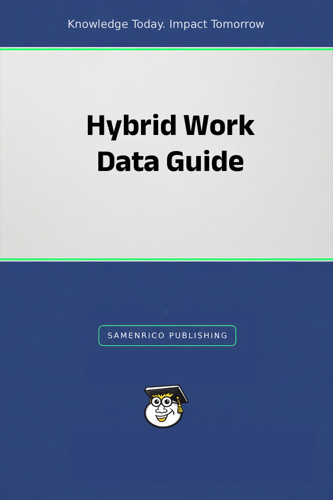
Non-FictionBusiness BriefData Analytics
Hybrid Work Data Guide eBook
Survey employees and analyze usage data to improve
by Lawson Erick
Survey employees and analyze usage data to improve hybrid policies.
Formats
Free sample
Chapter 1: The Half-Day Chasm--–- The CEO of a midsize tech company recently gathered his leadership team to announce a new mandate: four days a week in the office, effective immediately. When a brave vice president asked to see the data that supported this decision, the CEO gestured vaguely at a binder on the corner of his desk. "It's all in here," he said. "Industry benchmarks, best practices, the whole thing." The binder contained exactly three pages of internet printouts, none of which had any statistical validity, and two of which were opinion columns from commercial real estate executives. The CEO had not read the binder either.This story is not unusual.
It is, in fact, the default state of hybrid work leadership in the 2020s. Across industries and company sizes, executives are making billion-dollar decisions about where and how work happens based on gut feelings, nostalgia for pre-202o office culture, pressure from commercial real estate stakeholders, and occasionally—if they are feeling particularly rigorous—anecdotes from their golf partners. The result is a landscape of failed mandates, quiet quitting, and a pervasive sense that nobody actually knows what they are doing.This book exists because that landscape is unsustainable. The Hybrid Work Data Guide is built on a simple proposition: you cannot design a high-performing hybrid organization using intuition alone. You need data.
But not just any data—the right data, collected ethically, analyzed rigorously, and translated into policies that actually improve how people work.The $1.5 Trillion Mistake Before we build the solution, we must understand the scale of the problem. According to multiple global workforce studies conducted between 2021 and 2024, the gap between executive expectations and employee preferences for office attendance is remarkably consistent across industries, geographies, and company sizes. Leaders want employees in the office four to five days per week. Employees prefer two to three days per week. The difference is almost exactly half a day on average—hence the term we will use throughout this book: the Half-Day Chasm.This half-day gap might sound small.
It is not. When multiplied across millions of knowledge workers, half a day per week translates into billions of hours of commuting, trillions of dollars in real estate value, and incalculable costs in employee turnover, disengagement, and resentment. More importantly, the half-day gap represents a fundamental breakdown in trust and communication. Neither side understands the other's data because neither side has collected any. Executives assume that more office time equals more productivity.
Employees assume that less office time equals more autonomy. Both are operating on assumptions, not evidence.Consider the financial math. A typical Fortune 500 company spends an average of $4,000 to $8,000 per employee per year on office space. If that company mandates three days in office but only 60 percent of employees actually comply (a common compliance rate for unpopular mandates), the effective cost per occupied desk skyrockets. Meanwhile, the same company may be losing top performers who resign specifically because of inflexible policies.
The cost to replace a single mid-level manager ranges from 100 to 150 percent of their annual salary. When a policy based on intuition causes just five percent additional turnover, the financial damage can exceed the entire real estate budget.But the costs are not only financial. The half-day chasm corrodes organizational culture. When employees perceive that policies are arbitrary or driven by executive nostalgia, they disengage. They stop contributing ideas in meetings.
They stop going above and beyond. They become what researchers call "present but absent"—physically in the office but mentally checked out. And crucially, they stop trusting leadership. Once trust erodes, every subsequent policy, regardless of how well-intentioned or data-driven, is viewed with suspicion.The Productivity Paranoia Trap Why do otherwise intelligent executives make decisions that defy the available evidence? The answer lies in a psychological phenomenon that we will call Productivity Paranoia.
This term, which has appeared in several academic studies of remote work, describes the persistent belief among managers that employees who are not physically visible are not actually working.The irony is painful. The same managers who successfully led fully remote teams during the lockdowns of 2020 and 2021—often with measurable increases in productivity—suddenly develop amnesia once they return to the office themselves. They walk through empty hallways on Mondays and Fridays, see fewer people at desks, and conclude that work is not happening. Never mind that the quarterly results are strong, that customer satisfaction scores are up, that employee retention is stable. The absence of bodies creates an emotional response that overrides all rational analysis.Productivity paranoia has deep evolutionary roots.
Humans are wired to trust visual confirmation. For most of human history, if you could not see someone working, they probably were not working. But knowledge work has changed the rules. The output of a software engineer, a financial analyst, or a marketing strategist is not visible in the same way that stacking boxes on a warehouse floor is visible. The work happens inside heads, mediated by screens, and often occurs in concentrated bursts rather than continuous activity.The data on this point is unambiguous.
Multiple large-scale studies have found that remote and hybrid workers are, on average, at least as productive as their fully in-office counterparts. Some studies show modest productivity gains from remote work, particularly for tasks requiring deep concentration. Yet productivity paranoia persists because managers are not measuring outcomes—they are measuring presence.Here is the distinction that will save your organization years of pain: badge swipes and attendance data are useful for space planning and completely useless for evaluating individual performance. We will say this again because it is the most violated principle in hybrid leadership: badge swipes tell you how many desks you need, not how much value your people create. A developer who comes to the office five days a week but produces buggy code and misses deadlines is less valuable than a developer who comes in two days a week and ships clean features on time.
Yet most performance evaluation systems remain stubbornly anchored to visibility rather than value.Why Intuition Failed Us The pre-pandemic workplace was not particularly well-managed either. But the flaws were hidden by a simple fact: everyone was in the same place. Managers could walk around, see people at desks, and feel a sense of control. That feeling was always an illusion—presence has never correlated strongly with productivity—but it was a comfortable illusion.Hybrid work shattered the illusion. When half the team is at home on any given day, managers can no longer pretend that visibility equals value.
They are forced to confront the uncomfortable truth that they have been managing by sight rather than by outcome. Many managers respond to this discomfort by demanding more office days. They are trying to restore the old illusion rather than learning new skills. This is understandable but disastrous.Consider the specific ways that intuition-based hybrid policies fail:The Announcement Effect. When a company announces a mandate without data, employees immediately recognize the lack of rigor.
They begin tracking the gap between what leadership says and what leadership does. The mandate is framed as "data-driven," but no data is shared. Trust erodes within days.The Enforcement Gap. Policies based on intuition are…
This is the end of the free sample. Get the eBook to keep going. Buy now
About this book
Details
- Author
- Lawson Erick
- Publisher
- SamEnrico
- Language
- English
- Genre
- Non-Fiction, Business Brief, Data Analytics
- Released
- 2026-06-06
- Pages (approx.)
- 144
- Available as
- eBook, Audiobook

Read better in the ZLOADR app
Your eBooks on your phone or tablet. Sign in with your SamEnrico account and start reading.
More by Lawson Erick
 Email Copywriting Best PracticesLawson Erick$11.99
 Iron Management WorkbookLawson Erick$11.99
 Codependency Recovery Self EsteemLawson Erick$11.99
 Self Hypnosis For Migraine Prevention GuideLawson Erick$11.99
 Love and Shadows in the Congo: The Tragic Romance of the Last ExplorersLawson Erick$11.99
 Blood Moon Prophecies: The Forgotten Vampires of the Mayan UnderworldLawson Erick$11.99
 Understanding Epimetaphyseal Skeletal DysplasiaLawson Erick$17.99
 Harvard Extension vs LSE Library AccessLawson Erick$12.99
 House Sitting Thank You NoteLawson Erick$12.99
 Ultimate Handbook Guide to San Diego : (United States) Travel GuideLawson Erick$11.99
 Landscape LaborerLawson Erick$11.99
You may also like
 Hong Kong Handover 1997Dunn Johnnie$11.99
 Zumba For Postnatal Recovery CourseNeal Christian$11.99
 Zumba for BeginnersLadner Nikia$11.99
 YouTube Comment Mining GuideHumes Pandora$12.99
 Worry Box MeditationCarlin Rudy$11.99
 Workplace Stress MeditationNguyen Lynn$11.99
 Workplace Stress and Sleep RepairHawley Ivory$11.99
 Workplace Perfectionism CureDelaney Jeffry$11.99
 Workplace Injustice Anger GuideWallen Isabelle$11.99
 Work Addiction and Burnout LinkGreenwood Ester$11.99
 Women in Yoga and WellnessBeattie Galina$11.99
 Women in Stand Up ComedyChun Evangeline$11.99