
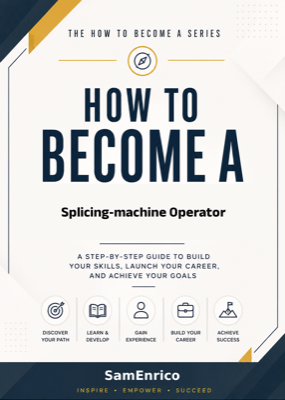
Non-FictionInformativeEducational
How to Become a Splicing-machine Operator eBook
How to Become a Splicing-machine Operator
How to Become a Splicing-machine Operator
Formats
Free sample
Chapter 1: The Glass Ceiling--You have been lied to.Not by malice, exactly. By omission. By a culture that spent thirty years telling every smart kid that the only path to success was a four-year degree, a cubicle, and a Linked In profile full of buzzwords. The guidance counselors didn't mention the $1.7 trillion in student debt. The career fairs didn't show you the manholes and the telephone poles and the bucket trucks.
And nobody—not one person—told you that you could make six figures welding glass in the rain.This book is going to fix that.Fiber optic splicing is the best job you have never heard of. It pays like a profession but feels like a trade. It requires precision like surgery but happens in places like ditches and subsea trenches. It is invisible work that holds together the most visible force in modern life: the internet. Every time you stream a movie, join a video call, or swipe right on someone's face, your data travels through glass.
And that glass is full of splices—microscopic welds made by operators just like the one you are about to become.But before we get to the how, we need to talk about the why. Because if you are going to spend twelve chapters learning to strip fiber, cleave glass, and fire an arc, you deserve to know what is waiting for you on the other side.The Invisible Highway Let us start with a simple fact: the internet is not a cloud.That fluffy icon on your phone screen is a lie. The internet is a physical thing. It is millions of miles of glass cables, laid in conduits underground, strung along telephone poles, and stretched across ocean floors. Those cables are the circulatory system of the digital age.
And like any circulatory system, they break. A backhoe digs where it should not dig. A storm brings down a pole. A ship drags an anchor across a subsea cable. And when that happens, the internet stops flowing.Someone has to fix it.That someone is a splicing-machine operator.The job is exactly what it sounds like.
You take two broken ends of a fiber optic cable, strip away the protective coating, clean the hair-thin glass inside, align the cores under a microscope, and fuse them together with an electric arc hot enough to melt sand into crystal. In five seconds, you restore internet service to a neighborhood, a hospital, an airport, or an entire continent.Consider the scale of what you are about to join. As of 2025, there are more than 5 million kilometers of subsea fiber optic cables on the ocean floor—enough to circle the Earth more than 120 times. There are tens of millions of kilometers of terrestrial cables. The global fiber optic market is growing at nearly 10% annually, driven by 5G deployment, fiber-to-the-home expansions, and the insatiable human demand for bandwidth.
Every new data center, every new cell tower, every new housing development requires splices.And here is the part the guidance counselors never mention: there is a massive labor shortage.The fiber optic workforce is aging. The average outside plant technician is over 45 years old. Telecom companies are desperate for young operators who can climb a ladder, handle a microscope, and show up on time. At the same time, the trades have been stigmatized for a generation. The result is a supply-and-demand imbalance that pushes wages higher every year.This is not a job that will be automated.
Artificial intelligence cannot crawl into a manhole. Robots cannot strip fiber in a rainstorm. The last mile of every network—the physical connection between the glass and the world—requires human hands. Your hands.The Three Ladders Before we go further, let me show you exactly where this path leads. Most career guides give you a single ladder: start here, climb there, retire somewhere.
That is not how fiber optics works. You have choices. Three of them, in fact.Ladder One: The Employee Path This is the most common route. You get hired by a telecom company, a construction contractor, or a broadband utility. They provide the training, the equipment, and the truck.
You show up, do the work, and collect a paycheck.Starting wages for entry-level splicing technicians range from 20to20 to 20to30 per hour, depending on location and experience. Add overtime—and in this trade, overtime is plentiful—and a first-year operator can clear 60,000to60,000 to 60,000to75,000. Benefits typically include health insurance, paid time off, and a 401(k) match. After two to three years, experienced operators earn 35to35 to 35to45 per hour, pushing annual income into the 80,000to80,000 to 80,000to100,000 range. Lead technicians and crew supervisors can reach $50 per hour or more.The employee path is stable.
Predictable. Low risk. You do not need to buy your own fusion splicer—a machine that costs 10,000to10,000 to 10,000to50,000 new. You do not need liability insurance. You do not need to chase down invoices.
You show up, splice, and go home.The trade-off is the ceiling. You work when you are told. You go where the truck goes. Your income is capped by the hourly rate, and that rate moves slowly.Ladder Two: The Independent Contractor Path This is where the money gets interesting.Independent fiber optic splicers—1099 contractors, sole proprietors, LLC owners—bill between 50and50 and 50and150 per hour. The range depends on your reputation, your speed, your equipment, and the urgency of the job.
Emergency restoration work pays the highest rates. A 2 AM call to repair a cut cable that is taking down a casino's network? That is $200 an hour territory.But here is the catch: you pay for everything.A used fusion splicer costs 4,000to4,000 to 4,000to8,000. A new one costs 10,000to10,000 to 10,000to30,000. An OTDR—the testing device that verifies your splices—adds another 2,000to2,000 to 2,000to10,000.
Liability insurance runs 500to500 to 500to1,500 per year. You pay your own taxes, which means setting aside 25% to 30% of every invoice. You have no paid time off, no health insurance, and no 401(k) match.Despite these costs, the math works for many operators. A contractor billing 75perhourfor1,500hoursperyear(roughly30hoursperweek,accountingfortravelandpaperwork)grosses75 per hour for 1,500 hours per year (roughly 30 hours per week, accounting for travel and paperwork) grosses 75perhourfor1,500hoursperyear(roughly30hoursperweek,accountingfortravelandpaperwork)grosses112,500. After expenses and taxes, take-home pay often exceeds what an employee makes at $40 per hour—and you set your own schedule.The independent path is for people who want freedom more than security.
It is for the self-starter who can bid jobs, manage clients, and maintain equipment without someone looking over their shoulder.Ladder Three: The Business Owner Path You start as an independent contractor. Then you hire another splicer. Then another. You buy a second fusion splicer, then a third. You bid on larger contracts—subdivisions, municipal broadband projects, backbone installations.
You stop splicing and start managing.This is the path to real wealth in the trade. Successful fiber optic contracting businesses generate 500,000to500,000 to 500,000to2 million in annual revenue, with profit margins of 20% to 30%. Owners work less and earn more. But this path requires business skills as much as technical ones: bidding, invoicing, payroll, insurance, bonding, and client relationships.Few operators reach…
This is the end of the free sample. Get the eBook to keep going. Buy now
About this book
Details
- Author
- Harman Lezlie
- Publisher
- SamEnrico
- Language
- English
- ISBN
- 9781506057583
- Genre
- Non-Fiction, Informative, Educational
- Released
- 2026-05-18
- Pages (approx.)
- 125
- Available as
- eBook, Paperback, Audiobook

Read better in the ZLOADR app
Your eBooks on your phone or tablet. Sign in with your SamEnrico account and start reading.
More by Harman Lezlie
 Shampoo for Balding MenHarman Lezlie$11.99
 Home Renovation PriorityHarman Lezlie$11.99
 Alumni Network LeverageHarman Lezlie$11.99
 RuneScape Grind Recovery GuideHarman Lezlie$11.99
 The Gig Economy State Tax GuideHarman Lezlie$11.99
 The Knight in Stone: How Antony Gormley Forged Modern MythsHarman Lezlie$11.99
 Understanding Meningoencephalocele-arthrogryposis-hypoplastic ThumbHarman Lezlie$17.99
 Robotics Software EngineerHarman Lezlie$11.99
 Ethical AI Governance GuideHarman Lezlie$12.99
 Project Management Quick ReferenceHarman Lezlie$12.99Project Management Quick ReferenceHarman Lezlie$12.99
You may also like
 Hong Kong Handover 1997Dunn Johnnie$11.99
 Zumba For Postnatal Recovery CourseNeal Christian$11.99
 Zumba for BeginnersLadner Nikia$11.99
 YouTube Comment Mining GuideHumes Pandora$12.99
 Worry Box MeditationCarlin Rudy$11.99
 Workplace Stress MeditationNguyen Lynn$11.99
 Workplace Stress and Sleep RepairHawley Ivory$11.99
 Workplace Perfectionism CureDelaney Jeffry$11.99
 Workplace Injustice Anger GuideWallen Isabelle$11.99
 Work Addiction and Burnout LinkGreenwood Ester$11.99
 Women in Yoga and WellnessBeattie Galina$11.99
 Women in Stand Up ComedyChun Evangeline$11.99