
Non-FictionInformativeEducational
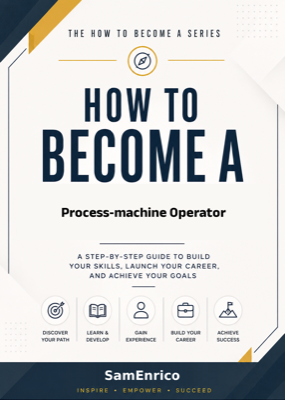
How to Become a Process-machine Operator eBook
How to Become a Process-machine Operator
How to Become a Process-machine Operator
Formats
Free sample
Chapter 1: Beyond the Wrench...--It was 3:47 on a humid Tuesday afternoon when Darrell discovered he’d been lied to. Not by anyone malicious, mind you. By the entire world. For twelve years, he had worked in a factory that stamped metal brackets for car seats. He stood at the same press, loaded the same coil of steel, pressed the same green button, and watched the same die slam down forty times an hour.
He was a machine operator. And he hated it. The work was loud, repetitive, and hot. His back ached. His hands were calloused in places that never quite healed.
He earned eighteen dollars an hour and thought, This is just what manufacturing is.Then his cousin, a woman named Elena who had barely graduated high school, mentioned over Thanksgiving dinner that she’d just bought a house. A real house. With a yard. Darrell, still renting a two-bedroom apartment with a roommate, asked how. “Process operator,” she said.
“Water treatment plant. I sit in a control room most of the shift, watch screens, walk the plant once an hour, and make thirty-four bucks an hour base. Overtime pushed me to ninety-two last year.”Darrell almost choked on his turkey.He asked what a process operator actually did. Elena thought for a moment and said, “I don’t run a machine. I run a system.
I take dirty river water, add chemicals, filter it, test it, and send clean water to half a million people. I don’t touch most of it. The pumps and valves and sensors do the work. I just watch them, adjust them, and fix them when they break.”That was the moment Darrell realized he had confused being a machine operator with being a process operator. They are not the same thing.
Not even close. And that confusion is the single biggest reason why thousands of people every year walk past six-figure careers without ever noticing them.If you are reading this book, you are probably a lot like Darrell. You have worked with your hands. You are not afraid of grease, sweat, or early mornings. You may have driven a forklift, packed boxes, run a CNC mill, or assembled components on a line.
Or maybe you are completely new to industrial work but you are mechanically inclined—you fix your own car, you built a shed in the backyard, you understand that things work in cycles and systems. You are looking for a path that does not require four years of college, does not bury you in debt, and does not trap you behind a desk staring at spreadsheets.You have found that path. But first, you need to unlearn what you think you know about manufacturing.The Great Misunderstanding: Machine Operator vs. Process Operator Walk into any automotive parts plant and you will see rows of workers doing exactly what Darrell did. They load raw material, press a button, wait for a cycle to complete, unload the finished piece, and repeat.
That is discrete manufacturing. You make one thing, then another identical thing, then another. The machine is a tool. You are its feeder. The work is measured in units per hour.
Your value is measured in repetition.Now walk into a refinery, a water treatment plant, a pharmaceutical factory, or a food processing facility. The difference is immediately obvious. You will not see rows of identical machines. Instead, you will see pipes—miles of them, snaking between towers, tanks, heat exchangers, and pumps. You will hear the low hum of motors and the whisper of steam.
And in the center of it all, a control room filled with computer screens showing trends, pressures, temperatures, and flow rates. The people in that control room are not pressing buttons every thirty seconds. They are watching. Monitoring. Waiting.
And when something changes—a pressure drop, a temperature spike, a pump that stops responding—they act.That is process manufacturing. You do not make discrete units. You transform raw materials continuously. Crude oil goes in one end of a refinery; gasoline, diesel, and jet fuel come out the other end. Corn goes into a biorefinery; ethanol, animal feed, and carbon dioxide come out.
River water goes into a treatment plant; drinking water comes out. The product is not a “unit.” It is a flow. And your job is not to feed a machine. Your job is to manage the transformation.Here is the key insight that changes everything: In discrete manufacturing, the machine is the star. You are the support act.
In process manufacturing, the system is the star. You are the conductor.A conductor does not play an instrument. She does not saw wood or blow air through brass. She listens, watches, and guides. She knows when the violins are too loud, when the brass is late, when the tempo needs to shift.
The orchestra plays itself most of the time. The conductor’s job is to handle the exceptions—and to set the conditions for excellence.That is what a process operator does. You set the conditions—pressure, temperature, flow, chemistry—and then you let the system run. You monitor constantly. And when the system drifts, you bring it back.
You do not muscle the work. You think the work.Why This Confusion Costs You Money Here is the brutal truth that recruiters will never tell you. When a hiring manager sees “machine operator” on a resume, they think: repetitive motion, limited problem-solving, physical labor, and a ceiling of about twenty-two dollars an hour. When they see “process operator” (or “process technician,” “plant operator,” “control room operator”), they think: system thinking, troubleshooting, responsibility, and a range of twenty-eight to forty-five dollars an hour, plus overtime that can double that.The words matter. The frame matters.
And right now, you are probably sitting on a resume that sells you short.Let me give you an example. Two people apply for the same job at a chemical plant.Applicant A writes: “Operated a filling machine, loaded pallets, inspected finished products, maintained clean work area.”Applicant B writes: “Monitored flow rates and pressure on a three-stage filling system, adjusted PLC setpoints to maintain fill accuracy within ±0.5%, performed line clearance between batches to prevent cross-contamination, and documented all deviations in batch records.”Both applicants did exactly the same job. But Applicant A framed it as discrete machine operation. Applicant B framed it as process operation. Applicant B gets the interview.
Applicant A gets the rejection email.This book will teach you not only how to do the work of a process operator but how to talk about that work in a way that gets you hired, promoted, and paid what you are worth. And it starts with this chapter, where we lay the foundation for everything that follows: the three pillars of process operation, the flow of materials through a plant, and the single most important mental model you will ever learn as an operator.The Three Pillars: Safety, Environment, Efficiency Every decision you make as a process operator will be measured against three things. I call them the Three Pillars. If you forget everything else in this book, remember these. They are the lens through which your…
This is the end of the free sample. Get the eBook to keep going. Buy now
About this book
Details
- Author
- Upshaw Juliann
- Publisher
- SamEnrico
- Language
- English
- ISBN
- 9781505930696
- Genre
- Non-Fiction, Informative, Educational
- Released
- 2026-05-11
- Pages (approx.)
- 159
- Available as
- eBook, Paperback, Audiobook

Read better in the ZLOADR app
Your eBooks on your phone or tablet. Sign in with your SamEnrico account and start reading.
More by Upshaw Juliann
 NVC For Eating DisordersUpshaw Juliann$11.99
 Zinc and Magnesium for TestosteroneUpshaw Juliann$11.99
 Sleep Restoration During Alcohol RecoveryUpshaw Juliann$11.99
 Franchising Your Local Brand Across Borders Patent StrategyUpshaw Juliann$11.99
 Peer Teaching Memory GuideUpshaw Juliann$11.99
 Hybrid LTC Annuity GuideUpshaw Juliann$11.99
 Cocaine Recovery AffirmationsUpshaw Juliann$11.99
 Secondary Infertility MenUpshaw Juliann$11.99
 The Kidnapping of the Beagle Boys: Colombia’s Most Audacious Hostage Rescue (1981)Upshaw Juliann$11.99
 The Alpine Obsidian: Switzerland's Volcanic IngenuityUpshaw Juliann$11.99
 EU VAT Import One Stop Shop BlueprintUpshaw Juliann$12.99
 Tech Support Student EmploymentUpshaw Juliann$12.99
You may also like
 Hong Kong Handover 1997Dunn Johnnie$11.99
 Zumba For Postnatal Recovery CourseNeal Christian$11.99
 Zumba for BeginnersLadner Nikia$11.99
 YouTube Comment Mining GuideHumes Pandora$12.99
 Worry Box MeditationCarlin Rudy$11.99
 Workplace Stress MeditationNguyen Lynn$11.99
 Workplace Stress and Sleep RepairHawley Ivory$11.99
 Workplace Perfectionism CureDelaney Jeffry$11.99
 Workplace Injustice Anger GuideWallen Isabelle$11.99
 Work Addiction and Burnout LinkGreenwood Ester$11.99
 Women in Yoga and WellnessBeattie Galina$11.99
 Women in Stand Up ComedyChun Evangeline$11.99