
Non-FictionInformativeEducational
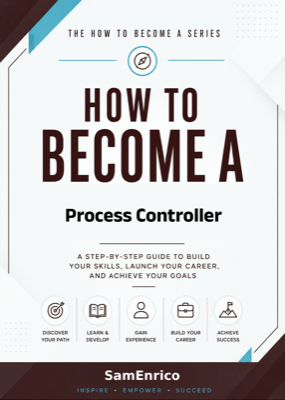
How to Become a Process Controller eBook
How to Become a Process Controller
by Ligon Bess
How to Become a Process Controller
Formats
Free sample
Chapter 1: The Three Chairs...--At 2:47 on a Tuesday morning, a junior engineer named Priya watched a DCS screen flicker through thirty-seven alarms in forty-two seconds. A distillation column was flooding. The console operator beside her – a woman with twenty-three years of experience – didn't flinch. She clicked three buttons, typed two numbers, and the alarms stopped. The column stabilized.
Priya asked, "How did you know which alarms were real?" The operator replied, "Because I understand what's inside the tower, not just what's on the screen."That exchange captures the single most important lesson of process control: the screen is not the process. A controller does not manipulate numbers on a display. A controller manipulates pressure, temperature, flow, and level inside pipes, vessels, and towers that often contain flammable, toxic, or explosive materials. The numbers on the DCS are just messengers. Kill the messenger, and the process continues – often toward a dangerous outcome.This book exists because the gap between academic control theory and industrial practice is vast and dangerous.
Universities teach Laplace transforms, root locus diagrams, and state-space models. These are valuable tools, but they do not prepare you for a plant where a pressure transmitter drifts because a condensate line is partially plugged, or where a valve sticks because the packing gland was overtightened by a well-meaning maintenance technician, or where an operator has bypassed an interlock because "it always false trips."Process control is not mathematics applied to physics. Process control is physics applied to economics, wrapped in human factors, constrained by safety, and executed through fallible hardware.If you are reading this book, you likely fit into one of three categories. You might be a student or recent graduate who has studied control theory but has never seen a real P&ID. You might be a technician who can calibrate a transmitter blindfolded but struggles to understand why a loop oscillates.
Or you might be an engineer who has been tuning loops by trial and error and suspects there is a better way.All three paths converge on the same destination: the control room. But the seats in that control room are not all the same. Before you can become a process controller – before you can design, tune, operate, or troubleshoot – you must first understand which chair you are aiming for.The Three Archetypes of Process Control Walk into any major industrial facility – a refinery, a chemical plant, a pharmaceutical manufacturing site, a power station – and you will find three distinct roles working together. They are often confused by outsiders, and sometimes even by insiders. But the distinction is critical because each role requires a different combination of skills, different career paths, and different day-to-day realities.The Console Operator The first chair belongs to the Console Operator.
This person sits in the control room for twelve-hour shifts, often on a rotating schedule that includes nights, weekends, and holidays. Their eyes move constantly across a bank of screens displaying hundreds of process variables, alarms, and trends. Their hands rest on a keyboard and trackball, ready to adjust setpoints, transfer control, or acknowledge alarms.The console operator's superpower is situational awareness. They know, at any given moment, where the process is, where it is going, and what could go wrong. They have memorized the normal ranges for dozens of key variables.
They can feel – almost viscerally – when a controller is "fighting" or when a measurement seems "off."Their day-to-day work includes:Monitoring the DCS for deviations from normal operating conditions Acknowledging and responding to alarms according to priority Making real-time adjustments to setpoints, tuning parameters, and modes (auto/manual)Communicating with field operators to coordinate manual operations like pump starts, valve lineups, and sample collection Documenting upsets, actions taken, and lessons learned in shift logs Participating in shift handoffs, where control of the process transfers from one team to the next The console operator does not typically design control strategies or tune loops from scratch. They inherit a running process and keep it running. Their decisions happen in seconds or minutes. A mistake can cost millions or cause a fatality.The path to this chair often starts with field operations: working as a outside operator, learning the physical plant first, then moving to the board. Many console operators have decades of experience but no engineering degree.
In some industries, a two-year technical degree is the standard entry point.The key insight for aspiring console operators: You do not need to derive transfer functions. You do need to understand what each instrument measures, how each valve behaves, and what happens upstream and downstream of every loop. Your credibility comes from knowing the process, not from knowing the math.The Controls Technician The second chair belongs to the Controls Technician. This person spends most of their time outside the control room, in the plant, or in a workshop. Their tools include multimeters, communicators, calibration equipment, laptops with configuration software, and an ever-present radio.The controls technician's superpower is hardware intuition.
They know that a pressure transmitter reading that drinks slowly is almost always a plugged impulse line. They know that a valve position that jumps erratically means stiction. They can hear a failing positioner from twenty feet away.Their day-to-day work includes:Calibrating pressure, temperature, flow, and level transmitters Replacing and configuring valve positioners Troubleshooting wiring faults, ground loops, and signal noise Installing and commissioning new instruments Maintaining and repairing final control elements (valves, actuators, VFDs)Configuring PLC I/O and basic logic Supporting maintenance turnarounds and shutdowns The controls technician does not typically design advanced regulatory control strategies or perform detailed loop tuning. They ensure that the hardware works correctly so that the controls engineer and console operator can do their jobs. Their decisions happen in minutes to hours.
A mis-calibrated transmitter or a mis-wired valve can cause exactly the same process upset as a bad tuning constant – but the technician finds the physical cause.The path to this chair almost always begins with a trade: instrumentation, electrical, or electronics. Many controls technicians start as electricians or maintenance mechanics and specialize. Certifications like the ISA Certified Control Systems Technician (CCST) are highly valued.The key insight for aspiring controls technicians: You do not need to design a cascade controller. You do need to know how to bench-check a valve, how to simulate a 4-20 m A signal, and how to read a loop drawing. Your credibility comes from making things work reliably, not from writing configuration files.The Process Control Engineer The third chair belongs to the Process Control Engineer.
This person splits their time between an office, the control room, and the field. Their tools include dynamic simulation software, tuning calculators, data historians, and the DCS engineering workstation.The process control engineer's superpower is system thinking. They see not just individual loops, but the interactions between loops. They understand how a change in reflux ratio affects the entire distillation column. They can look at a poorly performing control strategy and redesign it from first principles.Their day-to-day work includes:Developing new control strategies to improve product quality, throughput, or energy efficiency Tuning PID loops using open-loop bump tests or closed-loop methods (with caution)Designing and configuring advanced regulatory control (cascade, feedforward, ratio, override)Leading troubleshooting…
This is the end of the free sample. Get the eBook to keep going. Buy now
About this book
Details
- Author
- Ligon Bess
- Publisher
- SamEnrico
- Language
- English
- ISBN
- 9781505930665
- Genre
- Non-Fiction, Informative, Educational
- Released
- 2026-05-08
- Pages (approx.)
- 153
- Available as
- eBook, Paperback, Audiobook

Read better in the ZLOADR app
Your eBooks on your phone or tablet. Sign in with your SamEnrico account and start reading.
More by Ligon Bess
 Opioid Induced HypogonadismLigon Bess$11.99
 NVC For Imposter SyndromeLigon Bess$11.99
 Franchising Your Local Brand Across Borders Territorial RestrictionsLigon Bess$11.99
 Stimulant and RelationshipsLigon Bess$11.99
 Mindfulness Based Relapse Prevention for AlcoholLigon Bess$11.99
 Home Sharing Platform GuideLigon Bess$11.99
 Short Answer Exam GuideLigon Bess$11.99
 Anabolic Steroid ReversalLigon Bess$11.99
 The Opium Wars' Poisoned Legacy: The Triads' Deadly Medical ConspiracyLigon Bess$11.99
 The Counterfeit Kings of Berlin: The Great Prohibition ScandalLigon Bess$11.99
 How to Produce Colored Exterior StainLigon Bess$11.99
 How to Produce GrommetsLigon Bess$11.99
You may also like
 Hong Kong Handover 1997Dunn Johnnie$11.99
 Zumba For Postnatal Recovery CourseNeal Christian$11.99
 Zumba for BeginnersLadner Nikia$11.99
 YouTube Comment Mining GuideHumes Pandora$12.99
 Worry Box MeditationCarlin Rudy$11.99
 Workplace Stress MeditationNguyen Lynn$11.99
 Workplace Stress and Sleep RepairHawley Ivory$11.99
 Workplace Perfectionism CureDelaney Jeffry$11.99
 Workplace Injustice Anger GuideWallen Isabelle$11.99
 Work Addiction and Burnout LinkGreenwood Ester$11.99
 Women in Yoga and WellnessBeattie Galina$11.99
 Women in Stand Up ComedyChun Evangeline$11.99