
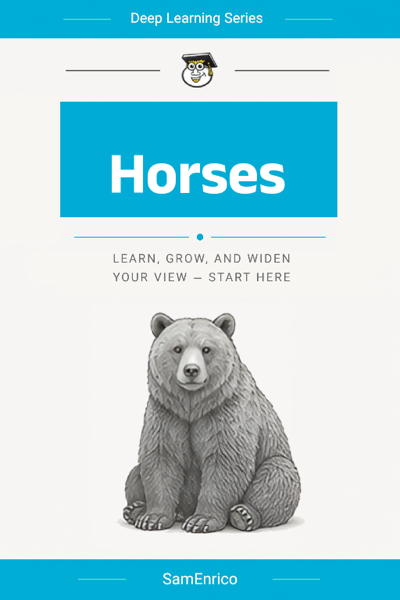
Non-FictionInformativeEducational
Horses eBook
A Coursebook on Horses
by Thiel Carie
A Coursebook on Horses
Formats
Free sample
Chapter 1: The Prey Who Pretends...-- Six thousand years of domestication. That is how long humans have bred, fed, housed, and ridden horses. Six thousand years of selective breeding for docility, for size, for speed, for color. Six thousand years of halter-breaking, saddle-training, and stall-keeping. And yet, beneath the glossy coat and the willing demeanor, beneath the soft muzzle that nuzzles your pocket for a carrot, beneath the patient horse who stands for the farrier and the child who plods along on a lead line—beneath all of it, the brain remains virtually identical to that of the extinct wild horse who roamed the Pleistocene steppes alongside saber-toothed cats and dire wolves.This is not metaphor.
This is neurology.The horse you lead out of the stall this morning processes the world through the same sensory apparatus, the same threat-detection circuitry, and the same fight-or-flight wiring as the horse who ran from predators fifty thousand years ago. Domestication has changed the horse's body. It has not changed the horse's brain.This chapter is the foundation for everything that follows. If you skip it—if you jump ahead to the training chapters or the veterinary protocols or the riding biomechanics—you will be applying techniques to a creature you do not understand. You will be guessing.
And with a 1,200-pound prey animal, guessing gets people killed.Here is the truth that every horseman must internalize before touching a single lead rope: Your horse does not see you as a partner. Not yet. Not automatically. He sees you as a potential predator who occasionally brings hay. The partnership is something you earn, moment by moment, by never forgetting what he really is.The Great Lie of Domestication Let us begin with a thought experiment.
Imagine you adopt a wolf cub. You raise it in your home. You feed it from your hand. You teach it to sit, to stay, to walk on a leash. For twelve years, that wolf sleeps at the foot of your bed.
It has never bitten anyone. It wags its tail when you come home.Now ask yourself: would you turn your back on that wolf while it ate a raw steak? Would you let a toddler pull its ears? Would you assume it had forgotten how to kill?Of course not. Because domestication is a thin veneer.
The wolf is still a wolf.The horse is not a wolf, but the principle is identical. The horse is a prey animal whose every instinct evolved to detect, evade, and survive predators. Domestication has not erased those instincts. It has suppressed them, like a hand pressing down on a coiled spring. The spring does not stop being a spring.
It waits.Consider the following data from equine neuroscience (Jones, 2023; Horse Brain, Human Brain). When a horse is placed in a novel environment—a new arena, a strange trailer, a barn with unfamiliar smells—its cortisol levels spike within thirty seconds. This is not anxiety about "change." This is the ancient brain scanning for predators. The horse does not know that the plastic tarp is harmless. It knows that in the wild, novel objects often conceal danger.The "thin veneer" is the fragile trust the horse extends to you.
It can be shattered in a single moment of perceived predation. You raise your hand too fast. You shout. You jerk the lead rope. And in that instant, the horse does not see you—the person who fed him this morning, the person who scratched his withers yesterday.
He sees a predator who has finally revealed itself.The Fire Drill: A Case Study in Prey Instincts To understand how quickly the veneer can shatter, consider the fire drill. This analogy will appear throughout this book because it captures something essential about the horse's brain.Imagine a calm barn on a summer afternoon. Ten horses in their stalls. Hay nets hanging. Water buckets full.
Humans chatting in the aisle. The scene is peaceful, domesticated, safe.Now imagine a spark. A frayed extension cord. A dropped cigarette. Within thirty seconds, smoke fills the aisle.
Within two minutes, flames are visible.What happens to the horses?The answer, drawn from barn fire reports compiled by the Equine Disaster Response Council (2022), is that the horses do not process the fire as "fire." They do not think, I should wait calmly for a human to open my stall door. They process the fire as predator. The smoke is the predator's scent. The heat is the predator's breath. The crackling is the predator's footsteps.The threat hierarchy activates instantly.Freeze.
For one to three seconds, the horse stops all movement. This is not "thinking." This is the brain assessing: Is the predator looking at me? Can I escape without being seen? In a barn fire, this freeze is deadly. Horses have been found standing in their stalls, unburned, dead of smoke inhalation—because they froze until their lungs filled.Flight.
If the horse perceives an escape route, it will flee at full speed, with no regard for obstacles. Horses have run through solid wooden stall doors during fires. They have jumped through closed windows. They have trampled humans standing in the aisle. This is not aggression.
This is the prey animal's survival algorithm: Run now, assess later.Fight. Only when freeze and flight are impossible does the horse fight. A cornered horse will bite, strike, and kick with lethal force. Barn fire reports include horses who kicked through stall walls, who bit through handler's arms, who threw themselves against metal gates until they collapsed.The fire drill matters because it reveals the truth that this entire book is built upon: The horse's brain does not distinguish between a fire and a plastic bag. Between a predator and a shouting human.
Between a life-threatening emergency and a mildly startling event. The same neurological pathways activate. The same cortisol surge occurs. The same threat hierarchy begins.The only difference is intensity.A plastic bag blowing across the arena is a low-intensity predator. The horse startles, maybe spins, then calms down.
A fire is a high-intensity predator. The horse may panic to death.But the kind of response is identical. The horse does not have a separate "small scare" circuit and a "big emergency" circuit. It has one threat detection system, and it treats everything from a plastic bag to a wildfire as a potential predator.This is why calm handling is not optional. It is not a philosophy or a preference.
It is a survival requirement. If you raise your voice in frustration, the horse's brain processes that voice as predator growl. If you jerk the lead rope, the horse's brain processes that jerk as predator strike. You cannot explain, "I was just frustrated about the trailer." The horse does not understand frustration. He understands threat.Evolution: From Forest to Steppe To understand the horse's brain, we must understand the world that shaped it.
The evolutionary journey of the horse is one of the best-documented in paleontology, and it reveals a creature shaped entirely by the pressure of predation.The earliest equid, Eohippus (formerly Hyracotherium), appeared approximately 55 million years ago. It was the size of a small dog: about…
This is the end of the free sample. Get the eBook to keep going. Buy now
About this book
Details
- Author
- Thiel Carie
- Publisher
- SamEnrico
- Language
- English
- Genre
- Non-Fiction, Informative, Educational
- Released
- 2026-06-03
- Pages (approx.)
- 156
- Available as
- eBook, Audiobook

Read better in the ZLOADR app
Your eBooks on your phone or tablet. Sign in with your SamEnrico account and start reading.
More by Thiel Carie
 Addiction and Anger ManagementThiel Carie$11.99
 Priority Comparison MatrixThiel Carie$11.99
 Loving Kindness for Anger Management HandbookThiel Carie$11.99
 Self Hypnosis for Driving HabitsThiel Carie$11.99
 Beginner Mindfulness for AthletesThiel Carie$11.99
 The Sails of Healing: How Pacific Island Medicine Men Discovered Nature’s First AntibioticsThiel Carie$11.99
 Code Blue: The Night the Hospital Ran Out of BedsThiel Carie$11.99
 Community Course IntegrationThiel Carie$12.99
 Nonprofit Financial Statement PrepThiel Carie$12.99
 Understanding Deafness X-linked, Dfn3Thiel Carie$17.99
 How to Start a Cartons Made of Corrugated Paper Business (Beginners Guide)Thiel Carie$11.99
You may also like
 Hong Kong Handover 1997Dunn Johnnie$11.99
 Zumba For Postnatal Recovery CourseNeal Christian$11.99
 Zumba for BeginnersLadner Nikia$11.99
 YouTube Comment Mining GuideHumes Pandora$12.99
 Worry Box MeditationCarlin Rudy$11.99
 Workplace Stress MeditationNguyen Lynn$11.99
 Workplace Stress and Sleep RepairHawley Ivory$11.99
 Workplace Perfectionism CureDelaney Jeffry$11.99
 Workplace Injustice Anger GuideWallen Isabelle$11.99
 Work Addiction and Burnout LinkGreenwood Ester$11.99
 Women in Yoga and WellnessBeattie Galina$11.99
 Women in Stand Up ComedyChun Evangeline$11.99