
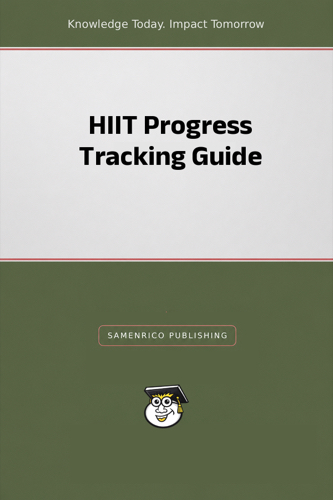
HIIT Progress Tracking Guide eBook
Measure improvements in power output, heart rate r
Measure improvements in power output, heart rate recovery, and endurance.
Formats
Free sample
Chapter 1: The 6-Month Lie--–- Sarah had done everything right. For 26 consecutive weeks, she woke up at 5:45 AM, laced her shoes, and drove to the gym before the rest of her family stirred. She did the workouts her Instagram fitness influencer swore by—the ones with names like “The Annihilator” and “Metabolic Mayhem” and “12 Minutes to Hell.” She pushed until her vision blurred. She collapsed on the mat after each session, chest heaving, sweat pooling under her back. She felt, in the moment, like a warrior.And after six months, she had absolutely nothing to show for it.Her weight hadn't changed.
Her resting heart rate was the same. Her 5K run time had actually gotten slower by 47 seconds. She was tired all the time—not the satisfying tired of a good workout, but the bone-deep exhaustion of someone running on empty. She had developed insomnia, waking at 2:00 AM with her heart racing for no reason. She was irritable with her kids.
Her libido had vanished. Her coworkers had started asking if she was “feeling okay,” which is corporate code for “you look terrible.”Sarah came to me not because she wanted to get faster or stronger. She came to me because she thought something was medically wrong with her. She had already seen her primary care physician, who ran a full blood panel. Everything came back normal.
Thyroid: fine. Iron: fine. Testosterone: normal for a 42-year-old woman. The doctor’s final verdict: “Maybe you’re just getting older.”But Sarah knew, in her gut, that “getting older” didn’t explain this. She had been an athlete in college—a Division II soccer player who could run for 90 minutes and then go do it again two days later.
She knew what fitness felt like. And this wasn’t it.When I asked her to describe her typical week of training, she pulled out her phone and showed me her workout log. It was meticulous. She had recorded every session, every interval, every rep. There were hundreds of entries.
And every single one of them looked something like this:*“HIIT: 30s on, 15s off x 20 rounds. RPE 9/10. Felt amazing.”*Or:“Tabata: 20s on, 10s off x 8 rounds x 4 sets. Dying. Great workout.”Or:“Met Con: Burpees, box jumps, row sprints.
3 rounds for time. 14:22. Legs jelly.”I scrolled through months of data. And then I asked her the question that changed everything.“Sarah,” I said, “how do you know you’re getting fitter?”She looked at me like I had asked her to explain quantum physics. “Because… I feel like I worked hard?”“But you’ve been working hard for six months,” I said.
“And you’re getting slower. You’re more tired. You’re sleeping worse. So either hard work isn’t the same thing as effective work, or something else is going on.”Something else was going on. And that something else is the reason you’re holding this book.The Plateau That Pretends to Be Progress Sarah’s story is not unusual.
In fact, it is so common that exercise physiologists have a name for it: non-functional overreaching. It sounds clinical and boring. What it actually means is “training so hard that you get weaker instead of stronger.”Non-functional overreaching happens when the stress of training exceeds the body’s ability to recover, and the athlete ignores the warning signs because they mistake suffering for success. They think “more pain” means “more gain.” They believe that if they aren’t collapsing at the end of every session, they didn’t work hard enough. They have been sold a story—by fitness influencers, by supplement companies, by gym culture—that the only valid workout is the one that leaves you gasping on the floor.That story is a lie.Here is the truth that the fitness industry does not want you to know: You can work incredibly hard and make zero progress.
You can even work incredibly hard and go backward.The relationship between training effort and training results is not a straight line. It is an inverted U-shaped curve. At the left side of the curve, doing too little produces no results. In the middle, doing the right amount produces optimal results. On the right side, doing too much produces worse results than doing nothing at all.
This is called the Fitness-Fatigue Model, and it is one of the most well-replicated findings in exercise science.Every single workout you perform creates two opposing effects:Fitness. A positive adaptation. Your muscles get slightly stronger. Your heart pumps slightly more blood per beat. Your mitochondria (the tiny power plants inside your cells) become slightly more efficient.
This is the benefit.Fatigue. A negative cost. Your nervous system gets slightly depleted. Your muscles accumulate micro-damage. Your hormone levels shift toward catabolism (breakdown).
This is the debt.Immediately after a workout, fatigue always exceeds fitness. That is why you feel tired, not superhuman, right after you exercise. Over the next 24 to 72 hours, fatigue dissipates faster than fitness decays. If you allow enough recovery time, fitness emerges as the winner—you become fitter than you were before the workout.But if you perform another hard workout before fatigue has cleared, you add a new dose of fatigue on top of the residual fatigue from the previous session. Do this repeatedly, and fatigue accumulates.
Fitness stagnates. And eventually, if you keep pushing, fatigue overwhelms fitness entirely, and your performance crashes.This is exactly what happened to Sarah. She was doing HIIT five days per week. Her workouts were hard—genuinely hard, with RPE consistently at 9 or 10. But she never gave her body enough time to convert the fatigue into fitness.
She was digging a hole faster than she could fill it. By week 12, she was in a deficit. By week 20, she was in a crater. By week 26, she was clinically overtrained—insomnia, irritability, declining performance, and a resting heart rate that had actually increased (a cardinal sign of overtraining syndrome).And here is the cruelest irony: Sarah thought her declining performance meant she wasn't working hard enough. So she worked harder.
Which made everything worse.The Three Numbers That Could Have Saved Her If Sarah had been tracking the right metrics, she would have seen the crash coming weeks before it happened. She would have seen the warning signs in her data. She would have known when to push and, more importantly, when to rest.This book is built around three specific metrics—three numbers that, when tracked together, tell you everything you need to know about whether you are actually getting fitter or just getting more tired.Number One: Power Output Power is the most objective measure of your performance. It does not care how you feel. It does not care about your excuses.
Watts on a bike, watts per kilogram on a run, pace on a rower—these numbers are the truth. If your power is going up over time, you are getting fitter. If your power is flat or declining, you are not. It is that simple.But power alone is not enough. You can increase your power by becoming more explosive while simultaneously digging yourself into an overtraining hole.
That is why you need the second number.Number Two: Heart Rate Recovery (HRR)Heart rate recovery is the measure of how…
This is the end of the free sample. Get the eBook to keep going. Buy now
About this book
Details
- Author
- Jacobson Linsey
- Publisher
- SamEnrico
- Language
- English
- Genre
- Non-Fiction, Health & Wellness, Fitness Metrics
- Released
- 2026-06-10
- Pages (approx.)
- 147
- Available as
- eBook, Audiobook

Read better in the ZLOADR app
Your eBooks on your phone or tablet. Sign in with your SamEnrico account and start reading.
More by Jacobson Linsey
 Teleophthalmology Senior GuideJacobson Linsey$11.99
 Online Shopping Addiction WorkbookJacobson Linsey$11.99
 Father's Meth Lab HomeJacobson Linsey$11.99
 Smoking Cessation for SeniorsJacobson Linsey$11.99
 Whispers of the Forbidden: The Enigma of Cleopatra’s Lost LettersJacobson Linsey$11.99
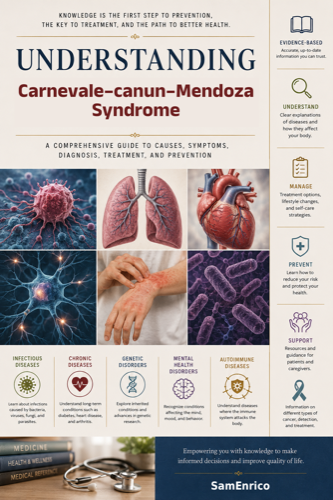 Understanding Carnevale–canun–Mendoza SyndromeJacobson Linsey$17.99
 How to Start a Pots Made of Plastic (not Flower Pots) Business (Beginners Guide)Jacobson Linsey$11.99
 Open Book Online Exam GuideJacobson Linsey$12.99
 Competitive Landscape GCC GuideJacobson Linsey$12.99
 Sales Funnel Systems with GoHighLevelJacobson Linsey$11.99