
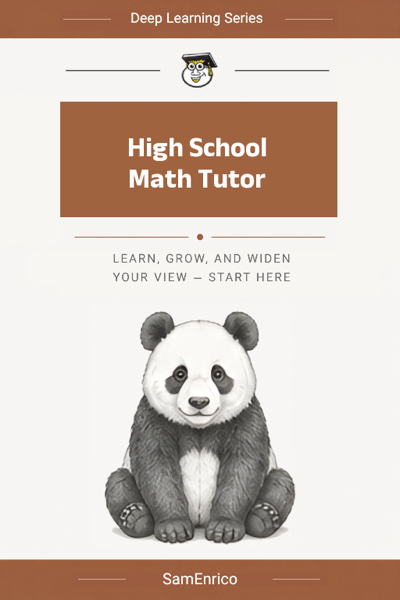
Non-FictionInformativeEducational
High School Math Tutor eBook
A Coursebook on High School Math Tutor
by Dukes Pok
A Coursebook on High School Math Tutor
Formats
Free sample
Chapter 1: The Number Line Lies--– Most students believe they understand numbers by the time they reach high school. They have been counting, adding, and multiplying for years. They can look at “7” and tell you it means seven things. They can look at “½” and tell you it means half of a pizza. But somewhere between elementary arithmetic and high school algebra, the ground shifts beneath their feet.
Numbers stop being simple. They start behaving in ways that feel wrong, illogical, or even broken. The student who once loved math suddenly feels lost. The problem is not the student. The problem is that the number line they learned in elementary school—neat, orderly, and complete—is a lie.
Not a malicious lie, but a simplification that hides the true complexity of the mathematical universe. This chapter pulls back the curtain. By the time you finish, you will see numbers not as simple counting tools but as a rich, layered hierarchy. You will understand why some numbers behave nicely, why others refuse to behave at all, and why the number line is actually full of holes that mathematicians have spent centuries trying to fill.The Pain Point: Why Numbers Suddenly Feel Unfamiliar Every high school math teacher has heard the same complaint: “This doesn’t make sense anymore. Numbers used to be easy.” The student is not wrong.
In elementary and middle school, numbers did three predictable things: you could add them, subtract them, multiply them, and divide them. They lived on a simple line where every number had a clear position. Zero sat in the middle, positive numbers stretched to the right, and negative numbers stretched to the left. Every point on that line represented a real number. Everything else, the student assumed, was either a fraction or a decimal.
Then high school introduces √2. The student knows that 1.414 times 1.414 is approximately 2, but they cannot write √2 as a simple fraction. It goes on forever without repeating. This feels suspicious. Then the teacher mentions π, which also goes on forever, and the student starts to wonder: are most numbers actually like this?
Then comes the real blow: √-1. The student has been told for years that you cannot take the square root of a negative number. Now someone says you can, but the answer is “imaginary.” The number line, which once felt so solid, now has holes. Worse, the student is told that numbers exist completely off the line altogether.This chapter directly addresses that discomfort. The fear of irrational numbers and imaginary numbers is not a sign of weakness.
It is a sign that the student has outgrown a simplified model of mathematics. The goal of this chapter is not to mock that old model but to expand it. You will learn to classify every number you encounter in high school math into a clear hierarchy. You will learn why √2 is not a weird exception but a member of a huge and important family. You will learn why imaginary numbers are not “fake” but essential tools for solving equations that would otherwise have no solution.
And you will master the fundamental rules—exponents, scientific notation, and order of operations—that govern how all numbers behave, no matter how strange they first appear.Tutor Strategy: The Number Line Visualizer Professional tutors know that abstract classifications mean nothing without a visual anchor. That is why this chapter introduces the Number Line Visualizer. This is not the simple number line from elementary school. The Number Line Visualizer is a mental tool that teaches you to “zoom in” on the number line at different magnifications, revealing the structure hidden beneath the surface.Here is how it works. Imagine a standard number line from –3 to 3.
Mark the integers: –3, –2, –1, 0, 1, 2, 3. Most students stop there. But the Number Line Visualizer asks: what lies between 0 and 1? The answer is an infinite universe of numbers. Zoom in on the segment between 0 and 1.
Now mark 0.5, the midpoint. Zoom in again between 0.5 and 1. Mark 0.75. Zoom in again. You can keep zooming forever, and you will never run out of points.
That is the first insight: between any two distinct real numbers, there are infinitely more real numbers.Now apply the Number Line Visualizer to a specific problem. Identify whether a number is rational or irrational. A rational number, when written as a decimal, either terminates (like 0.75) or repeats a pattern forever (like 0.333…). An irrational number never terminates and never repeats. The Number Line Visualizer helps you see that rational numbers are everywhere—they are dense on the number line—but irrational numbers are even more numerous.
In fact, between any two rational numbers, there are infinitely many irrational numbers. The number line is not mostly rational numbers with occasional irrational intruders. It is mostly irrational numbers with occasional rational landmarks.The Number Line Visualizer also demystifies square roots. When you see √2, your first instinct is to treat it as a complicated symbol. But √2 is simply the number that, when multiplied by itself, equals 2.
Use the Number Line Visualizer to approximate it. You know 1² = 1 and 2² = 4. Since 2 is between 1 and 4, √2 must be between 1 and 2. Zoom in: 1.4² = 1.96, slightly less than 2. 1.41² = 1.9881, still less.
1.414² = 1.999396, very close. You will never find an exact terminating decimal for √2, but the Number Line Visualizer shows you exactly where it lives: between 1.414 and 1.415, forever narrowing but never landing on a neat fraction. That is not a flaw. That is the nature of real numbers.Classifying the Number Hierarchy Before you can manipulate numbers confidently, you must know what family they belong to. High school mathematics organizes numbers into a hierarchy.
Each level contains all the levels below it and adds new kinds of numbers.Counting Numbers (Natural Numbers): These are the numbers you learned first: 1, 2, 3, 4, and so on. Some definitions include 0 as a counting number, but most high school texts distinguish natural numbers as positive whole numbers. These are the simplest numbers, used for counting discrete objects.Whole Numbers: Add 0 to the counting numbers, and you get whole numbers: 0, 1, 2, 3, 4, … Whole numbers are useful when you need to represent “none” as a quantity.Integers: Add the negatives of the counting numbers, and you get integers: …, –3, –2, –1, 0, 1, 2, 3, … Integers allow you to represent debt, temperature below zero, and any situation that requires direction.Rational Numbers: Any number that can be expressed as a fraction a/b where a and b are integers and b ≠ 0. This includes all integers (since 5 = 5/1), terminating decimals (0.75 = ¾), and repeating decimals (0.333… = ⅓). Rational numbers get their name from “ratio”—they represent a ratio of two integers.Irrational Numbers: Any real number that cannot be expressed as a fraction of two integers.
Their decimal expansions go on forever without repeating. Examples include √2, √3, π, e, and the golden ratio φ. Irrational numbers are surprisingly common. In fact, most real numbers are irrational, even though the rational numbers are the ones you learned first.Real Numbers: The union of all rational and irrational numbers. Every point on the infinite number line corresponds to a real number.
Real numbers are all you need for most of high school math—but not all.A Note on Imaginary and Complex Numbers: You will occasionally encounter √–1 and its multiples. These are not real numbers because no real number multiplied by itself gives a negative result. They live on…
This is the end of the free sample. Get the eBook to keep going. Buy now
About this book
Details
- Author
- Dukes Pok
- Publisher
- SamEnrico
- Language
- English
- Genre
- Non-Fiction, Informative, Educational
- Released
- 2026-05-06
- Pages (approx.)
- 139
- Available as
- eBook, Audiobook

Read better in the ZLOADR app
Your eBooks on your phone or tablet. Sign in with your SamEnrico account and start reading.
More by Dukes Pok
 The OCD Family Support GuideDukes Pok$11.99
 Validation Without Agreement GuideDukes Pok$11.99
 HIIT Music Tempo GuideDukes Pok$11.99
 Conductor Rehearsal PsychologyDukes Pok$11.99
 Step Four Moral Inventory CourseDukes Pok$11.99
 The Iron Fists of Shanghai: How a 19th-Century Martial Arts Master Shaped the WorldDukes Pok$11.99
 AI Tool Free to PaidDukes Pok$12.99
 Churn Prediction ModelsDukes Pok$12.99
 The Breeder's Guide to Java ChickensDukes Pok$11.99
 How to Start a Blood Pressure Machine Operation (coin Operated) Business (Beginners Guide)Dukes Pok$11.99
You may also like
 Hong Kong Handover 1997Dunn Johnnie$11.99
 Zumba For Postnatal Recovery CourseNeal Christian$11.99
 Zumba for BeginnersLadner Nikia$11.99
 YouTube Comment Mining GuideHumes Pandora$12.99
 Worry Box MeditationCarlin Rudy$11.99
 Workplace Stress MeditationNguyen Lynn$11.99
 Workplace Stress and Sleep RepairHawley Ivory$11.99
 Workplace Perfectionism CureDelaney Jeffry$11.99
 Workplace Injustice Anger GuideWallen Isabelle$11.99
 Work Addiction and Burnout LinkGreenwood Ester$11.99
 Women in Yoga and WellnessBeattie Galina$11.99
 Women in Stand Up ComedyChun Evangeline$11.99