
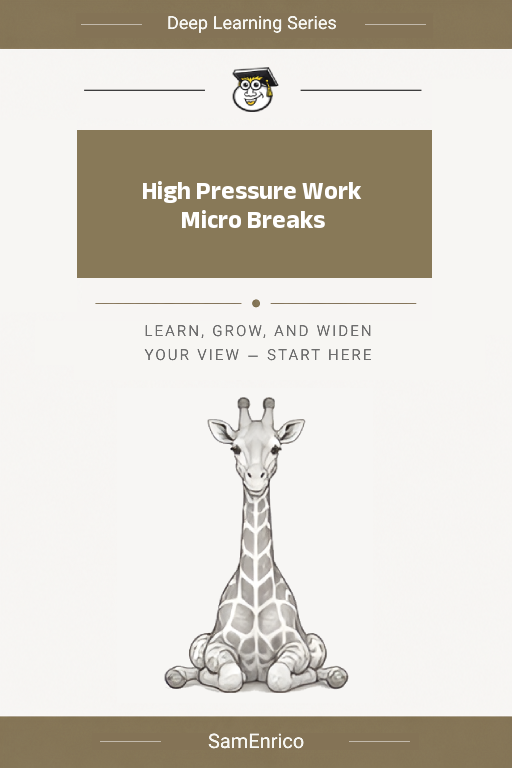
Non-FictionMental WealthPerformance
High Pressure Work Micro Breaks eBook
Uses micro-breaks during deadlines, presentations,
by Finch Luann
Uses micro-breaks during deadlines, presentations, and high-stakes moments to prevent nervous system overload and maintain cognitive function.
Formats
Free sample
Chapter 1: The Overload Myth--–- On a Tuesday afternoon in March, a forty-three-year-old portfolio manager named Sarah did something she had never done in seventeen years of high finance: she walked out of a client presentation in the middle of her own sentence. Not because she was angry. Not because she was sick. But because her brain simply stopped producing language. She stood at the head of a conference table, fourteen people waiting for her next word, and found nothing.
No thoughts. No numbers. No sentences. Just a buzzing blankness where her expertise used to live. She smiled, said “excuse me,” walked to the bathroom, and sat on the floor for twenty minutes.
Later that week, her doctor ran every test imaginable. The results were normal. “Your heart is fine,” the cardiologist told her. “Your nervous system is not.”This book exists because Sarah’s story is not rare. It is the quiet epidemic of the modern high-pressure workplace.
Surgeons who freeze mid-procedure. Trial lawyers who lose their thread during closing arguments. Software engineers who stare at a blinking cursor for an hour knowing exactly what to write but unable to type. Air traffic controllers who feel their heartbeat accelerate during a routine handoff and wonder, Is this the day I crack? These are not failures of skill, preparation, or character.
They are failures of a biological system pushed past its breaking point without the one thing it needs most: a pause.The Lie You Have Been Told Let us name the lie directly. You have been told, explicitly or implicitly, that high performance requires continuous effort. That the most successful people are the ones who outwork everyone else. That taking a break is a sign of weakness, a lack of dedication, or at best a necessary evil for people who cannot handle the heat. This lie is taught in business schools, reinforced in performance reviews, and embedded in the architecture of modern work: back-to-back meetings, open floor plans that discourage rest, and a cultural ethos that treats lunch at your desk as a badge of honor.The lie has a name in neuroscience: the productivity grind myth.
And it is demonstrably, measurably, catastrophically wrong.Let us look at the data. In a 2019 study published in the Journal of Applied Psychology, researchers tracked knowledge workers across two weeks of normal work. They found that after just twenty-five to sixty minutes of continuous focused work, cognitive load accumulated linearly—meaning every additional minute of work without a pause added measurable fatigue. By the ninety-minute mark, the average worker’s error rate had increased fourfold. Not because they cared less.
Not because they were lazy. But because the brain, like any biological system, requires recovery periods to maintain function.Cortisol, the primary stress hormone, tells the same story. Under normal conditions, cortisol follows a predictable daily rhythm: highest in the morning to wake you up, gradually declining throughout the day. But continuous work without breaks flattens and then reverses that rhythm. After ninety minutes of sustained high-pressure work, cortisol spikes by an average of 22 percent.
Worse, that elevation persists for four to six hours after the work ends. One intense morning without breaks does not just ruin your afternoon; it compromises your evening, your sleep, and your ability to recover before the next day begins.Here is what the grind myth does not tell you: the most productive people in any high-pressure field are not the ones who work the longest hours. They are the ones who work in sprints. They understand that the brain is not a muscle—it does not get stronger by pushing through fatigue. The brain is a battery.
And batteries need to recharge.The Default Mode Network: Your Brain’s Hidden Reset Button To understand why micro-breaks work, you need to meet a part of your brain you have probably never heard of: the Default Mode Network, or DMN. Discovered in 2001 by neurologist Marcus Raichle and his team at Washington University, the DMN is a collection of brain regions that become active only when you are not actively focused on an external task. When you are solving a problem, writing an email, or listening to a presentation, the DMN is quiet. When you pause—when you stare out a window, take a shower, walk without headphones, or simply sit with your eyes closed—the DMN lights up.What does the DMN do? Everything that makes you effective under pressure.
It consolidates memory, moving important information from temporary storage (working memory) into long-term retention. It makes connections between seemingly unrelated ideas, producing the famous “aha moment” that never arrives while you are staring at the screen. It regulates emotion, dampening the amygdala’s threat response and allowing you to reappraise stressful situations. And it restores attention, replenishing the neurotransmitters that focused work depletes.When you grind without breaks, the DMN never activates. You are essentially running your brain on a single, overtaxed circuit, bypassing the very system designed to keep you sharp, creative, and calm.
This is why marathon work sessions so often produce the opposite of their intended effect: more hours, worse outcomes.Consider a 2014 study of intensive care unit nurses. These professionals work in arguably the highest-pressure environment outside of combat: life-or-death decisions, constant interruptions, and shifts that can stretch to twelve hours. Researchers found that nurses who took even two minutes to sit quietly between patient emergencies made significantly fewer medication errors than nurses who moved continuously from one task to the next. Two minutes. That is all it took to reduce errors by a magnitude large enough to save lives.If two minutes works in an ICU, it will work in your boardroom, your courtroom, or your home office.The Forty Percent Rule: What Task Switching Costs You You might be thinking: I do not have time for breaks.
My day is already too full. That belief is the second lie, and it is even more dangerous than the first. The truth is that you are already taking breaks—you are just taking the wrong kind. Every time you check email in the middle of a project, glance at your phone during a meeting, or think about what to make for dinner while writing a report, you are switching tasks. And task switching without a deliberate reset is the most expensive cognitive habit you have.Let me introduce you to the concept of attention residue.
Coined by researcher Sophie Leroy at the University of Washington, attention residue is the persistence of cognitive activity from a previous task after you have moved to a new one. When you switch from Task A to Task B without a break, a portion of your brain remains stuck on Task A. You think you are working on Task B, but you are actually working on Task B while your brain continues to process Task A in the background. The result is slower performance, more errors, and a persistent feeling of mental clutter.Leroy’s research produced a startling number: task switching without a break leads to a 40 percent loss in productive cognitive function. To put that in human terms: if you switch tasks ten times in a day without…
This is the end of the free sample. Get the eBook to keep going. Buy now
About this book
Details
- Author
- Finch Luann
- Publisher
- SamEnrico
- Language
- English
- Genre
- Non-Fiction, Mental Wealth, Performance
- Released
- 2026-06-01
- Pages (approx.)
- 129
- Available as
- eBook, Audiobook

Read better in the ZLOADR app
Your eBooks on your phone or tablet. Sign in with your SamEnrico account and start reading.
More by Finch Luann
 Forgiving Your Younger Self GuideFinch Luann$11.99
 Submarine Veterans StoriesFinch Luann$11.99
 Workaholism and Mental HealthFinch Luann$11.99
 The Fintech Capital AllocationFinch Luann$11.99
 Anger for Sales ProfessionalsFinch Luann$11.99
 The Hydaspes Gambit: Alexander’s Last Great StandFinch Luann$11.99
 Understanding Spondyloepimetaphyseal DysplasiaFinch Luann$17.99
 How to Become a Pipe CutterFinch Luann$11.99
 Savings Cooperative East AfricaFinch Luann$12.99
You may also like
 Hong Kong Handover 1997Dunn Johnnie$11.99
 Zumba For Postnatal Recovery CourseNeal Christian$11.99
 Zumba for BeginnersLadner Nikia$11.99
 YouTube Comment Mining GuideHumes Pandora$12.99
 Worry Box MeditationCarlin Rudy$11.99
 Workplace Stress MeditationNguyen Lynn$11.99
 Workplace Stress and Sleep RepairHawley Ivory$11.99
 Workplace Perfectionism CureDelaney Jeffry$11.99
 Workplace Injustice Anger GuideWallen Isabelle$11.99
 Work Addiction and Burnout LinkGreenwood Ester$11.99
 Women in Yoga and WellnessBeattie Galina$11.99
 Women in Stand Up ComedyChun Evangeline$11.99