
Non-FictionHealth & WellnessHepatology
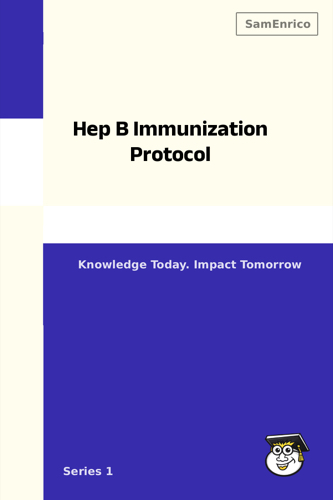
Hep B Immunization Protocol eBook
Birth dose and series completion for all ages.
Birth dose and series completion for all ages.
Formats
Free sample
Chapter 1: The 90% Rule...--–- The baby was born at 3:47 AM on a Tuesday in a suburban Atlanta hospital. Apgars were 8 and 9. Weight: 7 pounds, 2 ounces. The mother, a 28-year-old accountant named Sarah, had tested negative for Hepatitis B surface antigen (HBs Ag) at her first prenatal visit. Her chart was flagged as "Hep B negative, routine care." The night shift nurse, running on four hours of sleep, checked the box for "birth dose Hep B vaccine deferred per shared decision-making protocol." The reason field was left blank.
The infant, a boy they named Marcus, was discharged at 10:15 AM on Thursday. He never received the birth dose.Eighteen months later, Sarah noticed Marcus's stools were pale, almost clay-colored. His eyes had a yellow tint that came and went. The pediatrician ordered liver function tests. Alanine aminotransferase (ALT) was 1,200 IU/L—normal is below 40.
The Hepatitis B surface antigen test came back positive. Marcus had chronic Hepatitis B. The only possible source: his mother, who had contracted the virus between her first prenatal screen and delivery, a silent infection with no symptoms. A window period infection. One of the roughly 1 in 100,000 births where a "negative" mother transmits the virus to her child because her test was drawn too early.Marcus is now seven years old.
He sees a hepatologist twice a year. He has an ultrasound every six months to screen for liver tumors. He cannot share a toothbrush or a razor with his little sister. He takes tenofovir daily. His mother carries guilt that no counseling can fully relieve.
And every single piece of this—every clinic visit, every medication, every fear—could have been prevented by a single shot given within 24 hours of birth. A shot that costs the hospital less than twenty dollars.This is not a story about vaccine refusal. Sarah was not an anti-vaccine parent. She had gotten her flu shot, her Tdap, her COVID boosters. She simply did not know that the birth dose was important, and no one had made it the default.
The hospital's policy allowed deferral. The nurse was busy. The pediatrician assumed the hospital had handled it. The system failed, and a child now carries a virus that will shadow him for life.This book is written to ensure that Marcus's story never happens to another child.The Paradox That Defines Modern Prevention Hepatitis B is one of the most extraordinary success stories in the history of vaccinology. The first vaccine against the virus was licensed in 1981, just 16 years after Dr.
Baruch Blumberg discovered the Australia antigen that would become known as HBs Ag. By 1991, the United States had adopted a strategy of universal infant vaccination, a decision that has since prevented an estimated 250,000 chronic infections and 100,000 deaths from liver cancer among children born since that time. The World Health Organization has set a goal of eliminating Hepatitis B as a public health threat by 2030—a target that is biologically plausible because the vaccine works, it works nearly perfectly, and it works for decades.And yet.And yet, in 2024, an estimated 600,000 to 800,000 people die each year from Hepatitis B-related liver disease. Over 250 million people live with chronic infection globally. In the United States, despite universal infant vaccination since 1991, the CDC estimates that 1.5 to 2.4 million people are chronically infected, and approximately 15,000 die each year from HBV-related cirrhosis or hepatocellular carcinoma.
The virus remains the leading cause of liver cancer worldwide.How can this be? How can a vaccine that is 95% effective, safe, cheap, and widely available fail to eliminate the disease?The answer, as this chapter will demonstrate, lies not in the vaccine itself but in the timing of its delivery. The single most important dose of Hepatitis B vaccine is the one given at birth. Miss that dose, and the cascade of missed opportunities that follows—delayed second dose, forgotten third dose, lost patient—makes chronic infection almost inevitable for the exposed infant. The 90% Rule, which gives this chapter its name, is the single most important statistic in all of Hepatitis B prevention: an infant infected at birth has a 90% risk of developing chronic Hepatitis B, whereas an adult infected has only a 5% risk.
That 85-point difference is the gap between a healthy life and a lifetime of monitoring, between walking out of the hospital and walking into a hepatology clinic, between living and dying of liver cancer.This book is a protocol to close that gap.The Biology of the 90% Rule: Why Newborns Are Vulnerable To understand why the birth dose matters, we must first understand why newborns are uniquely vulnerable to Hepatitis B. The answer lies at the intersection of virology, immunology, and developmental biology.The Immature Immune System A newborn infant emerges from the sterile environment of the womb into a world teeming with pathogens. The immune system at birth is not deficient—that would be evolutionarily disastrous—but it is biased. The bias is toward tolerance rather than attack. This makes sense from an evolutionary perspective: the infant's gut is about to be colonized by trillions of bacteria, and the immune system must learn to distinguish between harmless commensals and dangerous pathogens.
The price of this tolerance, however, is that the neonatal immune system responds poorly to certain viruses, and Hepatitis B is at the top of that list.Specifically, the newborn's dendritic cells—the sentinels that process antigens and present them to T cells—express lower levels of co-stimulatory molecules like CD80 and CD86. They produce less interleukin-12, a cytokine that drives the Th1 response required for viral clearance. The result is that when Hepatitis B virus enters the newborn's hepatocytes, the immune system often fails to mount an effective response. Instead of attacking the infected cells, it tolerates them. The virus establishes what immunologists call "persistent infection," and the child becomes a chronic carrier.The numbers are stark.
In prospective studies of infants born to HBs Ag-positive mothers who do not receive post-exposure prophylaxis, 70-90% become chronically infected. In contrast, adults exposed to the same virus—through needlestick, sexual contact, or blood transfusion—develop chronic infection only 5-10% of the time. The difference is the immune system. The adult's mature dendritic cells process HBs Ag efficiently, present it to CD4+ T cells, and generate a robust cytotoxic T lymphocyte response that clears the infection. The newborn's immature system cannot do this.The Window of Opportunity The Hepatitis B virus has a replication cycle that takes approximately 24-48 hours from entry into the hepatocyte to the release of new virions.
In that window, the virus is vulnerable. If neutralizing antibodies—either from HBIG or from the vaccine—are present in the circulation before the virus reaches the liver, infection can be prevented. This is the biological rationale for the 24-hour standard. Every hour that passes after delivery increases the probability that the virus has established a foothold.For the infant of an HBs Ag-positive mother, the window is even narrower. Maternal viral load can exceed 10^8 copies per milliliter.
The inoculum delivered during passage through the birth canal is massive. In this setting, the virus can reach the liver and begin replication within 6-12 hours. That is why Chapter 5 of this book prescribes the stricter 12-hour standard…
This is the end of the free sample. Get the eBook to keep going. Buy now
About this book
Details
- Author
- Borrego Shantel
- Publisher
- SamEnrico
- Language
- English
- Genre
- Non-Fiction, Health & Wellness, Hepatology
- Released
- 2026-06-07
- Pages (approx.)
- 160
- Available as
- eBook, Audiobook

Read better in the ZLOADR app
Your eBooks on your phone or tablet. Sign in with your SamEnrico account and start reading.
More by Borrego Shantel
 The Nutrition and Emotion LinkBorrego Shantel$11.99
 TM for Emotional Eating GuideBorrego Shantel$11.99
 Self Hypnosis for Fear of DogsBorrego Shantel$11.99
 John Ramsey TodayBorrego Shantel$11.99
 Martha Washington First LadyBorrego Shantel$11.99
 Lip reading Classes GuideBorrego Shantel$11.99
 Divorce Acceptance GuideBorrego Shantel$11.99
 The Royal Astronomers of Meroë: Mapping the Cosmos from the Nile’s HeartBorrego Shantel$11.99
 Starlight Pilgrims: The Last Ark of AtlantisBorrego Shantel$11.99
 How to Produce SemiconductorsBorrego Shantel$11.99
 How to Produce Flying DiscsBorrego Shantel$11.99
 A Collector's Handbook to the Bentley Speed SixBorrego Shantel$11.99
You may also like
 Hong Kong Handover 1997Dunn Johnnie$11.99
 Zumba For Postnatal Recovery CourseNeal Christian$11.99
 Zumba for BeginnersLadner Nikia$11.99
 YouTube Comment Mining GuideHumes Pandora$12.99
 Worry Box MeditationCarlin Rudy$11.99
 Workplace Stress MeditationNguyen Lynn$11.99
 Workplace Stress and Sleep RepairHawley Ivory$11.99
 Workplace Perfectionism CureDelaney Jeffry$11.99
 Workplace Injustice Anger GuideWallen Isabelle$11.99
 Work Addiction and Burnout LinkGreenwood Ester$11.99
 Women in Yoga and WellnessBeattie Galina$11.99
 Women in Stand Up ComedyChun Evangeline$11.99