
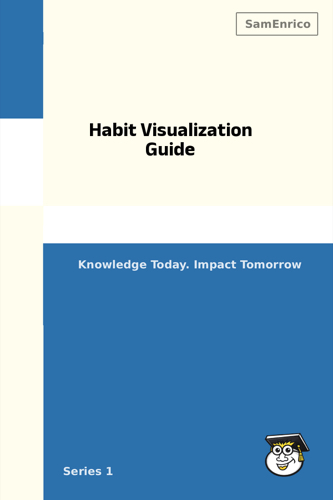
Habit Visualization Guide eBook
undefined
by Hiatt Celina
undefined
Formats
Free sample
Chapter 1: The Loop You Can’t Delete--–- You have tried to kill a bad habit with willpower. It did not work. It will never work. That statement is not pessimism. It is neuroanatomy.
Every time you gritted your teeth and swore, “This time I will stop,” you were fighting against a machine that does not recognize brute force. The machine is your basal ganglia—a small, walnut-shaped cluster of neurons deep inside your brain—and its only job is to automate repetition. It does not care about your goals. It does not care about your New Year’s resolutions. It cares about one thing: finding patterns that deliver a reward and then running those patterns on autopilot forever.If you have ever found yourself eating sugar when stressed, reaching for your phone when bored, or procrastinating when anxious, you have experienced the brutal efficiency of this machine.
You did not decide to perform those behaviors. They happened before you could intervene. That is the definition of a habit: a behavior that begins before conscious thought arrives. And the single most important fact about habits—the one that every exhausted striver needs to tattoo onto their inner eyelid—is this: you cannot delete a habit loop. You can only replace the routine inside it.This chapter is not gentle.
It is not encouraging in the way of inspirational posters. It is a scalpel. By the time you finish reading, you will understand exactly why your willpower failed, why that failure was never your fault, and how a technique called replacement rehearsal—the first application of the book’s core weapon, the 90-Second Preplay—will rewire the loop while you stand there doing almost nothing. But first, you must unlearn almost everything you believe about habit change.The Myth of Eradication Most people approach bad habits like they are pulling weeds. They grab the stem, yank, and assume the root is gone.
Three weeks later, the weed is back—thicker, greener, more defiant. This is not a failure of effort. It is a failure of biology. Charles Duhigg, the Pulitzer Prize-winning author of The Power of Habit, spent years mapping the neurological structure of automatic behavior. What he discovered was both simple and devastating: every habit operates on a three-part loop.The Cue is the trigger that starts the sequence.
It can be a location (your kitchen at 10 PM), a time of day (3:00 PM when energy crashes), an emotional state (boredom, stress, loneliness), or even the presence of another person. The cue is the brain’s alarm clock. It says, “Something is happening. Run the routine.”The Routine is the behavior itself. This is what you think of as the habit: eating the cookie, checking Instagram, biting your nails.
The routine can be physical, mental, or emotional.The Reward is the payoff. This is where almost everyone gets confused. The reward is not always pleasure in the way you expect. Sometimes it is relief from discomfort. Sometimes it is a brief escape from anxiety.
Sometimes it is simply the cessation of craving. Your brain does not distinguish between “good” rewards and “bad” rewards. It only distinguishes between rewards it has received before and novelty. And it prefers the familiar reward every single time.Here is the myth that has cost you years: you believed you could remove the routine from the loop and the loop would dissolve. It will not.
The cue remains. The reward craving remains. If you remove the routine without replacing it, your brain will feel the cue, anticipate the reward, and then experience a neurological vacuum. That vacuum is unbearable. Within seconds, your brain will either revert to the old routine or frantically search for a substitute—often worse than the original.The exhausted striver knows this experience intimately.
You quit sugar, and three days later you ate an entire sleeve of Oreos. You deleted social media, and you started checking email forty times an hour. You promised yourself you would wake up early, and you hit snooze so many times that the button wore down. You did not lack discipline. Your brain was doing exactly what it evolved to do: avoid a reward vacuum at all costs.The Loop That Owns You Before you can replace a routine, you have to see the loop clearly.
This is harder than it sounds because habits become invisible. The cue disappears into background noise. The reward becomes so expected that you no longer notice the craving. The entire loop runs in milliseconds, below conscious awareness.Let us make it visible. Consider a common exhausted striver habit: late-night phone scrolling.
You are tired. You get into bed. You tell yourself, “Just five minutes.” Two hours later, your eyes burn, your brain is overstimulated, and you feel vaguely ashamed. Here is the loop:Cue: The feeling of getting into bed (location + time of day) combined with a slight rise in mental alertness (the brain’s paradoxical response to fatigue).Routine: Picking up the phone, opening an app, scrolling.Reward: The cessation of the “what am I missing?” anxiety (variable reward schedule, the same mechanism that makes slot machines addictive) plus the numbing of the day’s unresolved thoughts.You have tried to delete the routine. You have tried phone lockboxes, app blockers, and solemn promises.
They work for two or three days. Then you find yourself scrolling on your laptop, or sitting up in bed staring at the wall feeling just as anxious but now with nothing to numb it. The cue remained. The reward craving remained. You simply removed the coping mechanism without providing a replacement.This is not a character flaw.
This is engineering.The Replacement Principle The solution is counterintuitive, almost insulting in its simplicity: keep the cue, keep the reward, change the routine. Your brain does not care which routine delivers the reward, as long as the reward arrives reliably. If you can train a new routine to satisfy the same craving triggered by the same cue, the old routine will wither from disuse. Not because you fought it, but because you starved it of relevance.This is the Replacement Principle. It is the foundation of every successful habit change in every domain—from quitting smoking to overcoming procrastination to managing emotional eating.
Smokers who quit successfully do not simply stop smoking. They replace the routine of lighting a cigarette with something else: chewing gum, taking deep breaths, drinking water, even holding a pen like a cigarette. The cue (stress, social pressure, post-meal completion) and the reward (nicotine delivery plus oral fixation) are preserved. Only the routine changes.The exhausted striver’s mistake has been trying to delete the routine while ignoring the cue and reward. You cannot.
The cue is not your enemy. The reward craving is not your enemy. They are neutral neurological events. The only question is which routine you will attach to them.Let us return to the late-night phone example. Keep the cue: getting into bed.
Keep the reward: cessation of the “what am I missing?” anxiety plus mental numbing. Now ask: what alternative routine could deliver the same reward without the screen?Reading a physical book delivers mental numbing (immersion in narrative)…
This is the end of the free sample. Get the eBook to keep going. Buy now
About this book
Details
- Author
- Hiatt Celina
- Publisher
- SamEnrico
- Language
- English
- Genre
- Non-Fiction, Self-Help / Visualization
- Released
- 2026-06-06
- Pages (approx.)
- 145
- Available as
- eBook, Audiobook

Read better in the ZLOADR app
Your eBooks on your phone or tablet. Sign in with your SamEnrico account and start reading.
More by Hiatt Celina
 Thunberg Sailing AtlanticHiatt Celina$11.99
 Student Social Anxiety GuideHiatt Celina$11.99
 Nicotine Cessation Mobile Apps GuideHiatt Celina$11.99
 The Self Kindness PracticeHiatt Celina$11.99
 The Collaborative Problem ReversalHiatt Celina$11.99
 Daniel Webster LibertyHiatt Celina$11.99
 Customer Service Burnout ShieldHiatt Celina$11.99
 The Southern Lights: New Zealand's Pioneers of the StarsHiatt Celina$11.99
 The Last Charge of the Red Lancers: Love and Valor on the Steppes (1812)Hiatt Celina$11.99
 How to Become a Sanding-machine OperatorHiatt Celina$11.99
 Contract Risk AnalysisHiatt Celina$11.99
 IPO Financial Statement PrepHiatt Celina$12.99
You may also like
 Nightmare Visualization GuideSmithson Venus$11.99
 Public Speaking VisualizationCardenas Anabel$11.99
 Morning Visualization GuideManning Bradley$11.99
 Spending Visualization GuideFain Lyndsey$11.99
 Scripting VisualizationsSwitzer Lecia$11.99
 Goal Visualization GuideLemons Dewayne$11.99
 Self Esteem Visualization GuideLemke Audie$11.99
 Resilience VisualizationWillson Trudi$11.99
 Job Loss VisualizationKrieger Janella$11.99
 Imagery Association GuideWade Elias$11.99
 Goal Setting VisualizationTaft Micah$11.99
 Financial Stress Visualization GuideOneal Gussie$11.99