
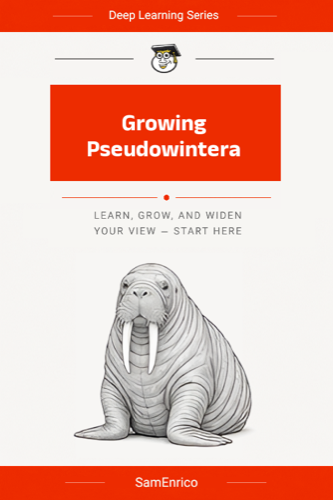
Growing Pseudowintera eBook
This publication, published by SamEnrico, covers G
by Shank Heike
This publication, published by SamEnrico, covers Growing Pseudowintera
Formats
Free sample
Chapter 1: The Last Pepper...–- In the temperate rainforests of New Zealand’s mountains, where mist curls through ancient podocarps and the forest floor sponges with moss, a shrub grows that remembers a world without flowers. Its leaves are leathery, speckled with crimson like drops of dried blood, and when crushed between thumb and forefinger, they release a heat that lingers—not the sharp bite of black pepper, but a slow, creeping warmth that spreads across the tongue and settles deep in the throat. This is Horopito. Botanists call it Pseudowintera. And it is, quite literally, a living fossil.The first time most gardeners encounter Pseudowintera, they do so by accident.
It appears in the back corner of a specialty nursery, tucked between rhododendrons and camellias, its tag faded and its price remarkably low for such an unusual specimen. The leaves catch the eye—those red blotches are unlike anything else in the temperate garden—but it is the story behind the plant that captures the imagination. This shrub, barely knee-high in its nursery pot, shares more DNA with the first flowering plants than it does with most modern garden shrubs. It has no veins in the conventional sense. Its flowers are primitive, lacking petals and sepals, appearing instead as tiny clusters of stamens and carpels that seem almost accidental.
And it produces a chemical compound found nowhere else in the plant kingdom, a compound that has kept herbivores at bay for eighty million years.This chapter is not merely an introduction to Pseudowintera. It is an origin story. To understand how to grow this plant—to truly master its quirks, its preferences, and its astonishing resilience—you must first understand where it came from, how it survived, and why it looks and behaves so differently from the roses, hydrangeas, and tomatoes that fill most gardening guides. The ancient lineage of Pseudowintera explains almost everything about its modern cultivation: its need for acidic soil, its intolerance of drying winds, its slow growth, and its remarkable freedom from pests. By the end of this chapter, you will see this plant not as a difficult specimen, but as a survivor—one that merely asks you to replicate, in your garden, the conditions of the ancient forests that birthed it.The Gondwanan Inheritance To speak of Pseudowintera is to speak of Gondwana.
This was the great southern supercontinent, a landmass that began to break apart 180 million years ago, scattering fragments that would become South America, Africa, Antarctica, Australia, and New Zealand. On that ancient continent, before the break, a family of plants called the Winteraceae evolved. They were among the earliest angiosperms—flowering plants—but they bore little resemblance to the flowers we know today. Their blooms were small, inconspicuous, and lacked the showy petals that would later evolve to attract pollinators. Instead, they relied on beetles and flies, insects that crawled across their primitive reproductive structures, transferring pollen in a messy, inefficient dance.The Winteraceae spread across Gondwana, adapting to the cool, wet, nutrient-poor soils of the southern hemisphere.
They developed thick, leathery leaves with a waxy coating—a feature botanists call "glaucescent"—that protected them from moisture loss and fungal attack in the damp, dim understory of ancient forests. They abandoned the complex vein networks of more advanced plants, retaining instead a primitive system of branching veins that resembles a disorganized road map. And they filled their leaves with defensive compounds, including the sesquiterpene dialdehyde known today as polygodial, which made them unpalatable to browsing animals.When Gondwana fragmented, the Winteraceae found themselves isolated on different continents. In South America, they gave rise to Drimys, the winter’s bark, still grown today as an ornamental. In Australia and New Guinea, they evolved into Tasmannia, the Tasmanian pepperberry.
And in New Zealand, uniquely isolated for eighty million years, they became Pseudowintera—the false wintera, named for its resemblance to Wintera (now classified as Drimys) but distinct in its flower structure and leaf chemistry.New Zealand’s isolation was the key. When the islands drifted away from Australia and Antarctica, they carried with them a cargo of ancient plants and animals that would evolve in isolation, untouched by the continental upheavals that transformed ecosystems elsewhere. There were no native land mammals except bats. The dominant herbivores were birds—moa, the giant flightless grazers that reached heights of three meters, and their smaller relatives. In this mammal-free world, plants evolved defensive strategies suited to bird herbivory.
Pseudowintera developed its speckled leaves not as a warning to mammals, but as a form of camouflage: the red blotches mimic dead or diseased tissue, discouraging birds from taking healthy bites. The polygodial compound, intensely hot and irritating to mammalian mouths, served a dual purpose—it deterred the occasional seal or sea lion that wandered inland, and it may have helped the plant resist fungal pathogens in the humid, spore-filled forests.The Three Living Species Today, Pseudowintera comprises three recognized species, each occupying a distinct ecological niche. Understanding these species is essential for the gardener, because each has different growth habits, tolerances, and garden applications. The first edition of this book described these species across two chapters, creating unnecessary repetition. Here, we present them once, in full, as a definitive reference.Pseudowintera colorata – The Mountain Horopito This is the species most commonly available in nurseries and the one that matches the classic image of horopito: a shrub reaching two to three meters in height, with yellow-green leaves heavily blotched with red.
The specific epithet colorata means "colored," a nod to this dramatic pigmentation. P. colorata grows at higher elevations, from sea level to 1,200 meters, throughout the North and South Islands of New Zealand. It is the hardiest species, tolerating light frosts and exposed conditions better than its relatives, though it still requires shelter from persistent cold winds.The leaves of P. colorata are the source of the commercial horopito trade, as they contain the highest concentrations of polygodial.
The red blotching is not uniform; it intensifies with sunlight exposure and stress, leading to the common gardener’s observation that "the more sun, the more red." This is both an aesthetic feature and a survival mechanism—the red pigments (anthocyanins) protect leaf tissues from UV damage while also deterring herbivores. In deep shade, P. colorata produces greener leaves with minimal speckling, reverting to a form that resembles its lowland relatives.P. colorata blooms in late spring to early summer, producing tiny, petal-less flowers that are easily overlooked. The flowers are unisexual, with male and female structures on separate plants (dioecious), meaning that to produce berries, you need both a male and a female plant.
The berries, when they appear, are small, black, and glossy—a valuable food source for native birds. In the garden, P. colorata serves as a specimen shrub, a low hedge, or a container plant. Its ultimate height, reached after five to ten years, is approximately 2.5 meters (eight feet), though pruning can maintain a smaller size.Pseudowintera axillaris – The Lowland Horopito If P. colorata is the showy mountain dweller, P.
axillaris is its more restrained lowland cousin. Growing up to four meters tall—significantly larger than colorata—this species prefers lower elevations, from sea level to 800 meters…
This is the end of the free sample. Get the eBook to keep going. Buy now
About this book
Details
- Author
- Shank Heike
- Publisher
- SamEnrico
- Language
- English
- Genre
- Non-Fiction, Informative, Educational
- Released
- 2026-06-02
- Pages (approx.)
- 147
- Available as
- eBook, Audiobook

Read better in the ZLOADR app
Your eBooks on your phone or tablet. Sign in with your SamEnrico account and start reading.
More by Shank Heike
 Task Assignment FrameworkShank Heike$11.99
 Gacy's Phone Calls from PrisonShank Heike$11.99
 TM And Other Spiritual PracticesShank Heike$11.99
 Anxiety Disorder at Work GuideShank Heike$11.99
 HIV Mental Health Integration Poor NationsShank Heike$11.99
 The Catholic Restoration DramaShank Heike$11.99
 Prescription Sleep Aid MemoryShank Heike$11.99
 Overcoming Pay Per View PornShank Heike$11.99
 Pattern Recognition PuzzlesShank Heike$11.99
 Neon Shadows: The Rise and Fall of the First AI PresidentShank Heike$11.99
 Grimalkin's Cunning: The Witch's Familiar Who Outwitted KingsShank Heike$11.99
 The Jade Serpent’s Vow: A Dragon’s Oath in the Forbidden MountainsShank Heike$11.99