
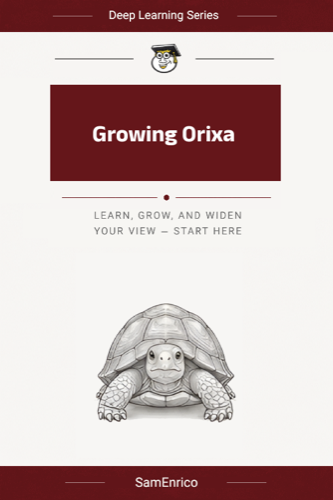
Non-FictionInformativeEducational
Growing Orixa eBook
This publication, published by SamEnrico, covers G
by Kroll Nu
This publication, published by SamEnrico, covers Growing Orixa
Formats
Free sample
Chapter 1: The Unnamed Longing...--There is a specific kind of restlessness that cannot be cured by any medicine, silenced by any distraction, or satisfied by any achievement. It arrives without warning, often in the quiet hours between sleep and waking, and it whispers a question you cannot quite translate into words. For some, it feels like homesickness for a place they have never visited. For others, it is a sudden fascination with Brazil, with the Portuguese language, with the drumming that seems to echo from somewhere deep in the bones. For many who find themselves holding this book, it is a memory of standing by a river and feeling that the water knew their name, or walking through a forest and sensing that the leaves were watching, waiting, speaking in a language just beyond hearing.This restlessness has a name, though no single English word captures it fully.
In the Afro-Brazilian traditions of Candomblé and Umbanda, it is called saudade do santo: the longing for the saint, the ache of separation from one's own spiritual origin. It is the sensation of a seed that knows it belongs in soil but has not yet been planted. And if you feel it, even vaguely, even doubtfully, then this chapter and this entire book is written for you.You have not stumbled upon these pages by accident. The Orixas do not work by accident. Whether you call them gods, forces of nature, archetypes, or ancestors, they move through the world with a purpose that often appears as coincidence to the untrained eye.
A book left on a park bench. A video recommended by an algorithm. A dream of a woman standing at the edge of the sea, her skirts made of moonlight. A sudden, inexplicable urge to light a white candle and sit in silence. These are not random events.
They are invitations. The question is not whether you have been called. The question is whether you will answer.This chapter is the threshold. It will introduce you to the spiritual universe of the Orixas, clarify the two major traditions in which they are honored, define the central concept of Axé, establish the ethical framework for approaching a culture that may not be your own, and guide you through the first practice of sensing the sacred energy within your own body. By the end of this chapter, you will understand what it truly means to "grow Orixa" and why that process begins not with a spell or a ritual but with a seed planted in the quiet soil of your own heart.The Two Rivers: Understanding Candomblé and Umbanda Before we can walk the path, we must know the landscape.
The religion of the Orixas in Brazil flows through two main channels, like great rivers that share the same source but have carved different valleys over time. These are Candomblé and Umbanda. Both are valid, both are powerful, and both contain the living presence of the Orixas. Yet they differ in history, structure, and accessibility, and understanding those differences will help you navigate your own journey without confusion or disrespect.Candomblé is the elder river, the one that runs deep and dark with the memory of centuries. It emerged directly from the spiritual practices of the Yoruba, Fon, and Bantu peoples who were captured in West Africa and transported against their will to Brazil during the transatlantic slave trade.
In the holds of slave ships, in the sugarcane fields, in the crowded senzalas or slave quarters, these men and women refused to let their gods die. They hid their otás sacred stones inside Catholic statues. They sang their pontos songs of praise disguised as Latin hymns. They transformed the forced conversion to Catholicism into a mask behind which the Orixas continued to breathe.Candomblé today remains close to these African roots. The liturgical language is Yoruba, not Portuguese.
Initiation is a long, demanding process that can take years, involving seclusion, sacrifice, and the ritual opening of the head to receive one's Orixa. The terreiros temples are often guarded by strict hierarchies, and secrecy is valued not out of paranoia but out of hard-won wisdom. For centuries, revealing oneself as a Candomblé practitioner could mean imprisonment, beatings, or death. That history lives in the bones of the tradition. As a result, much of Candomblé is closed to outsiders.
You cannot learn it from a book. You cannot watch it on You Tube. You must be invited, accepted, and initiated by a legitimate pai de santo or mãe de santo who has inherited the right to open that door.Umbanda is the younger river, born in the early twentieth century from a fusion of several spiritual currents. In 1908, a young medium named Zélio Fernandino de Moraes began receiving spirits who identified themselves as caboclos Indigenous Brazilian guides and pretos-velhos the spirits of elderly enslaved Africans who had died in captivity. These spirits, speaking through Zélio, declared that a new religion was needed, one that would synthesize African Orixa worship, Indigenous nature reverence, European Spiritism (the teachings of Allan Kardec), and popular Catholicism into a path accessible to all Brazilians, regardless of race or class.Umbanda spread rapidly because it offered something Candomblé could not: openness.
In Umbanda, the Orixas are still central, but they are approached through intermediaries the caboclos and pretos-velhos who are considered closer to human experience and therefore more accessible. The language is Portuguese, not Yoruba. The rituals are often held in public giras ceremonies where anyone may attend, ask questions, and receive spiritual guidance. Initiation, while still meaningful, is less arduous than in Candomblé, and many Umbanda practitioners never undergo full feitura de santo at all.Neither tradition is superior. Candomblé offers depth, lineage, and the raw power of unbroken African transmission.
Umbanda offers flexibility, inclusivity, and a gentler entry point for those who are not Brazilian, not Black, and not raised in the tradition. Many practitioners move between both worlds, attending Candomblé for deep initiatory work and Umbanda for weekly guidance. What matters is not which river you choose but that you enter the water with respect, humility, and a willingness to learn from those who have been swimming much longer than you.If you are reading this book in English, far from Brazil, with no personal connection to the African diaspora, you will most likely find your initial foothold in Umbanda's more open practices. This is not a judgment on your sincerity. It is simply a practical reality.
Candomblé requires proximity to a terreiro, fluency in Yoruba fragments, and a willingness to undergo initiation few outsiders are prepared for. Umbanda, by contrast, welcomes sincere seekers to its public giras, offers ritual baths and smoke cleansing as open practices, and does not demand initiatory secrets as the price of participation. This book draws heavily from Umbanda's accessible framework while honoring Candomblé's deeper mysteries. When a practice is closed requiring lineage, initiation, or direct transmission from a pai de santo we will clearly say so. When a practice is open safe for beginners to perform with respect we will provide clear instructions.Axé: The Force That Creates Worlds Now we arrive at the beating heart of everything you…
This is the end of the free sample. Get the eBook to keep going. Buy now
About this book
Details
- Author
- Kroll Nu
- Publisher
- SamEnrico
- Language
- English
- Genre
- Non-Fiction, Informative, Educational
- Released
- 2026-05-11
- Pages (approx.)
- 153
- Available as
- eBook, Audiobook

Read better in the ZLOADR app
Your eBooks on your phone or tablet. Sign in with your SamEnrico account and start reading.
More by Kroll Nu
 Work Addiction in Tech IndustryKroll Nu$11.99
 The Mental Health Tech OutlookKroll Nu$11.99
 Cash Flow for FranchisesKroll Nu$11.99
 NVC For Anger Management GuideKroll Nu$11.99
 The Little Flowers of FrancisKroll Nu$11.99
 Hillary Motor Accident SurvivalKroll Nu$11.99
 Waco Conspiracy TheoriesKroll Nu$11.99
 Attlee Quiet ManKroll Nu$11.99
 Train Derailment SurvivorKroll Nu$11.99
 The Last Stand at Akrotiri: Cyprus' Forgotten Cold War FlashpointKroll Nu$11.99
 The Last Pharaoh's Gold Heist: Cleopatra's Vanished FortuneKroll Nu$11.99
 The Clay Spy: Enkidu’s Forbidden MissionKroll Nu$11.99
You may also like
 Hong Kong Handover 1997Dunn Johnnie$11.99
 Zumba For Postnatal Recovery CourseNeal Christian$11.99
 Zumba for BeginnersLadner Nikia$11.99
 YouTube Comment Mining GuideHumes Pandora$12.99
 Worry Box MeditationCarlin Rudy$11.99
 Workplace Stress MeditationNguyen Lynn$11.99
 Workplace Stress and Sleep RepairHawley Ivory$11.99
 Workplace Perfectionism CureDelaney Jeffry$11.99
 Workplace Injustice Anger GuideWallen Isabelle$11.99
 Work Addiction and Burnout LinkGreenwood Ester$11.99
 Women in Yoga and WellnessBeattie Galina$11.99
 Women in Stand Up ComedyChun Evangeline$11.99