
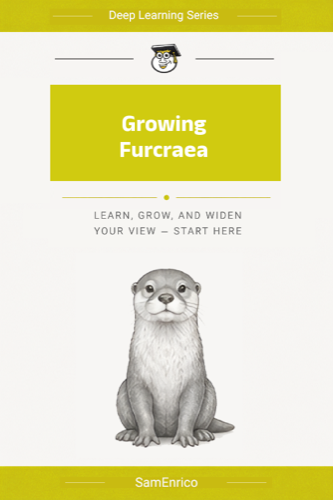
Growing Furcraea
This publication, published by SamEnrico, covers G
by Gary Isaura
This publication, published by SamEnrico, covers Growing Furcraea
Formats
About this book
Free sample
Chapter 1: Beyond the Rosette...–- When Daniel returned to his grandmother’s abandoned greenhouse in coastal Georgia, he expected rusted tools and broken glass. What he found instead was a twelve-foot-wide monster with sword-like leaves reaching toward the sky like green flames frozen in time. The plant had been neglected for seven years—no watering, no fertilizer, no protection from hurricanes or drought. Yet there it stood, untouched by time, its leaves still firm, its core still alive. A handwritten tag, faded but legible, dangled from a wire: Furcraea foetida ‘Mediopicta’.
That single discovery launched a twelve-year obsession and, eventually, the nursery that would supply variegated furcraeas to botanical gardens across the Southeast. This book exists because of that plant—and because of the countless questions it generated. Is this an agave? Why didn’t it die? How do I make mine grow that big?
What do I do when it finally flowers? The answers begin here.The Most Common Mistake You’re Making Right Now Walk into any nursery in Florida, California, Texas, or the Carolinas, and you will find them mislabeled. A striking rosette succulent with wide, arching leaves, creamy yellow margins, and soft terminal spines sits in a one-gallon pot with a plastic tag that reads “Variegated Agave.” This is wrong. It is not an agave. It is a furcraea.
And the distinction matters far more than taxonomic pedantry—it affects how you water, where you plant, how you propagate, and what you expect when the plant finally reaches maturity.The confusion is understandable. Both genera belong to the subfamily Agavoideae. Both form symmetrical rosettes of fibrous leaves. Both are monocarpic, meaning they flower once and die. Both originate from warm regions of the Americas.
But the differences, once you learn to see them, are as obvious as the difference between a cat and a bobcat—similar silhouettes, entirely different behaviors.Let us start with the leaves. Agave leaves are rigid, often thick and succulent, designed to store water in arid environments. They nearly always end in a sharp terminal spine, sometimes barbed, sometimes needle-sharp. Run your finger along…
This is the end of the free sample. Get the eBook to keep going. Buy now
Contents
- Chapter 1
- Chapter 2
- Chapter 3
- Chapter 4
- Chapter 5
- Chapter 6
- Chapter 7
- Chapter 8
- Chapter 9
- Chapter 10
- Chapter 11
- Chapter 12
Details
- Author
- Gary Isaura
- Publisher
- SamEnrico
- Language
- English
- Genre
- Non-Fiction, Informative, Educational
- Released
- 2026-05-25
- Pages (approx.)
- 130
- Available as
- eBook, Audiobook

Read better in the ZLOADR app
Your eBooks on your phone or tablet. Sign in with your SamEnrico account and start reading.
More by Gary Isaura
 Microbiome Prebiotic GuideGary Isaura$11.99
 Empathy For Postpartum MoodGary Isaura$11.99
 Governor's Second Term BluesGary Isaura$11.99
 Child Loss Parent Self Care GuideGary Isaura$11.99
 The Financial Envy Release GuideGary Isaura$11.99
 Weekend Sleep Catch Up GuideGary Isaura$11.99
 Supply Chain Crisis GuideGary Isaura$11.99
 Subclinical HypothyroidismGary Isaura$11.99
 The Khan’s Lightning: Subutai’s Ride to the Ends of the EarthGary Isaura$11.99
 The Billion-Dollar Bet: How a Math Genius Broke Wall StreetGary Isaura$11.99
 The Great Firewall: How China’s Digital Iron Curtain Reshaped the WorldGary Isaura$11.99
 Small Business Climate Insurance GuideGary Isaura$12.99