
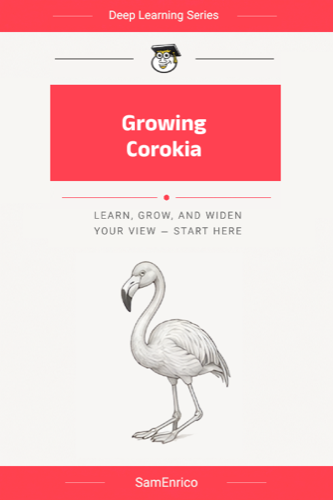
Non-FictionInformativeEducational
Growing Corokia eBook
This publication, published by SamEnrico, covers G
This publication, published by SamEnrico, covers Growing Corokia
Formats
Free sample
Chapter 1: The Twisted Architect...--Every great garden has its rebels—plants that refuse to obey the rules of tidiness, that grow sideways when expected to grow up, that thrive on neglect when every instinct screams to coddle. Corokia is the ringleader of these rebels. This is not a plant for the gardener who needs straight lines, predictable shapes, or the comforting green monotony of a boxwood hedge. This is a plant for the gardener who has learned that nature's most interesting forms emerge from struggle, not from comfort.If you have picked up this book, chances are you have already encountered a Corokia somewhere—perhaps in a coastal garden where it stood firm against salt-laden gales, its silver leaves flashing like a school of fish turning in unison. Or maybe you saw it in a botanical garden, a twisted, angular silhouette against a winter sky, bare of leaves but impossibly alive with branching patterns that seemed less like botany and more like calligraphy.
Or perhaps you simply heard the name—Corokia—and felt the strange pull of a plant that sounds more like a forgotten Greek island than a shrub from New Zealand.Whatever brought you here, you are about to discover that growing Corokia is not about mastering a set of horticultural techniques. It is about unlearning everything you think you know about gardening. It is about shifting from the role of carer to the role of curator. It is about learning to do less, not more, and discovering that the most beautiful plants are often the ones we interfere with the least.The Curious Case of the Name Before we dig into soil, sunlight, and the mechanical details of cultivation, we must first understand what Corokia actually is—and just as importantly, what it is not.Let us address the elephant in the room immediately. If you have searched for Corokia online, you may have encountered a peculiar detour.
The internet, in its infinite capacity for confusion, occasionally misdirects seekers to something called "Coroika"—a manga and anime character from the series One Piece. This furry, fictional creature has absolutely nothing to do with the plant in your garden. The similarity in spelling is pure coincidence, and yet it has caused no small amount of confusion for gardeners trying to research this genus. If you find yourself on a fan wiki discussing character arcs and voice actors, you have taken a wrong turn. Come back.
The real Corokia is far more interesting.The name Corokia derives from the Greek koro (meaning "helmet" or "head") and okia (meaning "dwelling" or "house"), a reference to the way the small, clustered leaves form a protective covering over the branches. Some botanical historians suggest the name also nods to the shape of the fruit, which resembles a tiny, bereted cap. But the plant's common names tell a more vivid story. In its native New Zealand, Corokia is known as the "wire-netting bush"—a name that captures its most distinctive feature perfectly. Run your fingers along a mature branch and you will understand immediately.
The stems are stiff, angular, and interwoven in a chaotic lattice that feels less like wood and more like a tangled ball of galvanized wire.Māori, the indigenous people of New Zealand, call it korokio (for Corokia cotoneaster) and kākāpōtaka (for Corokia buddlejoides). These names carry the weight of centuries of observation and use. Korokio, in particular, was valued not only for its hard wood—used for small tools and fish hooks—but also for its presence as a marker of healthy, functioning coastal ecosystems. Where korokio grew, the land was in balance.A Journey to the Edge of the World To understand how to grow Corokia, you must first understand where it comes from. This is not merely an exercise in botanical geography.
It is the key to the entire philosophy of this book.Corokia is endemic to New Zealand—a nation that is, in ecological terms, one of the strangest places on Earth. Isolated for eighty million years after breaking away from the supercontinent Gondwana, New Zealand developed a flora and fauna found nowhere else. There are no native land mammals except two species of bat. Instead, birds dominated. Giant moa—some standing twelve feet tall—browsed the forests.
Keas and kākā ripped through tough foliage with curved beaks. The plants of New Zealand evolved in response to these unique pressures, and Corokia is a perfect product of that evolutionary crucible.Look at a map of New Zealand and you will see two main islands, each with distinct climates. The North Island is volcanic, with geothermal zones, subtropical forests in the north, and a relatively mild, wet climate overall. The South Island is more dramatic—the Southern Alps running like a spine down its length, creating rain shadows, glacial valleys, and fierce, drying winds known as the nor'westers. Corokia species are found on both islands, but they consistently occupy a specific ecological niche: the margins.In the wild, Corokia grows at the edges.
It clings to coastal cliffs where salt spray would kill most shrubs. It scrambles over rocky outcrops in dry, rain-shadow valleys where summer drought is intense. It forms the understory beneath open-canopied forests of kānuka and mānuka, where dappled light is the brightest illumination available. It thrives where other plants struggle and fail.This is the single most important fact you will learn in this entire book: Corokia is a plant of harsh margins. It did not evolve in rich, loamy garden soil with regular irrigation and balanced fertilizer.
It evolved in places where nutrients were scarce, water was intermittent, and the wind never stopped blowing. When you treat Corokia like a rose—with rich soil, frequent water, and high-nitrogen fertilizer—you are not helping it. You are slowly killing it with kindness.The Genius of the Zig-Zag Let us examine the plant's most striking feature: the divaricating branching pattern. Divaricating comes from the Latin divaricatus, meaning "spread apart" or "straddling." In botanical terms, it describes a growth habit where branches grow at wide angles, often zig-zagging back and forth, creating a dense, tangled mesh.Corokia is not the only divaricating plant. New Zealand is home to an extraordinary number of divaricating shrubs—a group that includes Coprosma, Melicytus, and Myrsine, among others.
This clustering of similar forms in a single geographic region is unusual enough that botanists have long debated its cause. Several theories have emerged, and Corokia embodies all of them.The wind hypothesis is the most intuitively obvious. On windswept coastlines and exposed mountain slopes, a dense, tangled branching pattern reduces wind speed within the plant's canopy. The branches flex rather than snap, and the interwoven structure creates a porous barrier that slows the wind without catching it like a sail. If you have ever stood behind a Corokia hedge on a blustery day, you have felt this effect.
The wind howls on the windward side, but on the leeward side, it is reduced to a gentle rustle. For the plant itself, this means less water loss through transpiration and less physical damage to leaves and stems.The herbivore hypothesis points to New Zealand's unusual…
This is the end of the free sample. Get the eBook to keep going. Buy now
About this book
Details
- Author
- Barraza Danyel
- Publisher
- SamEnrico
- Language
- English
- Genre
- Non-Fiction, Informative, Educational
- Released
- 2026-06-02
- Pages (approx.)
- 137
- Available as
- eBook, Audiobook

Read better in the ZLOADR app
Your eBooks on your phone or tablet. Sign in with your SamEnrico account and start reading.
More by Barraza Danyel
 Lying Down Body Scan ManualBarraza Danyel$11.99
 Nobel Laureates In Laser PhysicsBarraza Danyel$11.99
 Katmai National Park VanishedBarraza Danyel$11.99
 The Nobel Laureate SpousesBarraza Danyel$11.99
 The No Buy Year JournalBarraza Danyel$11.99
 Ventilation Gestures GuideBarraza Danyel$11.99
 Vacation Disconnect ProtocolBarraza Danyel$11.99
 Meditation Posture CorrectionBarraza Danyel$11.99
 The Last Broadcast of the Titanic’s Radio RoomBarraza Danyel$11.99
 How to Produce Brooms and DustpansBarraza Danyel$11.99
 CTA for Nonprofits GuideBarraza Danyel$12.99
 Cracking JEE With Daily PracticeBarraza Danyel$12.99
You may also like
 Hong Kong Handover 1997Dunn Johnnie$11.99
 Zumba For Postnatal Recovery CourseNeal Christian$11.99
 Zumba for BeginnersLadner Nikia$11.99
 YouTube Comment Mining GuideHumes Pandora$12.99
 Worry Box MeditationCarlin Rudy$11.99
 Workplace Stress MeditationNguyen Lynn$11.99
 Workplace Stress and Sleep RepairHawley Ivory$11.99
 Workplace Perfectionism CureDelaney Jeffry$11.99
 Workplace Injustice Anger GuideWallen Isabelle$11.99
 Work Addiction and Burnout LinkGreenwood Ester$11.99
 Women in Yoga and WellnessBeattie Galina$11.99
 Women in Stand Up ComedyChun Evangeline$11.99