
Non-FictionInformativeEducational
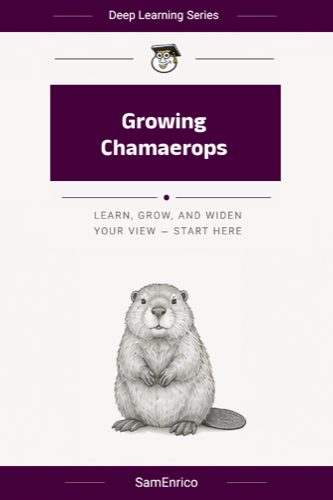
Growing Chamaerops eBook
This publication, published by SamEnrico, covers G
This publication, published by SamEnrico, covers Growing Chamaerops
Formats
Free sample
Chapter 1: The $30 Bet--The first palm I ever killed cost me six hundred dollars.It was a majestic Trachycarpus fortunei, five feet of trunk already, delivered on a dolly by a nurseryman who shook his head when he saw my yard. “South-facing wall gets good sun,” I told him, pointing. “Soil drains okay.” He nodded, took my money, and left. I planted it with the reverence of a surgeon. I watered it deeply.
I mulched it lovingly. I checked it every morning for the first hundred days, and it rewarded me with new leaves—pale green fans that unfurled like promises.That first winter, I wrapped it in burlap. I strung incandescent Christmas lights around the trunk (not LED—I’d done my homework). I built a PVC hoop house over it and covered it with frost cloth. I checked the weather app obsessively.
When the temperature dropped to 12°F, I went outside at midnight with a remote thermometer and held my breath.The palm died anyway.Not dramatically. Not overnight. It simply stopped growing in spring. The spear leaf in the center—the heart, the apical meristem, the single point of life for the entire plant—pulled out with a wet, rotting sound. The trunk, once firm, felt spongy.
I had overwatered it in autumn, and the wet cold had done what dry cold never would have: it had rotted the heart from the inside.I was out six hundred dollars and a year of hope.The second palm I killed was cheaper: three hundred dollars for a Sabal minor. I under-watered it that time, too afraid of repeating my mistake. It desiccated in a summer drought while I was on vacation. The third palm—a Butia capitata—I didn't even kill. It just refused to grow, sitting in its pot like a green rock for eighteen months before I gave it away in frustration.I was ready to give up on palms entirely.
I live in Zone 7a—northern Virginia, where winters are wet and unpredictable, summers humid, and the gardening culture revolves around azaleas and boxwoods. Everyone told me palms were for Florida and California. “You can’t grow a palm here,” my neighbor said, clipping her hydrangeas. “Wrong climate.”Then a friend gave me a scrappy little plant in a one-gallon nursery pot. “It’s a Mediterranean fan palm,” she said.
“Chamaerops humilis. Some guy at the farmers’ market was selling them for thirty bucks. I bought two. This one’s yours if you want it.”I almost said no. I was tired of killing things.
But it was free, and it was already October, and I figured I’d let it live in the garage over winter and forget about it.That was seven years ago.Today, that same scrappy little palm is six feet tall, has nine trunks (the original plus eight suckers), and sits in a half-barrel planter on my south-facing patio. It has survived four winters outdoors (after I got brave and planted it in the ground), including a polar vortex that dropped to 8°F for three consecutive nights. It has survived drought, neglect, a dog who dug up its root zone, and a falling branch that sheared off two trunks entirely. It has never been fertilized on schedule. It has been repotted exactly twice.
It has never looked better.The $30 bet paid off.This book is the story of that bet—and how you can make it yourself, no matter where you live.Why This Palm, Why This Book You might be holding this book because you love the look of palms. Maybe you’ve vacationed in the Mediterranean—the Greek islands, the Italian coast, the south of France—and you remember the silhouette of fan palms against whitewashed walls and blue sea. Maybe you live in a hot, dry climate (Arizona, Texas, inland California) and you’re tired of lawn and want something architectural, something that says “I belong here” without screaming “tropical.”Or maybe you’re like me: you live somewhere that supposedly can’t grow palms, and you want to prove the experts wrong.Whatever brought you here, I need you to understand something up front: Chamaerops humilis is not the most beautiful palm in the world. It’s not the fastest-growing, the rarest, the most expensive, or the most impressive. The crown goes to Bismarckia nobilis for beauty, Caryota urens for speed, and Copernicia baileyana for majesty—none of which you can grow outside the tropics.What Chamaerops offers is something better: resilience.This is the only palm species native to mainland Europe.
It grows wild from the Atlas Mountains of Morocco (where snow falls regularly) to the limestone cliffs of coastal Spain, from the dry maquis of Sardinia to the palm oases of southern France near Nice. It has evolved to tolerate drought, fire, poor soil, salt spray, and—most importantly for northern gardeners—cold. Not deep, prolonged, wet cold (more on that in Chapter 11), but the kind of cold that kills most other palms outright.And it clumps. That’s the secret weapon. While Trachycarpus grows a single trunk that dies if the heart rots, Chamaerops sends up suckers from the base—new trunks, new chances.
If one trunk dies, the others keep going. The plant as a whole is nearly immortal.In the pages that follow, I will teach you everything I’ve learned, plus everything I’ve gathered from the top palm growers, botanists, and Mediterranean gardening experts. You will learn:How to choose the right form (green, blue, dwarf, spineless) for your climate and space (Chapters 2 and 12)How to plant it so it doesn't rot—the single biggest killer (Chapter 4)How to water it without killing it with kindness (Chapter 5)How to feed it (Chapter 6, with a clear distinction between in-ground and container plants)How to prune it—or whether to prune it at all (Chapter 7)How to grow it in a container if you’re north of Zone 7 (Chapter 8)How to diagnose and treat pests and diseases (Chapter 9)How to design with it for maximum Mediterranean impact (Chapter 10)How to push the hardiness limits—growing it in Zone 6, 5b, or even colder (Chapter 11)How to collect rare cultivars like the silver-blue Atlas Mountain form (Chapter 12)By the time you finish this book, you will not only know how to keep Chamaerops alive. You will know how to make it thrive. And you will understand why I call it the $30 bet—the cheapest, most reliable way to bring the Mediterranean to your garden.What’s in a Name?
Chamaerops Explained Before we go any further, let’s talk about the name. I promise this won’t be a dry botanical lecture, but understanding the name helps you understand the plant.The Swedish botanist Carl Linnaeus—the father of modern taxonomy—first described this genus in 1753. He combined two Greek words: chamai, meaning “on the ground” or “dwarf,” and rhops, meaning “shrub” or “bush.” Chamaerops: dwarf shrub.Linnaeus wasn’t being dismissive. He was being accurate. Unlike the towering palms of the tropics (Cocos nucifera can reach 100 feet), Chamaerops humilis typically grows to 6 to 15 feet in cultivation.
In the wild, battered by wind and fire, it often stays under 6 feet—a shrub, not a tree. The second…
This is the end of the free sample. Get the eBook to keep going. Buy now
About this book
Details
- Author
- Keeton Armida
- Publisher
- SamEnrico
- Language
- English
- Genre
- Non-Fiction, Informative, Educational
- Released
- 2026-06-02
- Pages (approx.)
- 136
- Available as
- eBook, Audiobook

Read better in the ZLOADR app
Your eBooks on your phone or tablet. Sign in with your SamEnrico account and start reading.
More by Keeton Armida
 Teen Delayed Phase GuideKeeton Armida$11.99
 Essential Employee Departure Crisis HotlineKeeton Armida$11.99
 Morning Pain Meditation RoutineKeeton Armida$11.99
 DoorDash Fast Pay EconomicsKeeton Armida$11.99
 Spouse Death and Substance UseKeeton Armida$11.99
 Warm Up Vocal ReleaseKeeton Armida$11.99
 Resale Price Maintenance FinesKeeton Armida$11.99
 Cannabis Use Disorder and AnxietyKeeton Armida$11.99
 The Iron Crown of Lombardy: The Secret Diplomacy of Queen TheodelindaKeeton Armida$11.99
 The Bloodied Path to Unity: Ying Zheng’s Ruthless March to EmpireKeeton Armida$11.99
 How to Produce Bamboo Fiber FabricKeeton Armida$11.99
 Small Business AI Accounting EthicsKeeton Armida$12.99
You may also like
 Hong Kong Handover 1997Dunn Johnnie$11.99
 Zumba For Postnatal Recovery CourseNeal Christian$11.99
 Zumba for BeginnersLadner Nikia$11.99
 YouTube Comment Mining GuideHumes Pandora$12.99
 Worry Box MeditationCarlin Rudy$11.99
 Workplace Stress MeditationNguyen Lynn$11.99
 Workplace Stress and Sleep RepairHawley Ivory$11.99
 Workplace Perfectionism CureDelaney Jeffry$11.99
 Workplace Injustice Anger GuideWallen Isabelle$11.99
 Work Addiction and Burnout LinkGreenwood Ester$11.99
 Women in Yoga and WellnessBeattie Galina$11.99
 Women in Stand Up ComedyChun Evangeline$11.99