
Non-FictionInformativeEducational
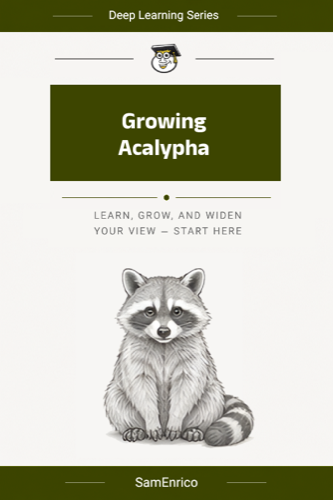
Growing Acalypha eBook
This publication, published by SamEnrico, covers G
This publication, published by SamEnrico, covers Growing Acalypha
Formats
Free sample
Chapter 1: The Paintbox Plant...–– Long before you ever dip your hands into soil, long before you select a pot or worry about watering schedules, you will likely fall for Acalypha the same way most gardeners do—you will see one. Not in a catalog photograph, not in a carefully staged social media post, but in person. Perhaps at a botanical garden during a summer visit, or in a neighbor’s front yard where a single shrub seems to glow with impossible colors. Or maybe in a nursery, tucked between predictable green foliage plants, where a flash of copper, pink, and crimson stops you mid-stride. You will stand there, momentarily confused, trying to understand how one plant can display so many colors at once.
The leaves will look painted. The edges will be scalloped in cream and rose. The new growth will be electric bronze, the older leaves deep burgundy, and somewhere in between, shades of orange and gold will appear as if lit from within. You will wonder if it is real, or if someone has dyed the plant like a cut flower. Then you will touch a leaf—slightly rough, slightly papery, alive—and you will want to take it home.
That moment, that first encounter, is where every Acalypha story begins. This book is designed to ensure that story has a happy ending.What you have just imagined is not an exaggeration. Acalypha wilkesiana, commonly known as Copperleaf, is one of the most vividly colored foliage plants in cultivation. In the world of ornamental horticulture, where most plants earn their keep through flowers that bloom for a few weeks each year, Copperleaf does something entirely different. It delivers constant, reliable, almost aggressive color from every single leaf, three hundred and sixty-five days a year, as long as conditions are right.
The genus Acalypha contains approximately four hundred fifty to five hundred species, distributed across tropical and subtropical regions worldwide, but only a handful have entered the ornamental plant trade. Among those, two distinct groups have captured the attention of gardeners: the foliage-driven Copperleaf varieties bred from Acalypha wilkesiana, and the flower-driven Chenille plants derived from Acalypha hispida and Acalypha pendula. Together, they offer something for nearly every gardening situation, from massive landscape shrubs to trailing hanging basket specimens.Yet despite their spectacular appearance and relative ease of care, Acalypha remains surprisingly underappreciated in mainstream gardening. Walk through a typical suburban neighborhood in USDA Zones 9 through 11, and you will see endless azaleas, gardenias, hibiscus, and bougainvillea. You will see lantana and plumbago and oleander.
But Copperleaf? Rarely. This is not because the plant is difficult or rare. It is because most gardeners simply do not know about it. And those who do often misunderstand its basic needs, leading to disappointing results—leggy growth, pale leaves, leaf drop, or death from overwatering.
The plant then gains an undeserved reputation as temperamental or demanding, when in truth, Acalypha is extraordinarily forgiving once you understand a few fundamental principles. This book exists to close that gap.The Etymology of an Unlikely Name Before we discuss how to grow Acalypha, it is worth understanding the peculiar story behind its name. The word Acalypha comes from the ancient Greek ακαλήφη (akalēphē), which meant "nettle" or a similar stinging plant. The Roman naturalist Pliny the Elder used the term to refer to a plant with irritating properties. When the Swedish botanist Carl Linnaeus formalized the genus name in his 1753 work Species Plantarum, he retained Acalypha, presumably referencing the rough, slightly scratchy texture of some species' leaves.
Here is the irony: most cultivated Acalypha varieties do not sting at all. They are not nettles. They do not cause skin irritation beyond the mild sensitivity some people experience from the sap, which is true of many Euphorbiaceae family members. So we have a plant named "unpleasant to touch" that is, in fact, a pleasure to handle. This disconnect between name and nature is part of the plant's charm.
It is a small botanical joke that has persisted for nearly three centuries.The common names are more descriptive and far more appealing. Copperleaf refers to the warm metallic tones that dominate the foliage of Acalypha wilkesiana varieties. Chenille plant, used for Acalypha hispida and Acalypha pendula, comes from the French word for caterpillar—an apt description of the fuzzy, drooping red catkins that resemble fuzzy worms or soft bottlebrushes. In some regions, particularly the Caribbean and parts of Central America, Copperleaf is called "Jacob's Coat" or "Fire Dragon," names that capture the plant's theatrical, almost flamboyant character. In Hawaii, where Acalypha has naturalized in many lowland areas, it is sometimes called "Beefsteak Plant" for the deep red-purple tones of certain cultivars.
Each name reveals something true about the plant: its color, its texture, its ability to command attention in any setting.The Spurge Family Connection Understanding that Acalypha belongs to the Euphorbiaceae family, commonly called the spurge family, provides important context for its care. This family is enormous and diverse, containing over six thousand species ranging from the iconic Poinsettia (Euphorbia pulcherrima) to the ubiquitous garden weed known as petty spurge (Euphorbia peplus), from the desert-adapted Crown of Thorns (Euphorbia milii) to the tropical rubber tree (Hevea brasiliensis), the source of natural latex. What unites this diverse family is a shared characteristic: all euphorbs produce a milky, often irritating sap that flows from broken stems or damaged leaves. In Acalypha, this sap is present but relatively mild compared to some of its relatives. It can cause minor skin irritation in sensitive individuals and should never be ingested, but it is not dangerous to handle casually.
The sap serves a defensive purpose in nature, discouraging herbivores from nibbling on the foliage. In cultivation, it simply means you should wash your hands after pruning and avoid touching your eyes or mouth while working with the plant.The Euphorbiaceae connection also hints at Acalypha's resilience. Spurges are survivors. They grow in poor soils, tolerate neglect, and bounce back from damage with impressive speed. Acalypha shares this family toughness, which is good news for beginning gardeners.
While the plant looks delicate and exotic, with its papery leaves and jewel-toned colors, it is actually quite robust. It can handle occasional missed waterings, imperfect light conditions, and less-than-ideal soil. The key is not to provide perfect conditions every single moment, but to avoid a few catastrophic mistakes—particularly overwatering and cold exposure—that kill more Acalyphas than any disease or pest.The Two Paths: Foliage vs. Flowers One of the most important distinctions for any Acalypha grower to understand is the difference between the foliage-focused varieties and the flower-focused species. These two groups have different habits, different care requirements, and different uses in the garden.
Confusing them is a common source of disappointment.The first group, derived primarily from Acalypha wilkesiana, is grown almost exclusively for its leaves. These plants produce small, insignificant flowers—tiny reddish or greenish catkins that appear in summer but add nothing ornamental to the display. The magic is in the foliage. A mature Copperleaf shrub can reach six to ten feet tall in frost-free climates, with individual leaves four to eight inches long, each one a masterpiece of color. The leaves…
This is the end of the free sample. Get the eBook to keep going. Buy now
About this book
Details
- Author
- Andersen Elenora
- Publisher
- SamEnrico
- Language
- English
- Genre
- Non-Fiction, Informative, Educational
- Released
- 2026-05-09
- Pages (approx.)
- 139
- Available as
- eBook, Audiobook

Read better in the ZLOADR app
Your eBooks on your phone or tablet. Sign in with your SamEnrico account and start reading.
More by Andersen Elenora
 Outbreak Shareholder Letter KitAndersen Elenora$11.99
 Mindfulness for ChildrenAndersen Elenora$11.99
 The Foster Care PregnancyAndersen Elenora$11.99
 International Dividend InvestingAndersen Elenora$11.99
 Creative Procrastination BreakthroughAndersen Elenora$11.99
 Maquis French Rural FightersAndersen Elenora$11.99
 Chronic Stress Vs BurnoutAndersen Elenora$11.99
 Child Illness Death GriefAndersen Elenora$11.99
 Zama's Last Stand: Hannibal's Final Gambit Against Rome (202 BC)Andersen Elenora$11.99
 The Ballad of the Maya Ballcourt: How Ancient Marketing Won the GameAndersen Elenora$11.99
 How to Produce Mattress PadsAndersen Elenora$11.99
 How to Produce a WindshieldAndersen Elenora$11.99
You may also like
 Hong Kong Handover 1997Dunn Johnnie$11.99
 Zumba For Postnatal Recovery CourseNeal Christian$11.99
 Zumba for BeginnersLadner Nikia$11.99
 YouTube Comment Mining GuideHumes Pandora$12.99
 Worry Box MeditationCarlin Rudy$11.99
 Workplace Stress MeditationNguyen Lynn$11.99
 Workplace Stress and Sleep RepairHawley Ivory$11.99
 Workplace Perfectionism CureDelaney Jeffry$11.99
 Workplace Injustice Anger GuideWallen Isabelle$11.99
 Work Addiction and Burnout LinkGreenwood Ester$11.99
 Women in Yoga and WellnessBeattie Galina$11.99
 Women in Stand Up ComedyChun Evangeline$11.99