
Non-FictionSelf-HelpUser Research
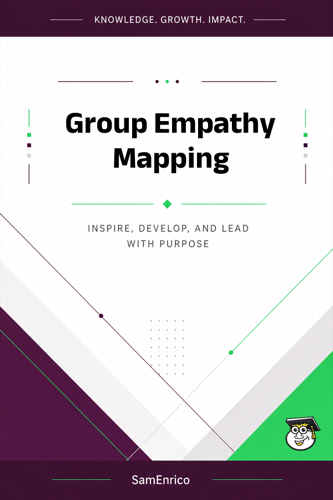
Group Empathy Mapping eBook
Creates user-centered ideas through collaborative
by Quick Taina
Creates user-centered ideas through collaborative customer understanding.
Formats
Free sample
Chapter 1: The $1.2 Million Post-it Note--It started with a yellow sticky note stuck to a whiteboard in a bustling San Francisco startup office. On that note, someone had written: “Becky, 34, likes yoga, drives a Honda, has two kids, cares about price.” That was their user persona. That was the sum total of their customer understanding. And over the next eighteen months, that single sticky note would cost them $1.2 million.This is a true story, though the names have been changed to protect the embarrassed. A mid-sized Saa S company—let’s call them Cloud Retain—had raised a respectable Series A round.
They had twelve engineers, a slick office with a keg, and a product that was supposed to revolutionize how small businesses managed customer retention. They had done everything “right.” They had built personas. They had run surveys. They had a marketing team that knew Becky intimately: her age, her income bracket, her preferred social media platforms.There was just one problem. Becky didn’t exist.Not in the sense that she wasn’t a real person—of course, she was an aggregate, a composite, a statistical fiction.
But more importantly, the Becky on that sticky note bore almost no resemblance to the actual humans who were supposedly using Cloud Retain’s product. The team had never watched a real Becky struggle with their interface. They had never sat in a Becky’s office and listened to her sigh when the software crashed. They had never read a support ticket where a Becky typed in all caps: “I HAVE TRIED THIS FOUR TIMES WHY ISN’T IT WORKING.”Instead, they had guessed. They had assumed.
They had projected their own preferences onto a fictional character and then built an entire product around those projections. The result was a retention tool that nobody could retain. After launch, 73% of users churned within the first 90 days. The company laid off half its staff. The CEO wrote a postmortem that began: “We thought we knew our customer.
We were wrong.”That yellow sticky note became known internally as “the $1.2 million Post-it.”The Assumption Monster Every organization has an Assumption Monster. It lives in the gap between what you believe about your customers and what is actually true. It grows fat on convenience, on meetings where someone says “I think the user wants…” without ever having spoken to a user, on personas that were written three years ago and never updated, on the comfortable delusion that you are your customer.The Assumption Monster has many disguises. Sometimes it wears the mask of “common sense.” Sometimes it speaks with the authority of “we’ve been in this industry for twenty years.” Sometimes it whispers “we don’t have time for user research” or “we already know what they want.” But its favorite disguise is the static persona—that neatly formatted document with a stock photo and a list of demographics that makes your team feel sophisticated while teaching you nothing.Here is the uncomfortable truth that Cloud Retain learned too late: Demographics don’t predict behavior. Context does.Knowing that a user is thirty-four years old, drives a Honda, and has two children tells you almost nothing about how they will interact with your product.
Will they click the blue button or the green button? Will they read the instructions or smash through the interface with brute force? Will they give up after one error message or persist through five? These are not questions of age or income. They are questions of psychology, environment, and moment-to-moment emotional state.The persona industrial complex has sold generations of product teams a dangerous lie: that if you can name your user and paste a photo next to their name, you understand them.
You don’t. You have simply labeled your ignorance.The Birth of Group Empathy Mapping If personas are the Assumption Monster’s favorite food, Group Empathy Mapping (GEM) is the silver bullet. GEM did not emerge from an academic lab or a consulting firm’s intellectual property factory. It emerged from necessity—from teams like Cloud Retain who realized that guessing was bankrupting them.The core insight of GEM is deceptively simple: understanding your customer is not a solo activity. It never has been.
The lone genius who intuits user needs through sheer brilliance is a myth, perpetuated by movies and tech journalism. In reality, no single person—not the CEO, not the lead designer, not the most experienced product manager—has a complete picture of the user. Marketing sees one slice (surveys, brand perception). Support sees another (complaints, confusion, workarounds). Sales sees another (objections, price sensitivity, competitors mentioned).
Engineering sees another (crash logs, performance data, feature requests).Each department holds a fragment of the truth. But fragments, when kept separate, are worse than useless. They create the illusion of knowledge while concealing the gaps.Group Empathy Mapping is the practice of bringing those fragments together into a single, collaborative artifact. It is a structured workshop process where cross-functional teams combine their disparate perspectives, ground them in actual customer data (not assumptions), and build a shared understanding of what users actually say, think, do, and feel.The result is not a persona. A persona is a static demographic profile.
An empathy map is a dynamic behavioral snapshot. A persona tells you that Becky is thirty-four. An empathy map tells you that Becky says she wants efficiency, but her actions show she scrolls for ten minutes before buying—suggesting comparison anxiety, not laziness. A persona is a label. An empathy map is an insight.The Four Quadrants (And Why They Work)At the heart of every empathy map are four quadrants, a structure first popularized by design thinker Dave Gray.
These quadrants are not arbitrary categories. They correspond to the fundamental dimensions of human experience that drive behavior.Says: The words users speak aloud. Customer support transcripts. Interview recordings. Social media posts.
Review comments. This is the surface layer—what users are willing to verbalize, which is often polite, edited, and incomplete.Thinks: The words users keep inside. The thoughts they are too embarrassed, too rushed, or too polite to voice. The silent curses. The second-guessing.
The “why is this taking so long” that never makes it into a support ticket but flashes across their face for half a second.Does: Observable actions. Where users click. What they ignore. How long they hesitate. The workarounds they invent.
The tabs they open. The back button they hammer. Behavior does not lie, even when users do.Feels: Emotional states. Frustration. Delight.
Anxiety. Boredom. Triumph. Humiliation. Emotions drive retention more than features do.
Users forgive bugs. They do not forgive feeling stupid.The power of the four quadrants is that they force a team to acknowledge the gaps in their knowledge. Most teams can fill the “Says” quadrant from support tickets. Very few can fill the “Thinks” quadrant without inference. The empty quadrants become a to-do list for research.The $1.2 Million Post-it, revisited, was a document that contained no “Thinks,” no “Feels,” and no “Does.” It was all “Says” (what Becky told a survey she cared about) and demographic filler.
Cloud Retain never knew what Becky actually thought because they never watched her try to use their product. They never…
This is the end of the free sample. Get the eBook to keep going. Buy now
About this book
Details
- Author
- Quick Taina
- Publisher
- SamEnrico
- Language
- English
- Genre
- Non-Fiction, Self-Help, User Research
- Released
- 2026-06-11
- Pages (approx.)
- 151
- Available as
- eBook, Audiobook

Read better in the ZLOADR app
Your eBooks on your phone or tablet. Sign in with your SamEnrico account and start reading.
More by Quick Taina
 Testosterone HGH Aging LinkQuick Taina$11.99
 Impossible Workload PrioritizationQuick Taina$11.99
 Chemistry Loci MethodQuick Taina$11.99
 Diamond Vault Alarm BypassQuick Taina$11.99
 PMS Breast Tenderness GuideQuick Taina$11.99
 Retirement Assets QTIP TrustQuick Taina$11.99
 Cold Turkey Nicotine ManualQuick Taina$11.99
 Church Pew RLS StrategyQuick Taina$11.99
 The Lion and the Rose: Elizabeth I and the Golden Age of EnglandQuick Taina$11.99
 Shadows of the Forgotten: The Black Spartans of Ancient RomeQuick Taina$11.99
 The Billionaire's Last Gift: How Warren Buffett's Pledge Transformed PhilanthropyQuick Taina$11.99
 The Dancer's Guide to KizombaQuick Taina$11.99
You may also like
 Hong Kong Handover 1997Dunn Johnnie$11.99
 Zumba For Postnatal Recovery CourseNeal Christian$11.99
 Zumba for BeginnersLadner Nikia$11.99
 YouTube Comment Mining GuideHumes Pandora$12.99
 Worry Box MeditationCarlin Rudy$11.99
 Workplace Stress MeditationNguyen Lynn$11.99
 Workplace Stress and Sleep RepairHawley Ivory$11.99
 Workplace Perfectionism CureDelaney Jeffry$11.99
 Workplace Injustice Anger GuideWallen Isabelle$11.99
 Work Addiction and Burnout LinkGreenwood Ester$11.99
 Women in Yoga and WellnessBeattie Galina$11.99
 Women in Stand Up ComedyChun Evangeline$11.99