
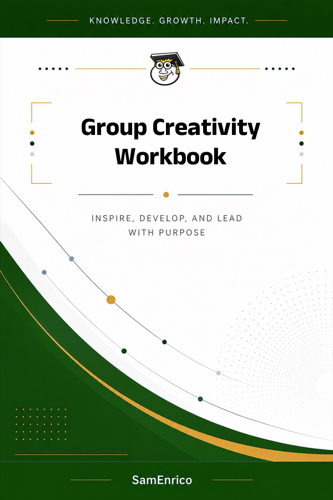
Non-FictionSelf-HelpCreativity
Group Creativity Workbook eBook
Exercises for collective problem solving and innov
Exercises for collective problem solving and innovation.
Formats
Free sample
Chapter 1: Breaking the Box...--–- Every problem arrives in a meeting room wearing a disguise. It does not show up as itself. Instead, it shows up as a set of assumptions that everyone has agreed to pretend are facts. The budget is fixed. The customer won't wait.
Legal will say no. We've always done it this way. None of these are facts. They are frames—invisible boxes that dictate which solutions seem possible and which seem insane. The most dangerous frame is the one you do not know you are in.This chapter is about seeing those boxes for the first time.
Not intellectually—most teams already know they have assumptions—but viscerally. The kind of seeing that makes a room go silent because thirty seconds ago everyone was stuck, and now everyone is embarrassed by how obvious the solution was. That silence is the sound of a frame breaking.Before we do anything else, before we generate a single idea or vote on anything, we have to answer one question: Where is our box? Because you cannot think outside a box you cannot see.The Cognitive Science of Invisible Boxes The human brain is a pattern-matching machine. It evolved to take incomplete information and fill in the gaps with assumptions.
That was useful on the savanna—if you heard rustling in the grass, assuming it was a lion (even if it was just the wind) kept you alive. But in a conference room, that same machinery works against you. Your brain fills in gaps with assumptions that feel like reality.Psychologists call these "cognitive frames." A frame is the mental structure that organizes your perception of a problem. Change the frame, and the solution changes automatically. Keep the frame, and you will generate the same solutions over and over, each time wondering why nothing works.Consider this: In one famous study, researchers gave two groups of doctors the same patient case.
One group was told the patient had a 90 percent chance of surviving surgery. The other group was told the patient had a 10 percent chance of dying. The doctors recommended surgery at dramatically different rates, even though the information was mathematically identical. The frame—survival versus death—changed everything.Your team does this every day. You frame a problem as a "budget shortfall," so you generate budget solutions.
You frame it as a "timeline problem," so you generate timeline solutions. You never ask whether the frame itself is wrong.This chapter is not about solving problems. It is about breaking the frame that makes the problem look unsolvable.The Nine Dots: A Physical Experience of Frame Breaking The most famous demonstration of this phenomenon is a puzzle created by psychologist Norman Maier in 1930. It has been used by creativity researchers, military academies, and design schools for nearly a century because it produces a reliable, measurable reaction: the groan.Setup (3 minutes):You will need a whiteboard or flip chart and markers. Draw nine dots arranged in a perfect square—three rows of three dots each, equally spaced.
Each dot should be about the size of a coin, and the entire grid should fit in a one-foot square. Do not draw any other markings. Do not draw a box around the dots. Do not say anything about boundaries.The Instructions:Read these exactly as written, without elaboration:"Your task is to connect all nine dots using exactly four straight lines. You cannot lift your pen from the page.
You cannot trace over the same line twice. You have two minutes. Go."Do not say anything about staying inside the dots. Do not say anything about the imaginary square. The box exists only in their heads.What Happens:Most participants will start by drawing lines that stay within the perimeter of the dot grid.
They will try three lines, then four, then five, growing frustrated. Some will attempt to connect the dots with a zigzag that stays inside the square. Others will draw a star shape. A few will give up entirely and say it is impossible.Watch their hands. They will hover over the paper, drawing tentative lines that stop at the edge of the dot grid.
They are boxing themselves in without being told.After 90 seconds, about 90 percent of groups will have failed. Some will claim the puzzle is rigged. Some will blame the instructions. Some will look at you with the expression of people who have just been told that everything they know is wrong.The Solution:Draw the first line starting from above the top-left dot, angling down so that it passes through the top-left dot, the top-middle dot, and the top-right dot, and continues well past the last dot into empty space. The second line starts from that extended endpoint, angles down and left, passing through the middle-right dot and the bottom-right dot, and continues past the bottom-right dot.
The third line goes straight left, passing through the bottom-middle and bottom-left dots, continuing past the bottom-left dot. The fourth line goes diagonally up and right, passing through the middle-left and center dots.When you draw this solution, do it slowly. Let them see the lines extend into the empty white space. Let them see that you never drew a box because no box existed.Then wait.The room will go silent. Someone will say, "Oh." Someone else will say, "Wait, we could go out there?" Someone will laugh, embarrassed.
That is the groan. It is the sound of a frame breaking.The Debrief (10 minutes):Facilitator asks these questions in order. Do not skip any."Where did the box come from?"Participants will say "You drew a box" or "The dots made a square." Push back gently: "Did I draw a box? Did I say 'stay inside the dots'?" The answer is no. The box was entirely self-imposed."What did you assume that you were not told?"List the assumptions on a whiteboard: The lines must stay inside the dots.
The lines cannot be longer than the grid. The lines must connect dots in order. The pen cannot go into empty space. Each of these was invented by the participants."How did it feel when you saw the solution?"Answers will include "stupid," "obvious in retrospect," "frustrated," "amazed." Normalize all of them. Say: "That feeling is not failure.
That feeling is learning.""What is the version of the nine dots in our real work?"This is the most important question. Ask the group to name one assumption they treat as a fact. Examples from real workshops include: "We assume the budget is fixed," "We assume the customer won't pay more than $50," "We assume legal will kill anything novel," "We assume we need approval from three VPs before we can test anything."Write each assumption on a sticky note. Do not debate whether the assumption is true or false yet. Just capture it.The Three Types of Frames Not all assumptions are created equal.
After running this exercise with hundreds of teams, I have identified three distinct types of frames. Each requires a different intervention.Type 1: The Ghost Frame This is an assumption that was once true but is no longer true. No one bothered to update it.…
This is the end of the free sample. Get the eBook to keep going. Buy now
About this book
Details
- Author
- Mayer Sharika
- Publisher
- SamEnrico
- Language
- English
- Genre
- Non-Fiction, Self-Help, Creativity
- Released
- 2026-06-05
- Pages (approx.)
- 148
- Available as
- eBook, Audiobook

Read better in the ZLOADR app
Your eBooks on your phone or tablet. Sign in with your SamEnrico account and start reading.
More by Mayer Sharika
 LCIS Lobular Neoplasia GuideMayer Sharika$11.99
 Road Rage Relapse PreventionMayer Sharika$11.99
 Postpartum for Teen MomsMayer Sharika$11.99
 Performance Review CycleMayer Sharika$11.99
 Meditation Journal for Anxious DaysMayer Sharika$11.99
 Anticipatory Grief Music TherapyMayer Sharika$11.99
 Liking Persuasion TechniqueMayer Sharika$11.99
 The Silk Road Conspiracy: How a British Spy Sold Secrets to the OttomansMayer Sharika$11.99
 The Buenos Aires Gold Heist: The Fingerprints That Cracked the CaseMayer Sharika$11.99
 How to Produce Paint MediumMayer Sharika$11.99
 How to Produce Cookie JarsMayer Sharika$11.99
 Cranes: Bird Biology, Migration & ConservationMayer Sharika$11.99
You may also like
 Hong Kong Handover 1997Dunn Johnnie$11.99
 Zumba For Postnatal Recovery CourseNeal Christian$11.99
 Zumba for BeginnersLadner Nikia$11.99
 YouTube Comment Mining GuideHumes Pandora$12.99
 Worry Box MeditationCarlin Rudy$11.99
 Workplace Stress MeditationNguyen Lynn$11.99
 Workplace Stress and Sleep RepairHawley Ivory$11.99
 Workplace Perfectionism CureDelaney Jeffry$11.99
 Workplace Injustice Anger GuideWallen Isabelle$11.99
 Work Addiction and Burnout LinkGreenwood Ester$11.99
 Women in Yoga and WellnessBeattie Galina$11.99
 Women in Stand Up ComedyChun Evangeline$11.99