
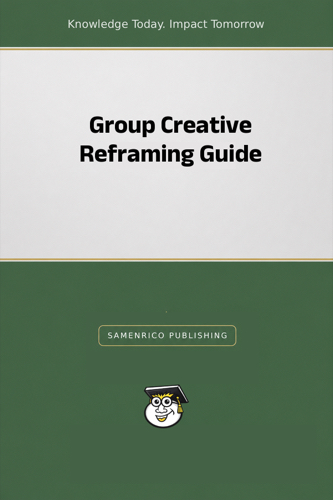
Group Creative Reframing Guide eBook
Teaches teams to restate problems from multiple an
Teaches teams to restate problems from multiple angles to unlock new solutions.
Formats
Free sample
Chapter 1: The Pause Power...--–- It begins the same way every time. A team gathers around a whiteboard, a spreadsheet, or a conference table littered with coffee cups. Someone – usually the loudest person in the room or the one with the most seniority – says, “All right, here’s the problem.” They state it with confidence. The team nods. And then, for the next ninety minutes, three days, or three weeks, everyone works furiously to solve that exact problem.
They generate ideas. They build plans. They assign tasks. They feel productive. They are, in fact, deeply unproductive.The problem they are solving is almost certainly the wrong one.Not because they are stupid.
Not because they are lazy. Not because they lack creativity. But because of a cognitive quirk so pervasive and so invisible that most teams never notice it: first-conclusion bias. When a problem appears, the human brain craves closure. It wants to name the enemy, label the issue, and move to action.
The very first plausible explanation that surfaces gets adopted as the truth. And then, like a train switching onto tracks, every subsequent thought follows that initial direction.This chapter is about derailing that train. Not by accident, but by design. It is about learning to pause before you solve, to build a team habit that feels unnatural at first but becomes indispensable once mastered. We call that habit The Pause Power.Before we go any further, let me show you what this looks like in real life.
Because the gap between knowing you should pause and actually pausing is where most teams fail.The $3 Million Pause A few years ago, I watched a product team at a mid-sized e-commerce company wrestle with flat sales. They had been flat for three quarters. The head of product, a sharp and impatient woman named Priya, opened the meeting with a statement: “Our pricing is wrong. Competitors undercut us by twelve percent on similar items. We need to run a price test.”The team agreed.
They started sketching A/B test designs. Someone calculated margin impact. Someone else volunteered to pull historical data. The energy was high. This felt like progress.Then a junior data analyst named Marcus raised his hand.
He had been at the company for six months. He rarely spoke in these meetings. “Can I ask something?” he said.Priya glanced at the clock. “Quickly.”“What if pricing isn’t the problem?” Marcus said. “I’ve been looking at cart abandonment by page.
People who leave after reading reviews abandon at twice the rate of people who leave before. Maybe it’s not the price. Maybe it’s what they’re reading in the reviews.”The room went quiet. Priya looked annoyed. “We don’t have time to chase every random data point,” she said.
“The price difference is obvious.”Here is where most teams would have plowed ahead. They would have thanked Marcus politely, ignored his observation, and run the price test. Three weeks later, they would have discovered that price wasn’t the issue. They would have wasted time, money, and team morale.But Priya’s team had recently learned a single technique. Someone – I think it was the engineering lead – said, “Let’s just pause for ten minutes.
Ten minutes. We’ll look at Marcus’s data. If it’s nothing, we go back to pricing.”They paused.Marcus pulled up the data. Customers who saw reviews with poor formatting, missing images, or negative language about shipping times abandoned at dramatically higher rates. Price wasn’t mentioned in the exit surveys at all.They reframed the problem.
Not “Our pricing is wrong” but “Why do customers abandon carts after reading reviews?” The answer turned out to be trust signals, not price cuts. They added verified purchase badges, standardized review formatting, and responded publicly to negative reviews. Conversions tripled within sixty days. The price test they almost ran would have cost them margin and changed nothing.The pause took ten minutes. Ten minutes saved them three months of misdirected work and approximately three million dollars in potential lost revenue.That is The Pause Power.The Anatomy of First-Conclusion Bias To understand why pausing is so difficult, you have to understand how your brain is working against you.
Psychologists have known for decades that humans suffer from what Daniel Kahneman called “what you see is all there is” bias. When we encounter a problem, our brains quickly assemble a story using the most available information. That story feels complete. It feels true. We don’t naturally look for information that might contradict it because the story already explains everything we think we need to know.In team settings, this bias becomes amplified through social pressure.
The first person to name a problem often sets the frame for everyone else. This is called “anchoring” in decision-making research. Once the anchor is set, even creative people struggle to escape it. They generate solutions that are variations on the anchor, not fundamental departures from it.Consider a classic study. Researchers gave teams a problem: a town’s only factory is closing, and the town needs new economic development.
Half the teams were told, “Some people think the answer is tourism.” The other half were told nothing. The teams that heard the tourism anchor generated almost exclusively tourism-related solutions – hotels, souvenir shops, guided tours. The teams without the anchor generated a much wider range of ideas: remote work infrastructure, small manufacturing, agricultural cooperatives.The anchor wasn’t presented as the answer. It was presented as “something some people think.” And it still hijacked the creative process.Now imagine what happens when a senior leader says, “Here’s the problem.” The anchor is not just present. It is reinforced by authority, by urgency, and by the natural human desire to be helpful.
No wonder most teams spend 90 percent of their time solving the first problem they name.First-conclusion bias is not a character flaw. It is a feature of how normal human brains work under uncertainty. The solution is not to try harder or to be more creative. The solution is to install a structural pause – a mandatory moment of reflection before the anchor sets.The Reframing Loop: A Better Way The Pause Power is one part of a larger pattern that top creative teams use instinctively. We call it the reframing loop: Pause → Expand → Reframe → Solve.Most teams skip the first three steps entirely.
They go directly from problem statement to solve. The reframing loop inserts three deliberate interventions before solving is allowed.Pause means stop the momentum. Do not generate solutions. Do not assign tasks. Do not agree on next steps.
Just stop. This feels wrong to action-oriented teams. That’s the point.Expand means generate alternative problem statements. Not solutions – problem statements. Ask “What else could this be?” “How might someone else describe this?” “What are we assuming that might be false?”Reframe means choose one or two alternative problem statements that seem most promising.
These become the new starting point.Solve means generate solutions to the reframed problem. Only now, after the pause, the expansion, and the reframe, is solving allowed.The product team in our opening story ran…
This is the end of the free sample. Get the eBook to keep going. Buy now
About this book
Details
- Author
- Hagen Sherill
- Publisher
- SamEnrico
- Language
- English
- Genre
- Non-Fiction, Self-Help, Reframing
- Released
- 2026-06-11
- Pages (approx.)
- 145
- Available as
- eBook, Audiobook

Read better in the ZLOADR app
Your eBooks on your phone or tablet. Sign in with your SamEnrico account and start reading.
More by Hagen Sherill
 Gambling Addiction and SuicideHagen Sherill$11.99
 Weight Loss Without ExerciseHagen Sherill$11.99
 Jamaican Professional OutlookHagen Sherill$11.99
 Alcohol and Anger Trigger AmplificationHagen Sherill$11.99
 Vanished Over the Yukon: The 1972 UFO Wave That Changed EverythingHagen Sherill$11.99
 The Golden Handshake: How a Billion-Dollar Bribe Toppled a Prime MinisterHagen Sherill$11.99
 Understanding Chromosome 7, Trisomy MosaicHagen Sherill$17.99
 QGIS ArcGIS Replacement GuideHagen Sherill$12.99
 Defense and Aerospace BuyersHagen Sherill$12.99
 How to Become a Buttonhole-machine OperatorHagen Sherill$11.99
 Software SpecialistHagen Sherill$11.99
You may also like
 Hong Kong Handover 1997Dunn Johnnie$11.99
 Zumba For Postnatal Recovery CourseNeal Christian$11.99
 Zumba for BeginnersLadner Nikia$11.99
 YouTube Comment Mining GuideHumes Pandora$12.99
 Worry Box MeditationCarlin Rudy$11.99
 Workplace Stress MeditationNguyen Lynn$11.99
 Workplace Stress and Sleep RepairHawley Ivory$11.99
 Workplace Perfectionism CureDelaney Jeffry$11.99
 Workplace Injustice Anger GuideWallen Isabelle$11.99
 Work Addiction and Burnout LinkGreenwood Ester$11.99
 Women in Yoga and WellnessBeattie Galina$11.99
 Women in Stand Up ComedyChun Evangeline$11.99