
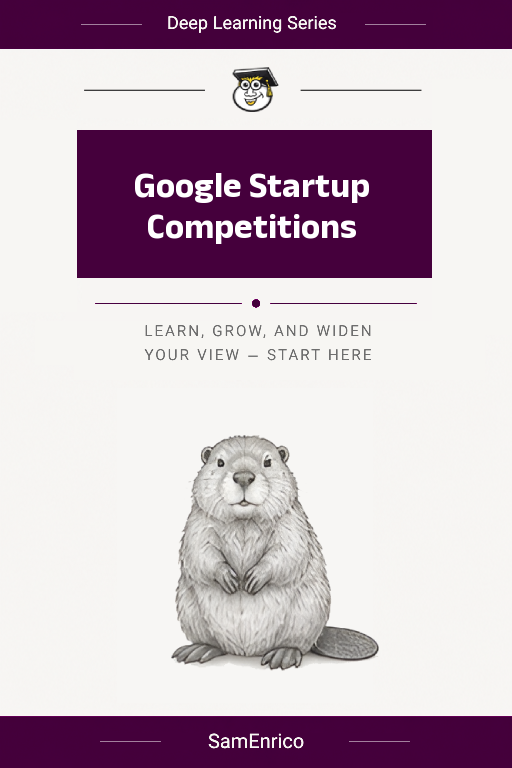
Non-FictionStartup GuideNon-Dilutive Grants
Google Startup Competitions eBook
Find Google-sponsored startup competitions. Google
Find Google-sponsored startup competitions. Google for Startups accelerator and pitch events.
Formats
Free sample
Chapter 1: The Three Doors...--There is a secret that Google does not advertise, that most founders never discover until it is too late, and that this book will reveal in the first few pages.Google does not run one startup competition. It runs dozens.Every year, thousands of founders type “Google startup competition” into the search bar, click the first link, fill out a generic application, and never hear back. They assume they were not good enough. They assume Google only funds Ivy League graduates with perfect pitch decks and seven-figure traction.They are wrong.What actually happened is that they applied to the wrong program. Or they applied at the wrong time.
Or they applied with the wrong materials. Or they applied from the wrong geography. Or they applied to a program that had already closed its application window six months earlier.Google’s startup ecosystem is not a single door. It is three doors, each leading to a different type of opportunity, each with different requirements, different timelines, and different judges. Most founders try the first door they find, get rejected, and walk away.
The founders who win try all three doors, systematically, with preparation tailored to each one.This chapter will show you those three doors, help you identify which one is yours, and give you the framework to walk through it with confidence.The Three Doors of Google’s Startup Ecosystem Imagine you are standing in a long hallway. At the end of the hallway are three doors. Each door is labeled, but the labels are small, easy to miss, and written in a language you do not yet understand.Door Number One: Pitch Competitions These are single-day events, sometimes online, sometimes in person, where founders stand on a stage (or in front of a webcam) and deliver a short pitch to a panel of judges. The prizes are immediate cash, cloud credits, and media exposure. The time commitment is minimal.
The barrier to entry is the lowest of the three doors.But here is what most founders misunderstand: Pitch competitions are not a shortcut to Google’s accelerator. They are a separate track entirely. Winning a pitch competition does not guarantee you a spot in the 10-week accelerator. It gives you cash, validation, and a line on your resume. That is valuable, but it is different.Pitch competitions are best for early-stage founders who need cash to extend their runway, need validation to attract their first customers, and are not yet ready for the intensity of a multi-week accelerator.Door Number Two: Accelerators These are structured programs, typically 8 to 10 weeks long, combining remote technical sprints with in-person “whiteboarding” weeks at Google offices.
The prizes are mentorship from Google engineers, access to unreleased products, Cloud credits, and a Demo Day in front of 100+ venture capitalists. The time commitment is significant. The application process is rigorous.But here is what most founders misunderstand: Accelerators are not looking for ideas. They are looking for live products with verifiable traction. Every startup accepted into a Google accelerator in 2025 and 2026 had a working product, paying customers, or signed pilot letters from recognizable organizations.
No exceptions.Accelerators are best for founders who have moved beyond the “idea” stage, have a live MVP, and are ready to scale with Google’s technical and business mentorship.Door Number Three: Immersion Programs These are the newest and most selective door. Launched in May 2026, the Google for Startups Immersion program combines a two-week online bootcamp with a two-week offline residency at a Google office. The online phase is open to thousands of applicants. The offline phase invites only 25 founders to work side-by-side with Google engineers, use unreleased products, and receive direct feedback from Deep Mind and Cloud teams.But here is what most founders misunderstand: The Immersion program is not for generalist founders. It is for deeply technical founders who are already building on Google’s AI stack.
Of the 5,000+ founders who applied to the India Immersion program in 2026, only 25 reached the offline residency. That is a 0.5% acceptance rate. This is not a door for the faint of heart or the unprepared.Immersion programs are best for AI-native founders who have already integrated Gemini, Vertex AI, or Cloud TPUs into their product and want elite access to Google’s most sensitive unreleased technology.Why Most Founders Pick the Wrong Door The most common mistake in Google’s startup ecosystem is not a bad pitch, a weak product, or a poorly designed deck. It is applying to the wrong door entirely.Consider a hypothetical founder named Sarah. Sarah has built a prototype of an AI-powered customer support tool.
She has ten beta users, all friends and family. She has no revenue. She has not yet integrated any Google AI products. She applies to the Google for Startups Accelerator in North America. She is rejected within two weeks.Sarah assumes her product is not good enough.
She gives up on Google.But Sarah made a category error. She applied to Door Two (Accelerator) when she should have applied to Door One (Pitch Competition). Her prototype was not ready for an accelerator’s technical rigor, but it was perfectly suited for a pitch competition’s emphasis on vision and potential. If Sarah had applied to three pitch competitions instead of one accelerator, she might have won cash, validation, and the confidence to keep building.Now consider a different founder, Miguel. Miguel has a live AI-powered energy optimization platform for commercial buildings.
He has twelve pilot buildings, three paying customers, and a 22% average energy reduction. He has integrated Vertex AI and Gemini into his product. He applies to a pitch competition and wins $15,000 in cash. He is thrilled.But Miguel left value on the table. He was ready for Door Two (Accelerator) or even Door Three (Immersion), but he aimed too low.
The accelerator would have given him mentorship, Cloud credits, and a Demo Day in front of VCs. The Immersion program would have given him direct access to Deep Mind engineers. Instead, he took the cash and walked away.The right door depends on three factors: your stage, your technical depth, and your goals.The Decision Framework: Which Door Is Yours?Here is a simple decision framework that will save you months of wasted applications and rejection emails. Answer these three questions honestly.Question One: Do you have a live MVP that meets Google’s minimum thresholds?Google’s technical gate, which we will explore in depth in Chapter 2 and Chapter 6, has a clear operational definition. A live MVP means at least 50 active users who are not family or friends, OR three paying customers at any price point, OR one signed pilot letter from a recognizable organization.If you answer NO to this question, you are not ready for Door Two (Accelerator) or Door Three (Immersion).
You are barely ready for Door One (Pitch Competition), but you can apply if your prototype is compelling and your vision is clear.If you answer YES, you are eligible for all three doors. The next question will help you narrow further.Question Two: Have you deeply integrated Google’s AI stack into your product?Deep integration means you are not just “planning to use Gemini.”…
This is the end of the free sample. Get the eBook to keep going. Buy now
About this book
Details
- Author
- Tobias Elnora
- Publisher
- SamEnrico
- Language
- English
- Genre
- Non-Fiction, Startup Guide, Non-Dilutive Grants
- Released
- 2026-05-28
- Pages (approx.)
- 149
- Available as
- eBook, Audiobook

Read better in the ZLOADR app
Your eBooks on your phone or tablet. Sign in with your SamEnrico account and start reading.
More by Tobias Elnora
 The Cognitive Resilience WorkbookTobias Elnora$11.99
 Pan American Highway LeaderTobias Elnora$11.99
 Lonely Freelancer ConnectionTobias Elnora$11.99
 The Attention Residue Avoidance GuideTobias Elnora$11.99
 How to Start a Cleaning Materials (retail) Business (Beginners Guide)Tobias Elnora$11.99
 Biometrics for EE GradsTobias Elnora$12.99
 Learn to Play the BullroarerTobias Elnora$11.99
 Ayan HarvestingTobias Elnora$11.99
You may also like
 Hong Kong Handover 1997Dunn Johnnie$11.99
 Zumba For Postnatal Recovery CourseNeal Christian$11.99
 Zumba for BeginnersLadner Nikia$11.99
 YouTube Comment Mining GuideHumes Pandora$12.99
 Worry Box MeditationCarlin Rudy$11.99
 Workplace Stress MeditationNguyen Lynn$11.99
 Workplace Stress and Sleep RepairHawley Ivory$11.99
 Workplace Perfectionism CureDelaney Jeffry$11.99
 Workplace Injustice Anger GuideWallen Isabelle$11.99
 Work Addiction and Burnout LinkGreenwood Ester$11.99
 Women in Yoga and WellnessBeattie Galina$11.99
 Women in Stand Up ComedyChun Evangeline$11.99