
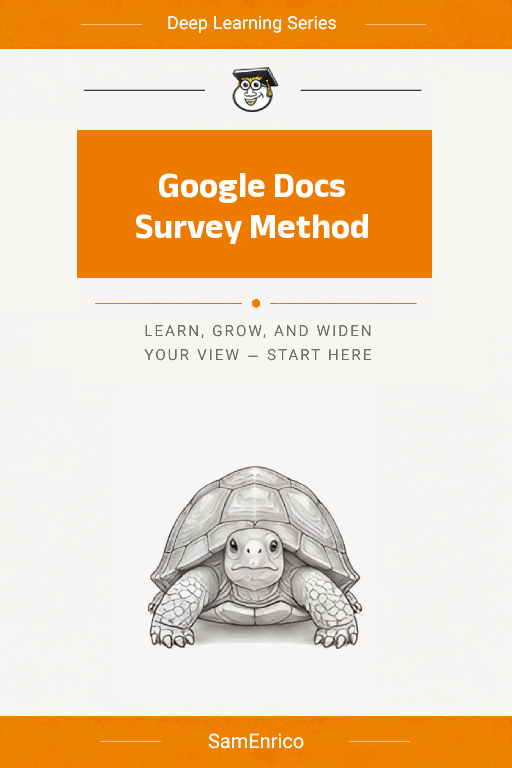
Google Docs Survey Method eBook
Write 5 problem questions, share the link in 3 Fac
Write 5 problem questions, share the link in 3 Facebook groups, and get 50 responses.
Formats
Free sample
Chapter 1: The 90-Second Rule--–- You are about to make a mistake. You do not know it yet, but you are probably planning to ask too many questions. You think more data is better data. You believe that a longer survey will give you deeper insights. You assume that your audience owes you their attention because your questions are important.
Every single one of these assumptions is wrong, and together they will kill your survey before it even has a chance to breathe.Let me tell you about Sarah. Sarah is a composite of about two hundred entrepreneurs I have coached, but her story is real in every way that matters. Sarah spent six weeks building a detailed twenty-question survey for her new freelance marketplace idea. She asked about features, pricing, demographics, brand preferences, competitor awareness, and future buying intent. She tested it with five friends who said it looked "professional." She posted the link in fourteen Facebook groups, two Linked In communities, and her personal email list of eight hundred people.
She waited. And waited. And then she watched in horror as 843 people clicked her link and only 41 finished the survey. The completion rate was 4.8 percent. The data she got was from forty-one people who were either pathologically helpful or had nothing better to do.
She had no idea if those forty-one represented her real market or just the most patient humans on the internet.Sarah came to me frustrated and confused. "I don't understand," she said. "My survey was good. People just don't care."She was wrong about both things. Her survey was not good, and people did care.
They cared enough to click the link. They cared enough to read the first question. They cared enough to start answering. But somewhere between question 1 and question 20, they ran out of caring. They hit what researchers call the "respondent burden ceiling" – the exact point where the perceived cost of continuing exceeds the perceived benefit of finishing.The Science of Running Out of Time Here is what Sarah did not know, and what most survey creators never learn: the average human being will give you approximately ninety seconds of undivided attention for an online survey.
That is not a guess or a rule of thumb. It comes from decades of research in survey methodology, particularly the work of Don Dillman and his Total Design Method, which has been validated across hundreds of studies involving millions of respondents. Ninety seconds. That is your budget. Spend it wisely.Think about what ninety seconds actually means.
It means the time it takes to brew a single cup of coffee. It means two commercial breaks during a television show. It means scrolling through approximately twelve Instagram posts. It means reading the first few paragraphs of a news article before the paywall hits. It is not a lot of time.
But it is enough time – exactly enough time – to answer five thoughtful questions.Here is the math that should scare you. Every question you add beyond the first five reduces your completion rate by roughly ten to fifteen percent. That is not a linear decline; it is an accelerating collapse. Question six costs you ten percent of your remaining respondents. Question seven costs you another twelve percent.
Question eight costs you fifteen percent. By the time you reach question twelve, you have lost more than half of the people who started. By question twenty, you are lucky to have ten percent still standing.But the damage is worse than just drop-offs. The people who do stay past question six are not necessarily your best respondents. They are often your most desperate, most bored, or most pathologically compliant.
They are the people who finish every survey they start because they cannot stand to leave anything incomplete. They are not representative of your market. They are representative of people who finish long surveys. Those two groups are radically different, and relying on their answers will systematically bias your data toward the most extreme, most patient, or most lonely segments of your audience.The Quality Collapse Nobody Talks About The drop-off problem is visible and painful, which is why most people focus on it. But there is a second problem that is even more dangerous because it is invisible.
When respondents pass their cognitive breaking point – usually around question six or seven for mobile users, slightly higher for desktop – they do not stop answering. They start cheating.This phenomenon is called "satisficing," a term borrowed from economics and popularized in survey research by Jon Krosnick at Stanford. Satisficing happens when a respondent wants to finish the survey but no longer wants to expend the mental energy to answer accurately. They shift from "optimizing" (giving the best answer they can) to "satisficing" (giving an answer that is good enough to move to the next question). In practice, this means they start selecting the first reasonable option they see.
They agree with statements regardless of content. They pick the middle option because it requires no thought. They speed-click through matrix questions without reading the rows.You cannot see satisficing in your data. The answers look real. They fit within expected ranges.
They have internal consistency. But they are noise. They are the respondent equivalent of a student filling in random bubbles on a multiple-choice test because they ran out of time. And here is the cruelest part: satisficing increases as survey length increases, but it does not increase evenly. The first five questions get mostly thoughtful answers.
Questions six through ten get maybe fifty percent thoughtful answers. Questions eleven through fifteen get maybe twenty percent. Beyond that, you are essentially measuring random clicking with a human face.I once consulted for a software company that had run a fifty-question annual customer survey for seven years. They had stacked years of data, run regressions, built dashboards, and made product decisions based on the results. When I asked them to show me the completion time distribution, they discovered that seventy percent of their respondents finished in under four minutes.
Fifty questions in four minutes is less than five seconds per question – impossible to read, let alone answer thoughtfully. They had been making million-dollar product decisions based on what was essentially random noise. The look on the CEO's face when I showed him the data is something I will never forget.The 5-3-50 Promise This book exists because there is a better way. It is not a compromise. It is not a shortcut that sacrifices depth for speed.
It is a fundamental rethinking of what survey research looks like when you stop pretending that your audience owes you attention and start earning it instead.The method is simple enough to fit on a sticky note: five questions, three Facebook groups, fifty responses. That is the 5-3-50 method. It is not a minimum and it is not a maximum. It is the precise formula that works for niche markets, early-stage products, and entrepreneurs who need answers this week, not this quarter.Let me break down each number so you understand why it matters.Five questions is not an arbitrary limit. Five questions is what fits comfortably inside the ninety-second attention window.
Five questions allows you to ask a qualifier, two pain-magnitude questions, a solution-history question, and an open-ended magic question. Five…
This is the end of the free sample. Get the eBook to keep going. Buy now
About this book
Details
- Author
- Forney Frankie
- Publisher
- SamEnrico
- Language
- English
- Genre
- Non-Fiction, Startup Guide, Market Validation, Zero-Cost Tools
- Released
- 2026-05-29
- Pages (approx.)
- 132
- Available as
- eBook, Audiobook

Read better in the ZLOADR app
Your eBooks on your phone or tablet. Sign in with your SamEnrico account and start reading.
More by Forney Frankie
 Religious Difference TalksForney Frankie$11.99
 Loneliness Hospital VolunteeringForney Frankie$11.99
 Recurring Dreams in Teens GuideForney Frankie$11.99
 Elder Exercise ConfidenceForney Frankie$11.99
 The Prevention JournalForney Frankie$11.99
 Stress Tinnitus ConnectionForney Frankie$11.99
 The Couple Who Never ArguedForney Frankie$11.99
 Needle Phobia HypnosisForney Frankie$11.99
 Antwerp Heist LegacyForney Frankie$11.99
 Ashen Echoes: The Last Song of TheraForney Frankie$11.99
 The Last Broadcast: How a Single Radio Transmission Halted the Cold WarForney Frankie$11.99
 The Day the Skywheel Fell: The Tragic Collapse of the London EyeForney Frankie$11.99