
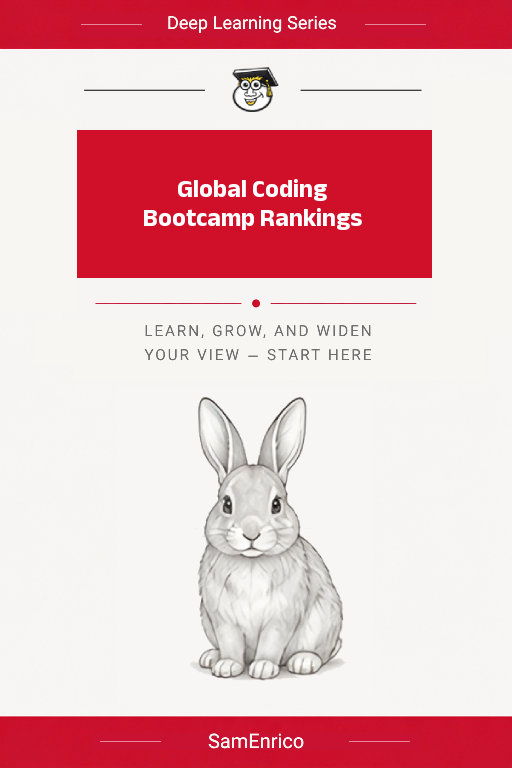
Non-FictionStudent's ShortcutGlobal RankingsBootcamp Comparison
Global Coding Bootcamp Rankings eBook
Compare top coding bootcamps worldwide by outcomes
by Sam Cecille
Compare top coding bootcamps worldwide by outcomes curriculum and cost using verified student data.
Formats
Free sample
Chapter 1: The Billion-Dollar Lie--–- On a Tuesday afternoon in March 2023, a 34-year-old former teacher named Sarah signed a contract that would cost her 28,000forajobshewouldneverget.Shehadspentthreemonthsresearching“bestcodingbootcamps”on Google,readfourteendifferentrankingarticles,andcalledsixadmissionsadvisorswhoalltoldherthesamething:9228,000 for a job she would never get. She had spent three months researching “best coding bootcamps” on Google, read fourteen different ranking articles, and called six admissions advisors who all told her the same thing: 92% placement rate, six-figure starting salary, money-back guarantee. Eight months later, she was working the drive-through window at a Starbucks in Phoenix, Arizona, 28,000forajobshewouldneverget.Shehadspentthreemonthsresearching“bestcodingbootcamps”on Google,readfourteendifferentrankingarticles,andcalledsixadmissionsadvisorswhoalltoldherthesamething:9228,000 in debt, and receiving collection notices for an Income Share Agreement that had kicked in despite her unemployment. The bootcamp that ranked #1 on three separate “top 10” lists had filed for bankruptcy. Its ranking articles were still live on the internet.
And Sarah’s story is not an outlier—it is the norm.The global coding bootcamp industry generates over $1.2 billion in annual revenue. More than 200,000 students enroll every year across 600+ programs worldwide. And almost every single one of them starts their journey the same way: they type “best coding bootcamp” into a search engine and trust the list that appears first. That trust is a trap.This chapter dismantles the illusion that most online “top 10 bootcamp” lists are useful. It reveals the perverse financial incentives that drive rankings, explains how to distinguish real data from marketing fiction, and introduces the only verification standards that actually matter.
By the end of this chapter, you will never look at a bootcamp ranking the same way again.The Affiliate Marketing Machine That Controls What You See Let me show you exactly how the game works.A bootcamp wants students. It cannot afford to run Super Bowl ads, so it pays affiliate marketers—bloggers, review sites, You Tube influencers—a commission for every student who enrolls through their link. That commission typically ranges from 500to500 to 500to3,000 per student. Some premium bootcamps pay as much as $5,000 per referral.Now consider the economics from the affiliate’s perspective. If you run a popular “bootcamp ranking” website and you send one hundred students per month to Bootcamp A (which pays 2,000perenrollment),youearn2,000 per enrollment), you earn 2,000perenrollment),youearn200,000 per month.
If you send them to Bootcamp B (which pays 500),youearn500), you earn 500),youearn50,000. Which bootcamp do you think will appear at the top of your ranking?The answer is obvious, and it is backed by data. In 2024, a consumer watchdog group ran an experiment: they created a fake bootcamp with no curriculum, no instructors, and no graduates. They offered affiliate commissions of $3,500 per enrollment. Within six weeks, that fake bootcamp appeared on seventeen “top 10” ranking sites.
It was listed as #3 on one prominent site, ahead of legitimate programs that had been operating for a decade.This is not a conspiracy. It is simply the logical outcome of an industry where the people ranking schools get paid by the schools they rank. No mainstream ranking site discloses these payments in plain language. They bury a line in their terms of service that says “we may receive compensation from featured schools.” They do not tell you that compensation determines the ranking order.The most popular bootcamp comparison site in the United States—which I will not name because they have a litigation-happy legal team—has a business model built entirely on this dynamic. They charge bootcamps between 500and500 and 500and5,000 per month for “premium placement” in their search results.
Their “top picks” are simply the bootcamps that pay the highest monthly fee. Their “user reviews” are often written by admissions staff posing as graduates. A former employee testified under oath in a 2023 lawsuit that she was instructed to write positive reviews for any bootcamp that paid for premium placement, regardless of her actual experience with the school.The Verification Problem: Self-Reported Data Is Worthless Even when a ranking site tries to be honest, it faces an impossible problem: bootcamps lie about their outcomes. Not all of them, and not about everything. But enough lie enough of the time that any unverified data should be treated as fiction until proven otherwise.Here is the most common trick.
A bootcamp reports: “90% of our graduates are employed within six months of graduation.” That sounds impressive. But what does “employed” mean? In most self-reported surveys, it means any job at all. Part-time barista? Counted.
Freelance work for $50 total? Counted. A “contractor” role that ends the day after the survey is submitted? Counted. One bootcamp famously counted a graduate who was working as a dog walker because she “used a mobile app to book her clients, which technically involves software.”The second trick is the response rate.
A bootcamp surveys two hundred graduates. Only forty respond. Of those forty, thirty-six have jobs. The bootcamp reports “90% employment” without mentioning that they only heard from 20% of their graduates. The other 160?
Some are unemployed. Some are embarrassed. Some have moved on and do not answer surveys. The bootcamp simply assumes they are employed, or excludes them entirely from the calculation.The third trick is the timeline. A bootcamp reports “90% employment within six months.” But they measure from the start of the program, not from graduation.
A six-month bootcamp plus six months of job searching equals one full year from enrollment to employment. That is very different from “six months after graduation,” which is what most prospective students assume.The fourth trick is the salary figure. A bootcamp reports a median starting salary of 85,000.Whattheydonottellyouisthatthisfigureincludesonlygraduateswhofoundjobsinhigh−cost−of−livingcitieslike San Franciscoand New York.Agraduatewhotakesaremotejobat85,000. What they do not tell you is that this figure includes only graduates who found jobs in high-cost-of-living cities like San Francisco and New York. A graduate who takes a remote job at 85,000.Whattheydonottellyouisthatthisfigureincludesonlygraduateswhofoundjobsinhigh−cost−of−livingcitieslike San Franciscoand New York.Agraduatewhotakesaremotejobat65,000 in rural Ohio is either excluded from the calculation or their salary is averaged in a way that masks the geographic reality.
As we will cover in detail in Chapter 2, 85,000in San Franciscohaslesspurchasingpowerthan85,000 in San Francisco has less purchasing power than 85,000in San Franciscohaslesspurchasingpowerthan50,000 in most of the country.These tricks are not theoretical. They have been documented in lawsuits, regulatory actions, and investigative journalism. In 2022, the Federal Trade Commission fined a prominent bootcamp $2.5 million for deceptive employment statistics. The bootcamp had claimed 94% placement rates when its internal documents showed the real number was 67%. The FTC called it “a classic bait-and-switch.”The Bloom Tech Collapse: A Case Study in ISA Predation No case study better illustrates the dangers of unverified claims than Bloom Tech, formerly known as Lambda School.Bloom Tech launched in 2017 with a revolutionary promise: pay nothing upfront, and instead pay 17% of your salary for two years after you land a job making more than $50,000 per year.
This Income Share Agreement, or ISA, was marketed as an alignment of incentives—the school only makes money if you succeed.By 2020, Bloom Tech was the most talked-about bootcamp in America. It raised over $120 million from top venture capital firms. Its founder appeared on every major podcast. Its website boasted “85%+ placement rates” and a “life-changing curriculum.” Students lined up to enroll.Behind the scenes, the reality was different.Internal documents later revealed that Bloom Tech’s actual placement rate for…
This is the end of the free sample. Get the eBook to keep going. Buy now
About this book
Details
- Author
- Sam Cecille
- Publisher
- SamEnrico
- Language
- English
- Genre
- Non-Fiction, Student's Shortcut, Global Rankings, Bootcamp Comparison
- Released
- 2026-05-29
- Pages (approx.)
- 142
- Available as
- eBook, Audiobook

Read better in the ZLOADR app
Your eBooks on your phone or tablet. Sign in with your SamEnrico account and start reading.
More by Sam Cecille
 Gaming Screen Time ResetSam Cecille$11.99
 Umayyad Expansion Conquest GuideSam Cecille$11.99
 HGH and Kidney AgingSam Cecille$11.99
 AI Video Production Cost ReductionSam Cecille$11.99
 Agoraphobia School Pickup Anxiety ManualSam Cecille$11.99
 The Great Moon Hoax: When Newspapers Tricked the WorldSam Cecille$11.99
 The Poisoned Perfume: The Untold Story of the Tylenol MurdersSam Cecille$11.99
 Overnight Veterinary AssistantSam Cecille$11.99
 Small Business Payroll AI GuideSam Cecille$12.99
 Understanding Bronchogenic CystSam Cecille$17.99
 How to Start a Rubber Cement Manufacturing BusinessSam Cecille$11.99
You may also like
 Hong Kong Handover 1997Dunn Johnnie$11.99
 Zumba For Postnatal Recovery CourseNeal Christian$11.99
 Zumba for BeginnersLadner Nikia$11.99
 YouTube Comment Mining GuideHumes Pandora$12.99
 Worry Box MeditationCarlin Rudy$11.99
 Workplace Stress MeditationNguyen Lynn$11.99
 Workplace Stress and Sleep RepairHawley Ivory$11.99
 Workplace Perfectionism CureDelaney Jeffry$11.99
 Workplace Injustice Anger GuideWallen Isabelle$11.99
 Work Addiction and Burnout LinkGreenwood Ester$11.99
 Women in Yoga and WellnessBeattie Galina$11.99
 Women in Stand Up ComedyChun Evangeline$11.99