
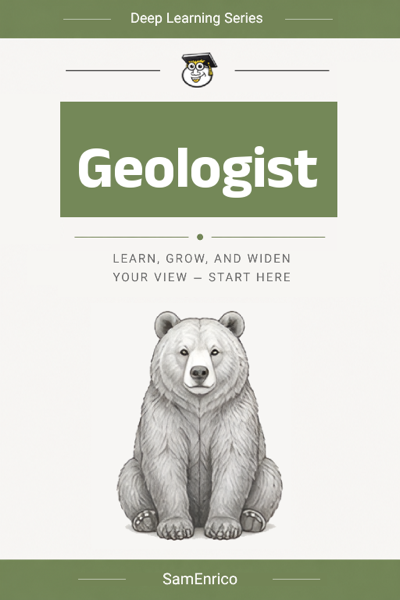
Non-FictionInformativeEducational
Geologist eBook
A Coursebook on Geologist
by Caron Glinda
A Coursebook on Geologist
Formats
Free sample
Chapter 1: The Accidental Time Traveler–- Every rock you have ever touched is older than the entire history of human civilization. The stone beneath your feet right now—whether it is concrete, tile, or actual bedrock—contains atoms that were forged inside a star that died billions of years before the Sun was born. The ground beneath your house has seen continents drift, ice ages come and go, mountains rise and erode to dust, and at least five mass extinctions. You are walking on a library of deep time. Most people never learn to read it.
This book will teach you how.Why Geology Secretly Runs Your Life Let us start with a simple question: what did you touch this morning? Your phone, presumably. That phone contains gold, copper, lithium, cobalt, and rare earth elements. All of those were mined from the Earth. The concrete building you woke up in—limestone and gypsum, both sedimentary rocks.
The glass in your window—silica sand, which is quartz grains. The fuel in your car or the electricity powering your lights—coal, natural gas, uranium, or solar panels made from silicon. Every single object in modern life begins with geology. The smartphone in your pocket is a rock that has been reorganized by human ingenuity. But we rarely think about that connection.
We live indoors, on paved surfaces, in climate-controlled boxes, and we have convinced ourselves that we have escaped nature. We have not. We are just better at ignoring it.Geology matters for three urgent reasons. First, resources. Everything we build, power, and eat comes from the Earth or depends on it.
Even agriculture relies on phosphate and potassium fertilizers—both mined from ancient marine deposits. Second, hazards. Earthquakes, volcanoes, tsunamis, landslides, and floods kill tens of thousands of people each year. The 2004 Indian Ocean tsunami killed 230,000 people in a single day. The 2010 Haiti earthquake killed 160,000.
These are not random acts of a vengeful planet. They are predictable outcomes of geological processes that we understand very well—and often ignore at our peril. Third, climate change. The planet has warmed before, but never this fast. The geology of the past tells us what happens when carbon dioxide levels spike: oceans acidify, sea levels rise, species go extinct.
We are running an uncontrolled experiment on the only habitable planet we will ever have. Geologists are the people who read the instruction manual—the rock record—and are trying to warn us what comes next.So this book is not an academic exercise. It is a field guide to the planet you actually live on, not the one you imagine. By the end of these chapters, you will never look at a road cut, a mountain, or even a grain of sand the same way again. You will see time.
You will see violence and patience. You will see stories.The Geologist's Way of Knowing Before we dive into the Earth itself, we need to understand how geologists think. The scientific method is simple in theory: observe, hypothesize, test, conclude. But geology faces a unique problem. A chemist can mix two chemicals in a flask and watch the reaction.
A physicist can drop a ball and measure gravity. A biologist can breed fruit flies and watch evolution unfold. A geologist cannot watch a mountain grow. A geologist cannot rewind time and watch the dinosaur-killing asteroid fall. A geologist cannot see a continent drift.
The time scales are too vast. The processes are too slow. The laboratory is the entire planet, and the experiment has been running for 4.6 billion years with no controls, no repeats, and no observer present for most of it.So geologists have developed a different way of knowing. We call it uniformitarianism. This is the idea that the geological processes we observe today—rivers depositing sediment, volcanoes erupting, earthquakes shaking the ground—have operated in the same way, at the same rates, throughout Earth's history.
The person who formalized this idea was a Scottish farmer-turned-scientist named James Hutton, who wrote in 1788: "The present is the key to the past." Hutton looked at a cliff face in Scotland called Siccar Point and saw something extraordinary. He saw layers of tilted rock below and horizontal layers above. The tilt meant the lower rocks had been deformed by ancient mountain-building. The flat layers above meant that after the mountains had eroded flat, new sediment had been deposited on top. The gap between them represented millions of years of missing time—an unconformity.
Hutton realized that the Earth was not six thousand years old, as the Bible chronology suggested. It was unimaginably ancient. He wrote that he could see "no vestige of a beginning, no prospect of an end."Uniformitarianism does not mean that all geological processes are slow. It means the physical laws are constant. A volcano in the past worked exactly the same way as a volcano today.
A river in the past deposited sediment exactly the same way as a river today. But the rates can vary enormously. Some processes are slow—continental drift moves at about the speed your fingernails grow, two to ten centimeters per year. Some processes are catastrophically fast—a landslide can move faster than a passenger jet. The geological record contains both.
The trick is learning to read the evidence left behind.This is where the geologist becomes a detective. You arrive at a rock outcrop. You see layers. You see fossils. You see faults cutting across layers.
You see pebbles embedded in other rocks. Each of these is a clue. By applying uniformitarianism—assuming that the laws of physics and chemistry have not changed—you reconstruct the sequence of events. This rock layer with ripple marks was once a riverbed. This fault that offsets the layers happened after the rock formed.
These fossils of marine shells mean this mountaintop was once under the ocean. Geologists call this deep time—the vast expanse of Earth's history, so far beyond human experience that we struggle to comprehend it. But we have tools to comprehend it, and we will spend an entire chapter on them later. For now, just hold this thought: every rock has a story. The geologist's job is to read it.What Lies Beneath: The Earth's Hidden Layers Now we need to know what we are standing on.
The Earth is not a solid ball of rock all the way through. It is structured like a peach: a thin skin, a thick fleshy middle, and a dense core. But the peach analogy only goes so far. Let us go deeper.The Earth has two ways of describing its layers. The first is compositional—what the layers are made of.
The second is mechanical—how the layers behave. You need both to understand the planet.Compositional Layers: Crust, Mantle, Core The crust is the outermost layer, and it is astonishingly thin. If the Earth were the size of an apple, the crust would be thinner than the apple's skin. The continental crust averages about 35 kilometers thick, ranging from 20 kilometers under some rift valleys to 70 kilometers under mountain ranges like the Himalayas. The oceanic crust is much thinner, only about 5 to 10 kilometers thick.
But the composition is different, too. Continental crust is felsic—rich in silicon and aluminum, with an average density of about…
This is the end of the free sample. Get the eBook to keep going. Buy now
About this book
Details
- Author
- Caron Glinda
- Publisher
- SamEnrico
- Language
- English
- Genre
- Non-Fiction, Informative, Educational
- Released
- 2026-06-02
- Pages (approx.)
- 153
- Available as
- eBook, Audiobook

Read better in the ZLOADR app
Your eBooks on your phone or tablet. Sign in with your SamEnrico account and start reading.
More by Caron Glinda
 Police De escalation NVCCaron Glinda$11.99
 The Accumulate Positives DBTCaron Glinda$11.99
 Submarine Silent ServiceCaron Glinda$11.99
 Gacy Lead ContaminationCaron Glinda$11.99
 Love Letters from the Trenches: The Playwright Who Defied WarCaron Glinda$11.99
 How to Start a Cleaning Service N.e.c. Business (Beginners Guide)Caron Glinda$11.99
 AI Code Review Checklist GenerationCaron Glinda$12.99
 Learn to Play the Alto FluteCaron Glinda$11.99
You may also like
 Hong Kong Handover 1997Dunn Johnnie$11.99
 Zumba For Postnatal Recovery CourseNeal Christian$11.99
 Zumba for BeginnersLadner Nikia$11.99
 YouTube Comment Mining GuideHumes Pandora$12.99
 Worry Box MeditationCarlin Rudy$11.99
 Workplace Stress MeditationNguyen Lynn$11.99
 Workplace Stress and Sleep RepairHawley Ivory$11.99
 Workplace Perfectionism CureDelaney Jeffry$11.99
 Workplace Injustice Anger GuideWallen Isabelle$11.99
 Work Addiction and Burnout LinkGreenwood Ester$11.99
 Women in Yoga and WellnessBeattie Galina$11.99
 Women in Stand Up ComedyChun Evangeline$11.99