
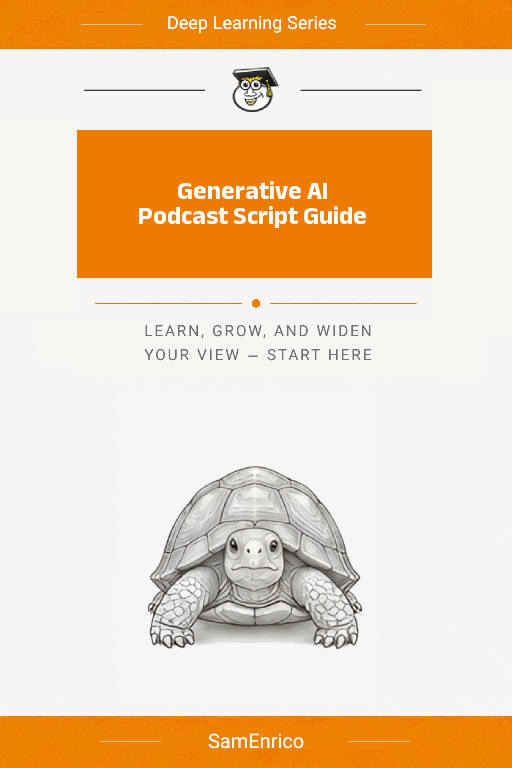
Non-FictionAI OperatorPodcasting
Generative AI Podcast Script Guide eBook
Write engaging podcast episodes, show notes, and p
Write engaging podcast episodes, show notes, and promotional clips using AI.
Formats
Free sample
Chapter 1: The Co-Pilot Manifesto--–- The first time you hear your own voice read back to you by a machine—intonation perfect, breath pauses precisely where you would place them, but faster, cleaner, almost too human—you will feel two things simultaneously: exhilaration and dread. The exhilaration comes from the raw power now sitting in your browser tab. The dread comes from the quieter question: If a machine can do this, what am I still needed for?Let me answer that question before we go any further. You are needed for everything that matters. The AI can arrange words, but it cannot bleed.
It can structure arguments, but it cannot feel the weight of a story you lived through at 3 AM. It can generate a hundred hooks in five seconds, but it cannot know which one will make your listener—the one driving home from a double shift, the one folding laundry while fighting back tears—feel seen. This book is not about replacing you. It is about stripping away everything that is not you.Welcome to the Co-Pilot Manifesto.If you are reading this, you are likely one of three people. First, the solo creator: you host, edit, promote, and answer every email.
You are exhausted, and the quality of your show has begun to slip not because you lack talent, but because you lack hours. Second, the aspiring podcaster: you have a voice, a message, and absolutely no idea how to turn a 4,000-word research document into something someone would actually want to listen to while washing dishes. Third, the professional producer: you manage a team, you know the old workflows, and you have watched three junior hires spend six hours writing show notes for a thirty-minute episode. You know something has to change, but you are terrified of sounding like a robot.All three of you are right to be here. And all three of you are wrong about one thing.
You think generative AI is a writer. It is not. Generative AI is a factory. A writer stares at a blank page and feels the terror of possibility. A factory takes raw materials—your research, your transcripts, your scrappy voice notes recorded on an i Phone—and stamps out consistent, high-quality components at scale.
The art is not in what the factory produces. The art is in what you choose to assemble, discard, or reshape. This book will teach you how to run that factory. But more importantly, it will teach you when to walk onto the factory floor and smash the machinery with a wrench because the human touch requires sabotage.The Lie of the “Raw Conversation” Era For the past decade, the dominant podcasting advice has been almost religious in its simplicity: Just be yourself. Hit record.
Don't overthink it. This advice worked beautifully in 2015, when the podcasting universe was small enough that a moderately interesting person with a USB microphone could rise to the top of the charts through sheer novelty. In 2026, that world is gone.Data from major listening platforms shows that audience retention has changed dramatically. In 2018, the average listener would give a new episode seven to ten minutes before deciding to stay or leave. Today, that window has collapsed to ninety seconds.
Worse, the “unstructured banter” format—two friends talking over each other, laughing at inside jokes, spending the first eight minutes discussing their coffee orders—now sees retention drop by over fifty percent within the first two minutes. Listeners are not more impatient. They are more sophisticated. They have infinite choices. They have learned to recognize the difference between authentic looseness and lazy drift.The winners in today’s podcast landscape have discovered a counterintuitive truth: structure liberates spontaneity.
A tightly scripted or carefully outlined episode paradoxically creates more room for genuine human moments because you are not burning cognitive energy trying to remember what you wanted to say next. When you know the skeleton of your episode cold, you can afford to go off-script for thirty seconds because you know exactly how to return. The “script-hybrid show”—part prepared, part improvised, with AI handling the heavy lifting of research, structure, and transcription—is not less authentic. It is more authentic, because the human energy is spent on connection, not logistics.This book will not force you to become a fully scripted podcaster. As we will establish in this chapter, you have a choice.
You can operate at Level 1 (Fully Scripted), Level 2 (Detailed Outline), or Level 3 (Bullet-Point Improv). The right level depends on your genre, your personality, and your risk tolerance. But the wrong level is no level at all. If you are currently hitting record with nothing but a vague topic and hope, you are not creating authentic content. You are gambling with your listener's time.
And the house always wins.The Three Pillars of the AI-Augmented Podcaster Before we dive into tools, ethics, or prompts, you need to understand the architecture of this book. Every technique, every workflow, and every case study in the following chapters rests on three foundational pillars. Think of these not as features but as capabilities. You do not need to master all three on day one. But you need to know which pillar solves which problem.Pillar One: Generation.
This is what most people think of when they imagine AI and podcasting. Generation means using large language models (LLMs) like Chat GPT, Claude, or Gemini to write script segments—cold opens, transitions, interview questions, ad reads, and conclusions. But generation is not about asking the AI to “write a podcast script” and publishing the result. That would be professional suicide. Generation is about iterative drafting.
You ask the AI for ten versions of a cold open. You pick the two that spark something. You combine them. You rewrite the third sentence because it sounds like a marketing brochure. You add an inside joke that only your regular listeners will catch.
The AI provides the clay. You provide the kiln.Pillar Two: Transcription. This pillar is profoundly undervalued by new podcasters. Transcription is not merely about converting audio to text for captions. That is the smallest use case.
Transcription is about repurposing. A one-hour episode contains enough material for: a full blog post (2,000 words), a newsletter (500 words), five social media captions, ten quote cards, three short-form video scripts, a Linked In article, and a Reddit summary. Without transcription, all of that material dies in the audio file. With AI-powered transcription and summarization, you can produce all of those assets in less than an hour. Transcription is how you turn one hour of work into a week of content.Pillar Three: Voice.
This is the most controversial pillar and the one we will handle with the most care. Voice AI includes text-to-speech synthesis (generating a human-like voice from a script), voice cloning (training a model on your own voice to produce new audio that sounds like you), and voice modification (cleaning up a flubbed line in post-production). The ethical guardrails here are non-negotiable. You will never clone someone else’s voice without written permission. You will always disclose when a voice is AI-generated if it might deceive a reasonable listener.
But within those boundaries, voice AI is a superpower. It allows you to fix a mispronounced word without re-recording an…
This is the end of the free sample. Get the eBook to keep going. Buy now
About this book
Details
- Author
- Benson Francisco
- Publisher
- SamEnrico
- Language
- English
- Genre
- Non-Fiction, AI Operator, Podcasting
- Released
- 2026-06-01
- Pages (approx.)
- 136
- Available as
- eBook, Audiobook

Read better in the ZLOADR app
Your eBooks on your phone or tablet. Sign in with your SamEnrico account and start reading.
More by Benson Francisco
 Non Alcoholic Drink Substitution GuideBenson Francisco$11.99
 House of Wisdom DestructionBenson Francisco$11.99
 Tom Hanks EverymanBenson Francisco$11.99
 Financial Stress MeditationBenson Francisco$11.99
 The Working Memory for DyslexiaBenson Francisco$11.99
 Spouse Loss and Children GuideBenson Francisco$11.99
 Asana Status Update AutomationBenson Francisco$11.99
 Job Loss JournalBenson Francisco$11.99
 The Dreadful Gaze of Medusa: A Sociological Study of Fear and PowerBenson Francisco$11.99
 The Dragon and the Dream: How Taiwan's Hsinchuang High School Defied the Odds in the 1990sBenson Francisco$11.99
 Growing BiarumBenson Francisco$11.99
 A Collector's Handbook to the Rockne -1933Benson Francisco$11.99
You may also like
 Hong Kong Handover 1997Dunn Johnnie$11.99
 Zumba For Postnatal Recovery CourseNeal Christian$11.99
 Zumba for BeginnersLadner Nikia$11.99
 YouTube Comment Mining GuideHumes Pandora$12.99
 Worry Box MeditationCarlin Rudy$11.99
 Workplace Stress MeditationNguyen Lynn$11.99
 Workplace Stress and Sleep RepairHawley Ivory$11.99
 Workplace Perfectionism CureDelaney Jeffry$11.99
 Workplace Injustice Anger GuideWallen Isabelle$11.99
 Work Addiction and Burnout LinkGreenwood Ester$11.99
 Women in Yoga and WellnessBeattie Galina$11.99
 Women in Stand Up ComedyChun Evangeline$11.99