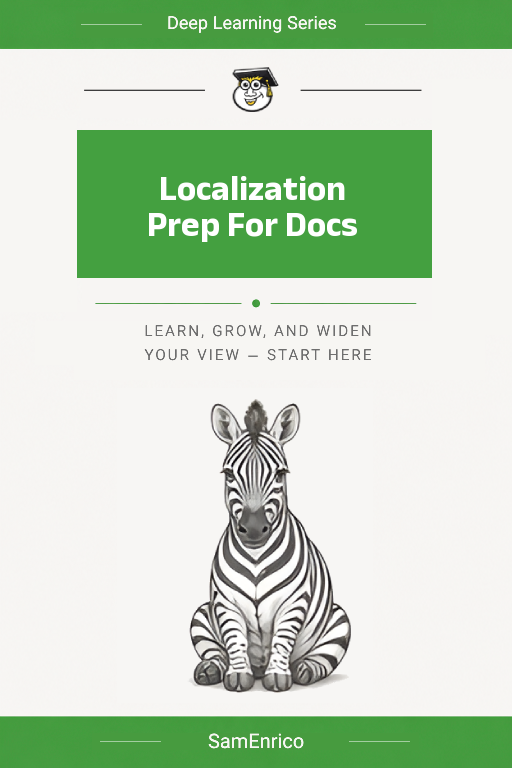
Generative AI Localization Guide eBook
Translate and adapt marketing content for multiple
Translate and adapt marketing content for multiple regions using AI tools.
Formats
Free sample
Chapter 1: The Multiplication Problem--–- In 2021, a rising direct-to-consumer footwear brand called Allbirds faced a dilemma that thousands of companies confront every year. They had built a loyal following in the United States with their messaging around sustainable materials, comfort, and understated design. Their tagline, “Better things in a better way,” resonated with eco-conscious American consumers. When they decided to expand into South Korea, they did what most companies do. They hired a translation agency.
They converted their website copy, product descriptions, and marketing emails from English to Korean. They launched with great fanfare. And then nothing happened.Sales were abysmal. Not just disappointing—catastrophically low. The brand team flew to Seoul to understand what went wrong.
What they discovered was a masterclass in the difference between translation and localization. In the United States, “sustainable materials” implies environmental responsibility. In South Korea, the same phrase, translated literally, sounded cheap and low-quality, as if the shoes were made from recycled trash. The word “comfort” in English suggests luxury and ease. In Korean, the direct translation implied laziness and lack of ambition.
The brand’s minimalist aesthetic, which Americans interpreted as sophisticated, was read by Korean consumers as boring and generic.Allbirds had not failed at translation. Their Korean website was grammatically perfect. They had failed at localization. They had assumed that words could be swapped like interchangeable parts, that meaning survived the journey from one language to another intact. It does not.
Meaning dies in translation unless it is resurrected through adaptation.This story is not unique. It is not even unusual. It is the rule, not the exception. And it points to a fundamental truth that most global marketers do not want to admit: the traditional model of localization is mathematically, operationally, and creatively broken. The scale of modern marketing has outpaced the capacity of human-only workflows.
The speed of social media has made traditional agency timelines obsolete. And the sophistication of today’s global consumer has rendered literal translation not just inadequate but actively dangerous.The problem is not that localization professionals are incompetent. It is that they are being asked to solve a multiplication problem with addition tools. And until you understand the shape of that problem, you will keep throwing money at solutions that cannot possibly work.The Mathematics of Modern Marketing Let me show you the math. I want you to feel the weight of it, because until you do, you will not understand why generative AI is not a luxury but a necessity.Assume you are the global marketing director for a mid-sized beauty brand.
You operate in fifteen countries. You launch twelve campaigns per year—monthly promotions, seasonal pushes, and a few tentpole events. For each campaign, you produce the following assets: one 60-second hero video, three 15-second social cuts, six static images, one email sequence of five messages, one landing page, and a set of five in-app notifications. That is twenty-one distinct content pieces per campaign.Multiply that by twelve campaigns. That is 252 assets per year.Now multiply that by fifteen markets.
That is 3,780 assets per year.But we are not done. Each of those assets must be adapted for multiple formats. The hero video must be cropped for Tik Tok (vertical, 9:16), Instagram Reels (vertical, slightly different dimensions), You Tube (horizontal, 16:9), and often Linked In (square, 1:1). The static images must be produced in three aspect ratios each. The email sequence must be tested for rendering on mobile, desktop, and dark mode.
So multiply by an average of three format variations per asset.You are now at 11,340 unique localized assets per year.This is not a hypothetical extreme. This is a conservative estimate for a brand of moderate size. Larger brands with more markets, more campaigns, and more content formats can easily exceed 50,000 localized assets annually.Now consider the cost. A skilled human translator can process roughly 2,500 words per day at a cost of 0.10to0.10 to 0.10to0.30 per word, depending on language pair and specialization. But translation is only one part of localization.
You also need transcreation for marketing copy, adaptation for visuals, re-recording for voiceover, testing for cultural appropriateness, and project management to coordinate it all. A full-service localization agency might charge 10,000to10,000 to 10,000to50,000 per campaign for a single market, depending on complexity.Do the math on 3,780 assets across fifteen markets. Even at the lowest end of the spectrum, you are looking at millions of dollars per year in localization costs. And that assumes you have the time. A traditional agency might take four to six weeks to localize a single campaign.
By the time you launch in your fifteenth market, the cultural moment you were trying to capture has long since passed.The Speed Problem The math problem is bad. The speed problem is worse.Marketing today operates in real time. A trend emerges on Tik Tok at 8:00 AM. By 2:00 PM, the first brands have already posted responses. By 8:00 PM, the trend is dead.
The window for relevance is measured in hours, not weeks.Traditional localization cannot function at this speed. The workflows are linear. The handoffs are slow. The approval chains are long. By the time a traditional agency delivers a localized version of a trend-driven campaign, the trend is already a nostalgic memory, and the brand looks not clever but desperate.I once consulted for a global beverage company that wanted to localize a Super Bowl ad for twelve markets.
The ad referenced American football—specifically, a controversial refereeing decision from the previous season. The company’s localization agency requested six weeks to adapt the ad. The problem? The Super Bowl happened in two weeks. The brand ended up publishing the ad as-is in all markets, with a note that said “This ad refers to an American sporting event.” The result was confusion in every market outside the United States.
Consumers in Brazil, Germany, and Japan had no idea what they were watching. The ad performed poorly. The brand wasted millions.This is the speed problem in action. Even when you have the budget, you do not have the time. And generative AI is the only tool that can bridge the gap.
An AI-powered localization workflow can adapt a video ad for twelve markets in hours, not weeks. It can transcreate a tagline for fifty languages in minutes. It can resize, re-voice, and re-render content at a pace that matches modern marketing velocity.The Creativity Problem There is a third problem, more subtle than the first two but equally damaging. I call it the creativity problem.Traditional localization treats content as something to be translated, not reimagined. But great marketing is not a collection of words to be swapped.
It is an emotional experience to be recreated. The same joke that lands in London may fall flat in Lagos. The same image that evokes nostalgia in New York may evoke nothing in Nairobi. The same offer that drives urgency in Berlin may trigger skepticism in Buenos Aires.Creativity does not travel. It must be reborn in each market.Consider the example of a global hotel chain that ran a campaign with the tagline “Open doors, open minds.” In English, the phrase is a simple play on words, suggesting both literal hospitality…
This is the end of the free sample. Get the eBook to keep going. Buy now
About this book
Details
- Author
- Dodge Lieselotte
- Publisher
- SamEnrico
- Language
- English
- Genre
- Non-Fiction, AI Operator, Localization
- Released
- 2026-06-01
- Pages (approx.)
- 138
- Available as
- eBook, Audiobook

Read better in the ZLOADR app
Your eBooks on your phone or tablet. Sign in with your SamEnrico account and start reading.
More by Dodge Lieselotte
 Negotiation Ethics GuideDodge Lieselotte$11.99
 Outdoor HIIT Trail GuideDodge Lieselotte$11.99
 Alcohol Withdrawal Safety PrimerDodge Lieselotte$11.99
 Trello Voting Power UpDodge Lieselotte$11.99
 Health Legacy GuideDodge Lieselotte$11.99
 Social Media Parenting ComparisonDodge Lieselotte$11.99
 Divorce and TherapyDodge Lieselotte$11.99
 Whispers of the Thunderbird: The Sky Chief's TrialDodge Lieselotte$11.99
 Charlemagne's Golden Brew: The Ale of a RenaissanceDodge Lieselotte$11.99
 Growing BeallaraDodge Lieselotte$11.99
 How to Produce Leather Production Machinery PartsDodge Lieselotte$11.99
 How to Become a Protective-signal-installer HelperDodge Lieselotte$11.99