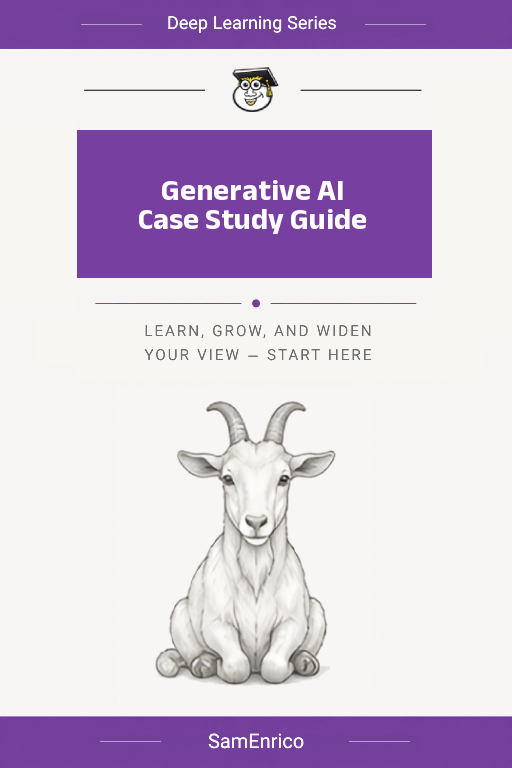
Generative AI Case Study Guide eBook
Turn customer interviews into compelling case stud
by Riggs Lahoma
Turn customer interviews into compelling case studies using AI drafting assistance.
Formats
Free sample
Chapter 1: The Invisible Case Study--–- The first time I realized that case studies had become invisible, I was sitting in a sales meeting that should have been a celebration. My team had just closed a $340,000 deal with a mid-market fintech company. The customer explicitly mentioned they had read our case study about a similar financial services client. They said it was “compelling.” They said it “made the decision easy.” The sales rep was thrilled. I was the head of marketing, and I felt vindicated.
The case study had worked. We celebrated. We high-fived. We posted about it on Linked In.Three months later, we lost a different deal. Same industry.
Same buyer persona. But this time, the prospect didn’t mention our case study. When we debriefed, the sales rep said, “They asked their AI assistant to compare us against two competitors, and we didn’t come up.” I asked what that meant. The rep explained: the prospect had opened Chat GPT and typed, “Which B2B compliance platform has the fastest implementation time for a 50-person fintech team?” Our competitor’s name appeared. Ours did not.
Our beautiful, meticulously crafted, customer-approved case study—the one that had helped us win that $340,000 deal—was nowhere in the answer. It existed. It was on our website. It was linked in our sales emails. But to the AI that the buyer trusted, it might as well have been a blank page.That was the moment I stopped thinking of case studies as documents and started thinking of them as data.Welcome to the first chapter of The Proof Engineer.
Everything you know about writing case studies is about to become incomplete. Not wrong, but incomplete. You will still need great stories, authentic quotes, and persuasive structure. But those things are no longer sufficient. Because the person reading your case study might not be a person at all.
Or rather, the person might be reading it only after an AI has decided whether to show it to them.This book is not about abandoning storytelling. It is about making sure your story can be found, retrieved, cited, and trusted by the new majority of buyers who start their research with an AI answer engine. If you are a marketer, customer success manager, founder, or sales professional who relies on customer proof to close deals, you are about to learn a completely new way of working. Not harder. Smarter.
And faster.Let me show you why your current case studies are failing, what “invisible” really means, and how a single shift in perspective will change everything you publish from this day forward.The PDF That Nobody Reads Let us start with a blunt truth. Most case studies are not read. They are skimmed at best. According to a 2023 study by the Content Marketing Institute, the average B2B buyer spends less than three minutes on a case study page. Three minutes.
That is barely enough time to read the headline, scan the pull quotes, and glance at the metrics. But even that statistic misses the larger problem. Three minutes assumes the buyer found the case study in the first place. Increasingly, they are not finding it at all because they are not searching the way you think they are.Traditional search engine optimization treats case studies as web pages. You optimize for keywords like “fintech compliance case study” or “Saa S implementation ROI.” That still works, but it is fighting for a shrinking slice of attention.
The real shift is happening in what analysts call “answer engines” or “AI search.” Chat GPT, Perplexity, Bing Chat, Gemini, and the growing list of AI-powered assistants do not return a list of blue links. They return a single answer. One answer. Sometimes a paragraph. Sometimes a bulleted list.
And that answer is synthesized from across the entire open web or a company’s internal knowledge base.Here is what that means for your case study. When a buyer asks an AI, “Which project management tool has the highest user adoption rate among remote engineering teams?” the AI does not show ten case studies. It shows one answer. Maybe it cites three sources. Maybe it names your competitor.
Maybe it names you. The only way your case study gets cited is if it is structured in a way that the AI can read, understand, and retrieve as factual evidence. A PDF of a beautifully designed one-pager is useless to an AI. A long-form blog post with no clear data markers is nearly useless. A case study that is optimized for human skimming but not machine parsing is effectively invisible.I have seen this play out across dozens of B2B Saa S companies.
The ones that adapted early—reformatting their case studies for what we will call “dual-purpose readability”—saw a dramatic increase in what I call “zero-click conversions.” That is when a buyer makes a decision without ever visiting your website, because the AI already gave them the answer. Your case study became the citation. The buyer trusted the AI. The deal started in your favor before you even knew the buyer existed.The $10 Million Misunderstanding To understand why case studies are failing, you need to understand how large language models actually retrieve information. I will keep this non-technical because you do not need to be an engineer to apply the principles.
But you do need to understand the metaphor.Imagine your case study is a book in a massive library. In the old world, a buyer walked into the library and asked the librarian, “Do you have any books about cloud cost reduction?” The librarian walked to a shelf, looked at the titles, and handed the buyer a few books. That is Google. Titles and keywords mattered. The librarian could see the cover.In the new world, the buyer walks in and says, “Tell me which book has the most specific data about reducing AWS costs by more than 30 percent without refactoring code.” The librarian does not walk to the shelf.
Instead, the librarian has a superpower: they can instantly read the contents of every book at the same time. But here is the catch. They only read the first few sentences of each chapter. They look for headings. They scan for numbers.
They ignore long paragraphs that are full of fluff. If your case study has a chapter called “The Challenge,” the librarian sees two words and moves on. If your case study has a heading that says “How a Fintech Company Cut AWS Costs by 42% in 11 Days,” the librarian stops, reads that sentence, and pulls that book.This is not a perfect metaphor, but it captures the core mechanism. Large language models do not read your case study the way a human does. They “chunk” text into segments—usually a few hundred tokens at a time—and they prioritize structured information.
Bullet points. Numbered lists. Tables. Clear headings that sound like questions or answers. JSON or markdown formatting.
The more you give them this structure, the more likely they are to retrieve your case study when a buyer asks a relevant question.I have consulted with a B2B Saa S company that sells sales…
This is the end of the free sample. Get the eBook to keep going. Buy now
About this book
Details
- Author
- Riggs Lahoma
- Publisher
- SamEnrico
- Language
- English
- Genre
- Non-Fiction, AI Operator, Case Studies
- Released
- 2026-06-01
- Pages (approx.)
- 149
- Available as
- eBook, Audiobook

Read better in the ZLOADR app
Your eBooks on your phone or tablet. Sign in with your SamEnrico account and start reading.
More by Riggs Lahoma
 Emotional Sobriety Training ManualRiggs Lahoma$11.99
 Negotiation Communication ScriptsRiggs Lahoma$11.99
 The Story Method MemoryRiggs Lahoma$11.99
 The Shame Prism ModelRiggs Lahoma$11.99
 Social Media Home ComparisonRiggs Lahoma$11.99
 Legacy Through CommunityRiggs Lahoma$11.99
 Hotel Room HIIT GuideRiggs Lahoma$11.99
 Divorce and NatureRiggs Lahoma$11.99
 The Shadow of the Golden Triangle: Mexico's First Narco-WarlordRiggs Lahoma$11.99
 The Harp of Ishtar: Divine Melodies of the Mesopotamian GoddessRiggs Lahoma$11.99
 Co Founder Online Communities ListRiggs Lahoma$12.99
 A Collector's Handbook to the Riley 2½-litre RmcRiggs Lahoma$11.99