
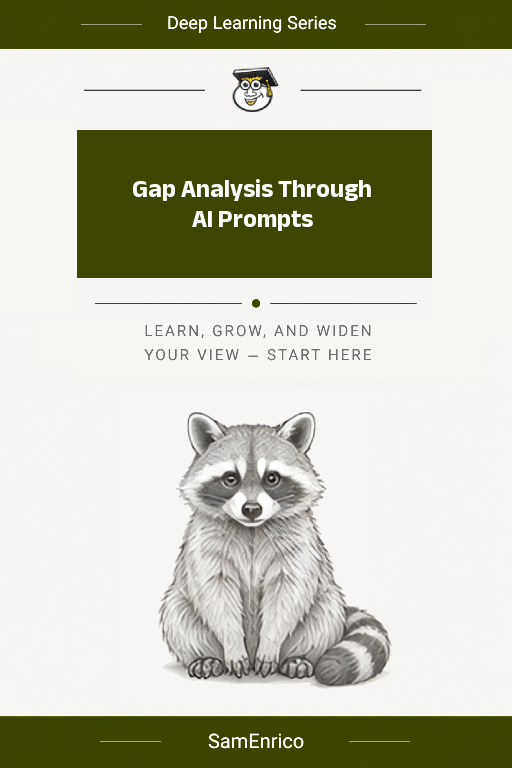
Non-FictionAI OperatorGap Analysis
Gap Analysis Through AI Prompts
Identify discrepancies between current and future
by Worden Mai
Identify discrepancies between current and future states by prompting AI to compare requirement documents.
Formats
About this book
Free sample
Chapter 1: The $2 Trillion Lie--–- The memo arrived at 4:47 PM on a Friday. Three paragraphs, twelve bullet points, and a single pie chart that took six weeks to produce. The conclusion: the $40 million ERP migration was “on track.” Three months later, the same project was dead. Not paused. Not rescoped.
Dead. And the one sentence that could have saved it—buried on page 47 of a requirements document from 2019—had never been compared to anything at all.The Anatomy of a Failure That Could Have Been Avoided Let me tell you about the project that broke me.It was 2019. I was a senior business analyst at a mid-sized manufacturing company that had just been acquired by a private equity firm. The new owners wanted “efficiency.” That meant replacing three legacy systems—one from the 1990s that ran on a server someone had literally found under a desk—with a shiny new cloud ERP platform.The budget: $40 million.The timeline: 18 months.The team: 12 smart, hardworking people who believed in spreadsheets.We did everything “right.” We held workshops. We interviewed stakeholders.
We created a requirements traceability matrix that was 147 pages long. We had a gap analysis spreadsheet with color-coded rows: green for “aligned,” yellow for “partial gap,” red for “full gap.” It was beautiful. It was meticulous. It was also completely, catastrophically wrong.Here’s what we missed.Page 47 of the legacy system requirements document—a document so old that the original author had left the company six years earlier—contained this sentence: “The legacy system automatically recalculates sales tax based on the ship-to address, not the bill-to address, for all interstate transactions.”The new ERP system, which we had selected after a seven-month evaluation, calculated tax based on the bill-to address. It was a standard feature.
It worked for 95% of the company’s transactions. But not for the 5% that crossed state lines.No one compared that sentence to anything. Why would they? The legacy document was 247 pages. The RFP was 189 pages.
The vendor responses added another 400 pages. No human being—no matter how diligent—could manually compare every requirement from the old system…
This is the end of the free sample. Get the eBook to keep going. Buy now
Contents
- Chapter 1
- Chapter 2
- Chapter 3
- Chapter 4
- Chapter 5
- Chapter 6
- Chapter 7
- Chapter 8
- Chapter 9
- Chapter 10
- Chapter 11
- Chapter 12
Details
- Author
- Worden Mai
- Publisher
- SamEnrico
- Language
- English
- Genre
- Non-Fiction, AI Operator, Gap Analysis
- Released
- 2026-05-30
- Pages (approx.)
- 156
- Available as
- eBook, Audiobook

Read better in the ZLOADR app
Your eBooks on your phone or tablet. Sign in with your SamEnrico account and start reading.
More by Worden Mai
 Workplace Burnout Prevention HandbookWorden Mai$11.99
 Night Terrors in Children GuideWorden Mai$11.99
 Disability Body Pride ManualWorden Mai$11.99
 Seasonal Hair Shedding GuideWorden Mai$11.99
 The Senior Technology Confidence GuideWorden Mai$11.99
 The Copernican Gambit: A Revolution in the ShadowsWorden Mai$11.99
 Speech Recognition ScientistWorden Mai$11.99
 Understanding Mental Retardation Unusual Facies Ampola TypeWorden Mai$17.99
 EU CSRD Directive GuideWorden Mai$12.99
 Ultimate Handbook Guide to Xianning : (China) Travel GuideWorden Mai$11.99
You may also like
 Hong Kong Handover 1997Dunn Johnnie$11.99
 Zumba For Postnatal Recovery CourseNeal Christian$11.99
 Zumba for BeginnersLadner Nikia$11.99
 YouTube Comment Mining GuideHumes Pandora$12.99
 Worry Box MeditationCarlin Rudy$11.99
 Workplace Stress MeditationNguyen Lynn$11.99
 Workplace Stress and Sleep RepairHawley Ivory$11.99
 Workplace Perfectionism CureDelaney Jeffry$11.99
 Workplace Injustice Anger GuideWallen Isabelle$11.99
 Work Addiction and Burnout LinkGreenwood Ester$11.99
 Women in Yoga and WellnessBeattie Galina$11.99
 Women in Stand Up ComedyChun Evangeline$11.99