
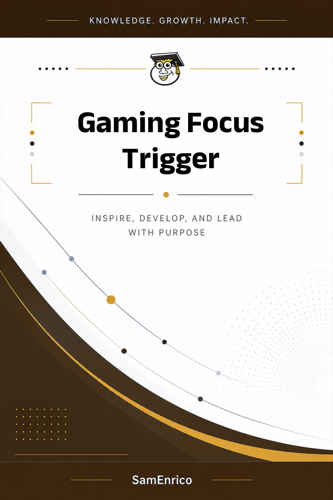
Gaming Focus Trigger eBook
Install deep concentration for esports and competi
Install deep concentration for esports and competitive gaming.
Formats
Free sample
Chapter 1: The Myth of Natural--If you have ever caught yourself staring at a professional esports player’s screen—watching their crosshair snap from one enemy to another, their map awareness flickering like a security camera, their fingers dancing across keys with what looks like effortless precision—and thought, “I could never do that,” you have already lost a battle you never needed to fight.That thought—I could never do that—is not humility. It is a lie. And it is the single most damaging belief in competitive gaming.The lie sounds like common sense. It whispers that great players are born great. That focus is a gift, not a skill.
That some people have “the clutch gene” and others do not. That after thousands of hours of grinding, you have hit your natural ceiling, and no amount of practice will push you higher.Every word of that is wrong.This chapter exists to burn that lie to the ground. By the time you finish reading, you will understand why “trying harder” has been failing you, why raw hours played is a terrible metric for improvement, and—most importantly—why your brain is not a fixed machine but a trainable weapon. The science of focus has advanced more in the last decade than in the previous fifty years, and almost none of it has made its way into the hands of ordinary competitive gamers. That ends now.The Natural Fallacy: Where the Lie Comes From The belief in “natural talent” is ancient and sticky.
For most of human history, it was reasonable. A person born with a larger frame was naturally better at farming or fighting. A person born with perfect pitch did have an innate advantage in music. But competitive gaming is not farming or classical music. It is a novel, rapidly evolving, cognitively complex activity that no human brain evolved specifically to do well.Here is what the research actually says.
In his landmark study of expertise, psychologist Anders Ericsson (the scientist behind the “10,000-hour rule”) found that what separates elite performers from competent ones is not innate ability but deliberate practice—structured, goal-directed, feedback-rich training. When Ericsson studied violinists at Berlin’s Academy of Music, the best players had not practiced more hours than the good players. They had practiced differently. They spent more time on their weakest skills, with full concentration, and immediately corrected errors. The good players just played.Esports researchers have replicated this finding across multiple games.
A 2020 study of League of Legends players found that rank was not predicted by total hours played. It was predicted by hours spent in focused, error-correcting practice. Players who mindlessly queued for ranked matches improved slowly or not at all. Players who reviewed their replays, isolated specific mechanical weaknesses, and drilled those weaknesses with full attention climbed rapidly.The word “natural” is often a mask for invisible practice. When you watch a pro player clutch a 1v3, you do not see the hundreds of hours they spent in custom games practicing that exact angle, that exact peek, that exact spray pattern.
You see the result and call it talent. But talent is just skill whose training you did not witness.Why “Trying Harder” Makes You Worse If natural talent is a myth, then the solution must be simple: try harder, right? Wrong. Trying harder is often counterproductive, and understanding why requires a quick tour of Cognitive Load Theory.Cognitive load is the total amount of mental effort being used in your working memory at any given moment. Your working memory is small—shockingly small.
The classic research puts its capacity at about four “chunks” of information at once. Four. That is it. You can hold your health bar, your ability cooldowns, the minimap position of one enemy, and your crosshair placement in your head at the same time. Add a fifth thing—say, your teammate shouting in voice chat—and something gets dropped.When you “try harder,” you are not expanding your working memory.
You are pouring more mental energy into the same small container. That energy does not create more space. It creates heat. Specifically, it creates anxiety, muscle tension, and over-monitoring of your own actions. The result is slower reaction times, narrower attention, and more mistakes.Here is a concrete example.
Imagine you are in a Valorant match, last alive, 1v2. Your heart is pounding. You tell yourself, “Focus. Focus. Do not mess this up.” That internal voice is itself a cognitive load.
It consumes working memory that could otherwise be used to track footsteps, predict enemy rotations, or line up your crosshair. You are not helping yourself. You are adding an extra task to an already overloaded system.The pro player in the same situation is not “trying harder.” They are trying less—or rather, they have automated so many core skills that their working memory is nearly empty, free to process only the highest-priority information. They are not thinking about how to aim. They are not thinking about which key to press for their ability.
Those actions have been moved from conscious control to automaticity through thousands of repetitions of deliberate practice. Their brain is in a state of reduced cognitive load, which is the true neurological definition of focus.The implication is radical but simple: You do not improve focus by squeezing your brain tighter. You improve focus by automating the basics, so your brain has nothing to do but see and react.The Three Attentional Muscles You Did Not Know You Had Not all focus problems are the same. A player who dies because they lost track of time during a 40-minute match has a different weakness than a player who dies because they cannot stop reading enemy team chat. To train your focus effectively, you must first diagnose which of your three attentional systems is failing.Sustained Attention is the ability to maintain consistent focus over long periods.
It is what keeps you locked in during a 40-minute League of Legends match, a best-of-three tournament set, or a marathon ranked session. Sustained attention falters when the task becomes monotonous (e.g., farming minions for ten minutes) or when fatigue accumulates. The classic sign of weak sustained attention is “mind wandering”—suddenly realizing you have no idea what happened in the last thirty seconds of the game.Selective Attention is the ability to filter relevant stimuli from irrelevant noise. It is what allows you to hear enemy footsteps through a chaotic teamfight, ignore the flashing HUD elements that do not matter, and tune out the spectator chatter on your friend’s stream. The classic sign of weak selective attention is distraction by irrelevant information—freezing when an ally pings danger, glancing at the scoreboard at the wrong moment, or getting tilted by a “?” ping from a teammate.Alternating Attention is the ability to shift focus between different tasks efficiently.
It is what allows you to check the minimap, then your crosshair, then your ability cooldowns, then back to the minimap—all in the span of a single second. The classic sign of weak alternating attention is the “switch cost” stutter: the millisecond delay when you move your eyes from one information source…
This is the end of the free sample. Get the eBook to keep going. Buy now
About this book
Details
- Author
- Dewitt Hilton
- Publisher
- SamEnrico
- Language
- English
- Genre
- Non-Fiction, Self-Help, Gaming
- Released
- 2026-06-09
- Pages (approx.)
- 129
- Available as
- eBook, Audiobook

Read better in the ZLOADR app
Your eBooks on your phone or tablet. Sign in with your SamEnrico account and start reading.
More by Dewitt Hilton
 Meal Prep for Weight LossDewitt Hilton$11.99
 Parental Stress And Empty NestDewitt Hilton$11.99
 The Interruption JournalDewitt Hilton$11.99
 Pet Loss Music TherapyDewitt Hilton$11.99
 Dinacharya RoutineDewitt Hilton$11.99
 Cloud Security IncidentsDewitt Hilton$11.99
 The Ink and the Heart: María Elena Walsh and Her Fractured Fairy TalesDewitt Hilton$11.99
 The Vanishing of the Cairo Courtesans: Egypt's Shadow of the 1880sDewitt Hilton$11.99
 How to Produce Roof TileDewitt Hilton$11.99
 A Collector's Handbook to the Alvis Tf21Dewitt Hilton$11.99
 Foreign Franchise Lease Guarantee RequirementsDewitt Hilton$12.99
 Pinterest VA Instagram Cross PromotionDewitt Hilton$12.99
You may also like
 Loneliness And Gaming CommunitiesSampson Lachelle$11.99
 Teen Gaming Identity BalanceGetz Monte$11.99
 Pattern Recognition for GamesPoe Brook$11.99
 Gaming Anger TriggersBellamy Nathalie$11.99
 Gamer Distraction Management GuideCummings Heather$11.99
 Teen Self Esteem and GamingTackett Lien$11.99
 Lonely Gamer ConnectionByars Alisha$11.99
 Flow and GamingBrunner Larry$11.99
 Gaming Emotional RegulationBaum Treasa$11.99
 Casino Dealer Stress ManagementLanham Junie$11.99
 Self Talk for Gaming AddictionMcgill Dorsey$11.99
 Self Esteem For GamersJustice Concepcion$11.99