
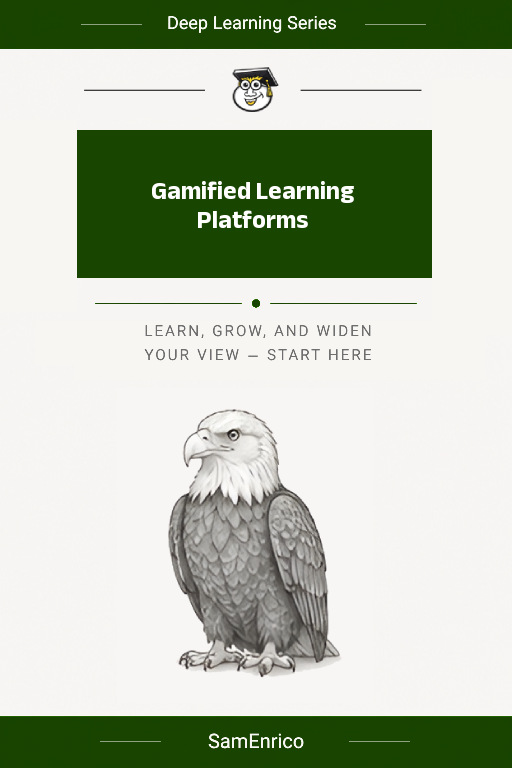
Non-FictionForecast & OutlookGamification
Gamified Learning Platforms eBook
Discover educational games, point systems, and lea
Discover educational games, point systems, and leaderboards boosting engagement and retention.
Formats
Free sample
Chapter 1: The Dopamine Deception--–- It was 3:47 on a Tuesday afternoon, and Sarah had just completed her forty-seventh vocabulary quiz of the month. Not because she needed to learn the words—she had mastered them two weeks ago—but because each correct answer triggered a satisfying chime, a burst of animated confetti, and the slow, deliberate filling of a purple progress bar. Her screen flashed: “LEVEL UP! You have earned the ‘Word Wizard’ badge.” Sarah smiled, then immediately felt hollow. She had spent fourteen hours on this platform, accumulated 12,450 points, and unlocked thirty-one badges.
She could not remember a single definition from the first week.This scene repeats across millions of classrooms and corporate training rooms every day. Learners grind through gamified platforms with the enthusiasm of casino patrons pulling slot machine levers, convinced that the points and badges signify genuine progress. They are not entirely wrong—engagement metrics soar, login frequency breaks records, and completion rates look impressive on quarterly reports. But something vital is missing. The purple progress bar filled, but the learner’s brain did not.
This is the dopamine deception: the seductive belief that measuring engagement is the same as ensuring learning.The neuroscience of gamification is both more promising and more dangerous than most designers realize. Your learner’s brain is not a simple reward-seeking organ, despite what the pop-science articles claim. It is a complex prediction engine, constantly calculating expected value, weighing effort against potential payoff, and recalibrating its internal models of reality based on every click, chime, and flashing badge. Understanding this machinery—and learning to work with it rather than exploit it—is the difference between building a platform that transforms competence and building an elaborate skinner box that produces nothing but hollow clicks and forgotten facts.The Architecture of Anticipation Before we can design effective gamified learning, we must dismantle a widespread misconception: that dopamine is the “pleasure chemical.” This error has led to thousands of failed gamification projects. Dopamine is not primarily about pleasure at all.
It is about anticipation. The neuroscientist Wolfram Schultz demonstrated this definitively in a series of elegant experiments with monkeys. When a monkey received a drop of juice, dopamine neurons fired briefly. But when a light appeared before the juice, the dopamine firing shifted—it occurred at the light, not the juice. The monkey’s brain had learned to anticipate reward, and that anticipation, not the reward itself, generated the strongest dopamine signal.This distinction changes everything about gamified learning design.
When a learner sees a progress bar approaching 100 percent, when they hear the distinctive chime of a correct answer, when they check a leaderboard and see they are one point away from overtaking a rival—that moment of almost generates more motivational fuel than the reward itself. The most successful gamified platforms are not those that deliver constant rewards but those that orchestrate exquisite anticipation.Consider the difference between a slot machine and a chess match. Both generate dopamine, but through radically different mechanisms. The slot machine uses variable rewards—unpredictable payoffs that hijack the brain’s error-prediction circuitry. Each pull could be the jackpot; the uncertainty keeps the lever pulling.
The chess match, by contrast, generates dopamine through skill-based mastery—the anticipation of checkmate after a sequence of carefully planned moves. Both are engaging, but only one builds competence.The educational gamification industry has overwhelmingly favored the slot machine model. Points drop randomly. Badges appear for trivial actions. “Surprise mechanics” deliver unannounced bonuses.
These tactics boost short-term engagement metrics precisely because they exploit the brain’s vulnerability to unpredictable rewards. But they create learners who are addicted to the interface, not committed to the content. When the variable rewards stop, the learner leaves. Worse, they often leave without having learned anything durable.The alternative—skill-based anticipation—requires more sophisticated design. A learner must be able to see the relationship between their effort and the anticipated outcome.
They must believe that studying that flashcard set will lead to defeating the next boss battle. They must experience the satisfying tension of knowing that they are one correct answer away from unlocking a new level. This is not manipulation; it is transparent challenge. And it produces learners who return not for the next random reward but for the next meaningful test of their growing abilities.The Flow State Illusion No concept in gamification has been more misunderstood than Mihaly Csikszentmihalyi’s flow. In popular accounts, flow is presented as a magical state of effortless concentration that game designers can simply “induce” by balancing challenge against skill.
This is technically correct but practically useless, like telling someone to “just be happy.” The actual mechanics of flow are far more specific and actionable.Flow occurs when three conditions align perfectly. First, the challenge must be slightly above the learner’s current skill level—not so easy that it bores them, not so hard that it triggers anxiety. Second, the learner must receive immediate, unambiguous feedback on their actions. Third, the task must have clear goals that the learner perceives as meaningful. Remove any of these three pillars, and flow collapses into frustration or apathy.The implications for gamified learning platforms are profound.
Most platforms get the feedback loop wrong. They provide immediate feedback on correctness—“Correct! +50 points”—but delayed or absent feedback on strategy. A learner knows they answered incorrectly, but they do not know why their approach failed or how to revise it. This produces a peculiar form of learned helplessness: the learner becomes adept at guessing, at pattern-matching to previous questions, at exploiting the platform’s quirks, without developing underlying competence.Effective flow design requires two feedback loops operating simultaneously.
The surface loop provides immediate confirmation or correction on each action. The deep loop provides strategic feedback after a sequence of actions—a heat map showing which problem types take longest, a comparison of the learner’s solution path against an expert’s, a suggestion to review specific concepts before attempting the next boss battle. The surface loop keeps the learner in the moment; the deep loop builds metacognitive skill.Flow also has a dark side that most gamification literature ignores. The same intense concentration that produces deep learning can also produce burnout when learners cannot disengage. Csikszentmihalyi himself noted that flow is not inherently good; it can occur during addictive gambling or destructive gaming marathons.
Gamified learning platforms must therefore design for sustainable flow—periods of intense concentration followed by forced disengagement. This might mean automatically pausing after thirty minutes of continuous activity, requiring a physical break before the next quest, or designing “cooldown periods” where learners reflect on what they have learned rather than immediately chasing the next reward.The platforms that achieve this balance are rare but instructive. They do not ask, “How can we keep learners on the platform longer?” They ask, “What is the optimal session length for deep learning of this material?” They do not celebrate twelve-hour streaks; they celebrate efficient mastery that frees learners to apply their skills in the real world.Intrinsic Versus Extrinsic: A False War The debate over intrinsic versus extrinsic motivation has paralyzed gamification design for a decade. One camp argues that external rewards destroy natural curiosity and…
This is the end of the free sample. Get the eBook to keep going. Buy now
About this book
Details
- Author
- Lerma Hipolito
- Publisher
- SamEnrico
- Language
- English
- Genre
- Non-Fiction, Forecast & Outlook, Gamification
- Released
- 2026-05-26
- Pages (approx.)
- 159
- Available as
- eBook, Audiobook

Read better in the ZLOADR app
Your eBooks on your phone or tablet. Sign in with your SamEnrico account and start reading.
More by Lerma Hipolito
 Twitter Follower Count GuideLerma Hipolito$11.99
 Fentanyl Crisis Family Rescue GuideLerma Hipolito$11.99
 Irish SEAI Home Energy GrantsLerma Hipolito$11.99
 Customer Win Back EmailLerma Hipolito$11.99
 The Timbuktu Calculators: How African Scholars Revolutionized MathematicsLerma Hipolito$11.99
 The Great Train Robbery: The Untold Heist That Shook 1963Lerma Hipolito$11.99
 Remote Work Lease Impact ManualLerma Hipolito$12.99
 Understanding Hypothalamic Hamartoblastoma SyndromeLerma Hipolito$17.99
 Giant Jenga Block MakerLerma Hipolito$11.99
 Ultimate Handbook Guide to Tyneside : (United Kingdom) Travel GuideLerma Hipolito$11.99
You may also like
 Hong Kong Handover 1997Dunn Johnnie$11.99
 Zumba For Postnatal Recovery CourseNeal Christian$11.99
 Zumba for BeginnersLadner Nikia$11.99
 YouTube Comment Mining GuideHumes Pandora$12.99
 Worry Box MeditationCarlin Rudy$11.99
 Workplace Stress MeditationNguyen Lynn$11.99
 Workplace Stress and Sleep RepairHawley Ivory$11.99
 Workplace Perfectionism CureDelaney Jeffry$11.99
 Workplace Injustice Anger GuideWallen Isabelle$11.99
 Work Addiction and Burnout LinkGreenwood Ester$11.99
 Women in Yoga and WellnessBeattie Galina$11.99
 Women in Stand Up ComedyChun Evangeline$11.99