
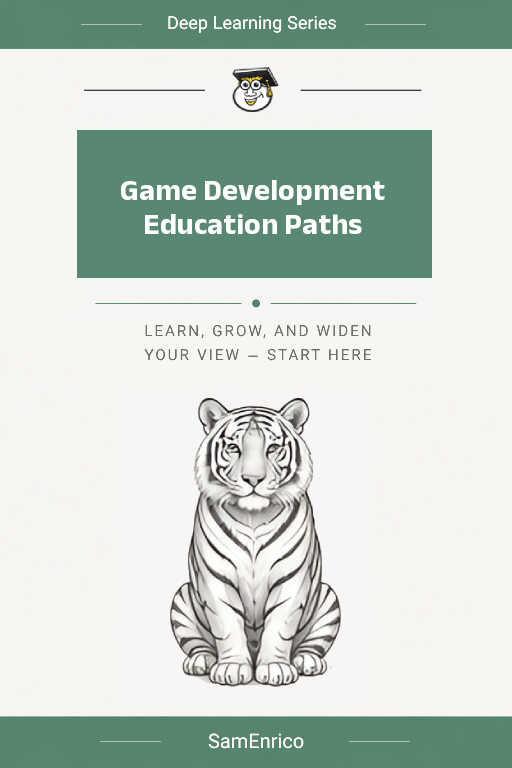
Non-FictionStudent's ShortcutGame DevelopmentStudio Careers
Game Development Education Paths Audiobook
Compare game design bootcamps and CS degrees for r
Compare game design bootcamps and CS degrees for roles at studios like Ubisoft Nintendo and indie success.
Formats
Free sample
Chapter 1: The Fun Loop...–- In the summer of 2015, a 22-year-old computer science graduate named Maya sat in a cramped San Francisco apartment, staring at a rejection email from Electronic Arts. She had perfect grades, a four-year degree from a reputable university, and a portfolio filled with technical demos she had spent hundreds of hours building. The rejection letter was polite, generic, and utterly crushing. Three thousand miles away, in a basement studio in Michigan, a 19-year-old high school dropout named Derek uploaded his first complete game to itch.io. It was a messy, unpolished platformer about a depressed robot.
It had no tutorial, no save system, and a game-breaking bug on level four. Within two weeks, it had been downloaded forty thousand times. A producer from Devolver Digital sent him a direct message on Twitter.The question that haunts every aspiring game developer is not "Can I code?" or "Do I have good ideas?" The question is far more fundamental, and far more terrifying: Why do people play games at all? And if you cannot answer that question with genuine insight, no degree, no bootcamp, and no amount of technical skill will save you.This chapter is not about education paths. It is not about CS degrees versus bootcamps.
It is not about Unity versus Unreal, or C++ versus C#, or any of the other surface-level debates that dominate online forums. This chapter is about the single most important concept in game development, the concept that separates the games you remember from the games you delete after five minutes. That concept is fun. And despite what you have been told, fun is not subjective. Fun is not mysterious.
Fun is not something you stumble upon by accident. Fun is a neurochemical process, a pattern recognition engine running inside three pounds of electrified meat inside your skull, and once you understand how that engine works, you can build games that feel inevitable, addictive, and unforgettable.The Neurochemistry of Why We Play Before you write a single line of code, before you open Unity or Unreal or Godot, before you decide whether to enroll in a four-year CS program or a twelve-week bootcamp, you need to understand what happens inside a player's brain when they engage with your game. This is not optional. This is not "nice to know." This is the foundation upon which every successful game is built, from the…
This is the end of the free sample. Get the Audiobook to keep going. Buy now
About this book
Details
- Author
- Wilburn Allegra
- Publisher
- SamEnrico
- Language
- English
- Genre
- Non-Fiction, Student's Shortcut, Game Development, Studio Careers
- Released
- 2026-05-30
- Pages (approx.)
- 141
- Available as
- eBook, Audiobook

Listen in the VoxFlicks app
Audiobooks and audio dramas wherever you go. Sign in with your SamEnrico account and press play.
More by Wilburn Allegra
 Celebratory Speech Anxiety GuideWilburn Allegra$11.99
 Growth Hormone Cycling ProtocolWilburn Allegra$11.99
 Self Hypnosis for GratitudeWilburn Allegra$11.99
 The Parent Mindfulness PracticeWilburn Allegra$11.99
 AI Voiceover Timing and PacingWilburn Allegra$11.99
 The Last Voyage of the SS America: A Titanic of the DeepWilburn Allegra$11.99
 Echoes of the Forgotten: The Last Voyage of the SS Andrea DoriaWilburn Allegra$11.99
 Inventory Control LeadWilburn Allegra$11.99
 How to Become a Scale OperatorWilburn Allegra$11.99
 Ecommerce Carbon Footprint OutlookWilburn Allegra$12.99
 Understanding Breast CancerWilburn Allegra$17.99
You may also like
 Hong Kong Handover 1997Dunn Johnnie$11.99
 Zumba For Postnatal Recovery CourseNeal Christian$11.99
 Zumba for BeginnersLadner Nikia$11.99
 YouTube Comment Mining GuideHumes Pandora$12.99
 Worry Box MeditationCarlin Rudy$11.99
 Workplace Stress MeditationNguyen Lynn$11.99
 Workplace Stress and Sleep RepairHawley Ivory$11.99
 Workplace Perfectionism CureDelaney Jeffry$11.99
 Workplace Injustice Anger GuideWallen Isabelle$11.99
 Work Addiction and Burnout LinkGreenwood Ester$11.99
 Women in Yoga and WellnessBeattie Galina$11.99
 Women in Stand Up ComedyChun Evangeline$11.99