
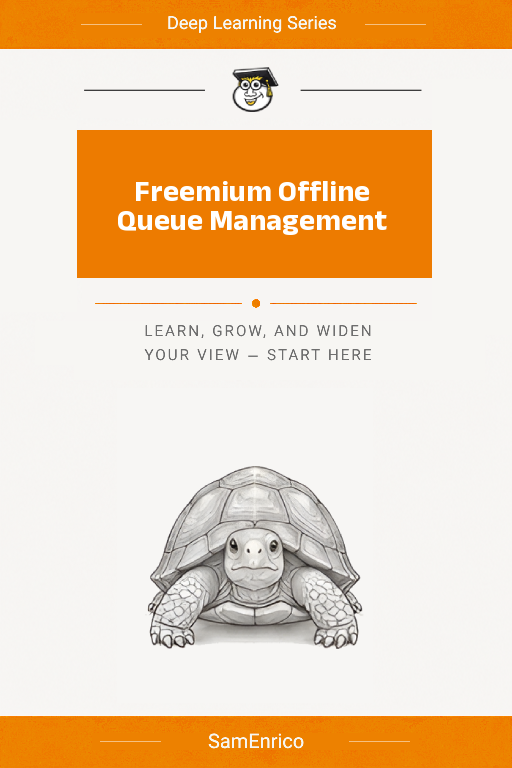
Freemium Offline Queue Management eBook
Allow freemium users to queue actions offline, syn
by Cooley Katia
Allow freemium users to queue actions offline, syncing later when connection available, reducing frustration on intermittent networks.
Formats
Free sample
Chapter 1: The Spinning Wheel–- The year is 2026. A young woman named Priya stands on a crowded subway platform in Mumbai. Her train arrives in ninety seconds. She opens her favorite budget-tracking app—a freemium product with four million users—to log an auto-rickshaw fare before she forgets. She taps "Add Expense." The screen goes white.
A spinner appears. It spins. And spins. The train doors open. Priya closes the app.
She never opens it again. That spinner just cost the company $0.47 in immediate lost lifetime value. But that's not the real damage. The real damage is that Priya will now tell three friends that the app "doesn't work when you need it." That spinner just multiplied its cost by a factor of ten.The Invisible Crisis Every day, billions of humans interact with software that assumes something demonstrably false: that the internet is always there, always fast, and always reliable. This assumption is the original sin of modern app development.
It is baked into our architecture, our user experience patterns, our business models, and—most dangerously—our expectations.The reality, drawn from aggregate data across major mobile network operators, is that the average smartphone user experiences some form of network interruption in roughly twelve percent of their app sessions. For users in emerging markets, that number exceeds thirty percent. For users on free tiers of freemium products, who disproportionately own older devices and remain on slower cellular plans, the figure approaches forty percent during peak hours.Let that sink in. Nearly half the time a free user tries to use your app, the network is working against them. And your app, like almost every app ever built, responds by showing them a spinner.The spinning wheel of death.
The progress bar that never fills. The "Connection Error" alert with a single "OK" button that leads nowhere. These are not neutral user interface elements. They are active destroyers of value. Each spinner is a tiny churn machine, quietly converting your hard-won users into former users.The Freemium Churn Loop There is a pattern that repeats across thousands of freemium applications, from ride-hailing to meditation guides to project management tools.
We call this pattern the Freemium Churn Loop, and it operates with mechanical regularity.Stage One: Acquisition. A user discovers your app through an ad, a referral, or an app store search. They download it. They are curious. They are, in the language of product-led growth, "activation-ready."Stage Two: First Friction.
Within the first three sessions, the user encounters a network error. Perhaps they are in a subway tunnel. Perhaps their cellular plan has hit a data cap. Perhaps they are in a crowded stadium with saturated towers. The specific cause doesn't matter.
What matters is the outcome: the app fails to respond.Stage Three: Attribution Error. The user does not think, "Ah, my network is temporarily unreliable." They think, "This app is broken." This is not user stupidity. It is rational behavior. When every other app on their phone—social media, messaging, maps—has learned to work offline or degrade gracefully, your app's spinner is a signal of incompetence.Stage Four: Abandonment. The user closes the app.
If this happens twice, they uninstall. They do not write a bug report. They do not email support. They simply vanish, silently, into the churn bucket.Stage Five: Contagion. The former user tells others.
"Don't bother with that app," they say. "It crashes all the time." They don't distinguish between a crash and a network timeout. To them, the distinction is academic. The experience was bad. That is all that matters.The Freemium Churn Loop is particularly vicious because it preys on the users you can least afford to lose.
Your free users are your future paying customers. Every user who churns before experiencing the value of your premium tier is a conversion opportunity incinerated.The Economics of a Spinner Let us quantify the damage. Consider a freemium app with one million monthly active users. Assume a conservative conversion rate of three percent from free to paid, with an average lifetime value of fifty dollars per converted user. The potential lifetime value of the free user base is roughly one hundred thousand dollars per month in future conversions.Now assume that twelve percent of sessions encounter a network error, as discussed.
Assume that thirty percent of those errors lead to immediate session abandonment, and ten percent of those abandonments lead to uninstall. This is a conservative estimate; real-world data from several large freemium applications suggests numbers closer to twenty percent uninstall after two errors.Do the math. One million users. Twelve percent error rate. Thirty percent abandonment.
Ten percent uninstall. That is 3,600 lost users per month. At a three percent eventual conversion rate and fifty dollar lifetime value, that is 5,400inlostfuturerevenuepermonth,ornearly5,400 in lost future revenue per month, or nearly 5,400inlostfuturerevenuepermonth,ornearly65,000 per year.But this is the tip of the iceberg. The real cost is not the direct revenue loss. It is the contagion effect.
Each lost user tells an average of three people not to use your app. Those three people never download at all. The acquisition cost you spent to reach them—perhaps two or three dollars each—is wasted. The true cost of the spinner, when you factor in wasted acquisition spend and lost word-of-mouth growth, is often five to ten times the direct revenue loss.That 65,000becomes65,000 becomes 65,000becomes500,000. That $500,000 becomes a line item on a CEO's spreadsheet titled "Network-Related Churn." And that line item is almost always invisible because almost no one measures it.The Cloud-Native Delusion How did we arrive at a place where our software fails users exactly when they need it most?
The answer lies in a design philosophy that has dominated software development for the past fifteen years: cloud-native architecture.Cloud-native thinking emerged as a solution to a real problem. In the early 2000s, companies struggled with expensive, inflexible server infrastructure. The cloud promised elasticity, scalability, and the ability to treat servers as disposable resources. This was a genuine advance.But cloud-native thinking carried an implicit assumption that has calcified into dogma: the network is reliable, fast, and always available. After all, cloud providers build redundant fiber connections, multiple availability zones, and global content delivery networks.
Within the data center, the network is indeed reliable.The user's device is not inside the data center. The user's device is on a subway, in a rural village, in a crowded stadium, on an airplane, in an elevator, in a parking garage, or in any of the thousands of other places where connectivity is intermittent at best. The cloud-native assumption, when applied to user-facing applications, is a category error of epic proportions.This error has been reinforced by the development environments in which most modern apps are built. The average developer works on a high-speed office network or a fiber-connected home internet connection. Their test devices are often the latest models, connected to robust Wi-Fi.
They never experience their own app as a free user on a three-year-old phone with a throttled data plan in a subway tunnel.The result is a form of systemic blindness. Developers build for the network they have, not the network their…
This is the end of the free sample. Get the eBook to keep going. Buy now
About this book
Details
- Author
- Cooley Katia
- Publisher
- SamEnrico
- Language
- English
- Genre
- Non-Fiction, Business Brief
- Released
- 2026-05-30
- Pages (approx.)
- 148
- Available as
- eBook, Audiobook

Read better in the ZLOADR app
Your eBooks on your phone or tablet. Sign in with your SamEnrico account and start reading.
More by Cooley Katia
 Sled Push HIIT GuideCooley Katia$11.99
 Gambling Recovery AffirmationsCooley Katia$11.99
 Stimulant Use in Homeless PopulationCooley Katia$11.99
 Gambling Urge Surfing TechniqueCooley Katia$11.99
 Financial Power of Attorney ScopeCooley Katia$11.99
 Teen Vulnerability StrengthCooley Katia$11.99
 Medication and Emotion RegulationCooley Katia$11.99
 Grief and Anger After Pregnancy LossCooley Katia$11.99
 Kamikaze Winds: The Mongols' Failed Invasion of JapanCooley Katia$11.99
 The Ballad of the Last Viking: How a 10th-Century Explorer Found a New WorldCooley Katia$11.99
 A Collector's Handbook to the Renault 14Cooley Katia$11.99
 Pop Up Retail Competitor Analysis GuideCooley Katia$12.99
You may also like
 Hong Kong Handover 1997Dunn Johnnie$11.99
 Zumba For Postnatal Recovery CourseNeal Christian$11.99
 Zumba for BeginnersLadner Nikia$11.99
 YouTube Comment Mining GuideHumes Pandora$12.99
 Worry Box MeditationCarlin Rudy$11.99
 Workplace Stress MeditationNguyen Lynn$11.99
 Workplace Stress and Sleep RepairHawley Ivory$11.99
 Workplace Perfectionism CureDelaney Jeffry$11.99
 Workplace Injustice Anger GuideWallen Isabelle$11.99
 Work Addiction and Burnout LinkGreenwood Ester$11.99
 Women in Yoga and WellnessBeattie Galina$11.99
 Women in Stand Up ComedyChun Evangeline$11.99