
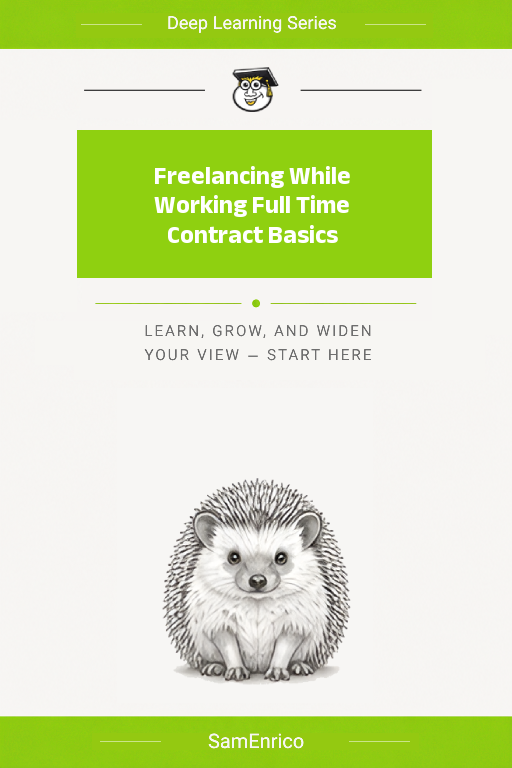
Non-FictionNon-Obvious CareerFreelance Law
Freelancing While Working Full Time Contract Basics eBook
Write simple freelance agreements that protect you
by Nix Lavada
Write simple freelance agreements that protect your intellectual property and limit liability without a lawyer's help.
Formats
Free sample
Chapter 1: The Stealth Audit--The email arrived at 9:47 on a Tuesday morning. Sarah opened it during her lunch break, coffee in hand, expecting a routine update from her freelance client. Instead, she found a legal notice. Her freelance client was being sued for trademark infringement over a logo she had designed six months earlier. The client’s lawyer had subpoenaed all her communications, drafts, and contracts.
That was bad enough. Then she read the forwarding note from her day job’s HR department: “Per company policy, all intellectual property created during employment is owned by the company. Please provide a complete accounting of your freelance work by Friday.”Sarah was a marketing manager at a mid-sized tech firm. She made 68,000ayear.Herfreelancesidehustle—logodesignonnightsandweekends—broughtinanextra68,000 a year. Her freelance side hustle — logo design on nights and weekends — brought in an extra 68,000ayear.Herfreelancesidehustle—logodesignonnightsandweekends—broughtinanextra15,000 annually.
She had used a free contract template she found online, the same one recommended by a popular freelancing blog. She thought she was protected. She was not protected. Within two weeks, she had been fired for violating her employer’s moonlighting policy. Her freelance client had frozen payment on three outstanding invoices totaling $4,200.
And she had received a letter from her employer’s legal department demanding that she “cease and desist using any company resources or time for outside work” — even though she had never touched a company laptop after hours.Sarah’s story is not unusual. It happens thousands of times every year to freelancers who work full-time jobs. And almost all of them make the same mistake: they focus entirely on the freelance contract with their client and ignore the employment contract with their boss.This chapter is about that mistake — and how you will never make it.The Invisible Contract You Already Signed When you think about “contract basics” for freelancing, your mind likely goes straight to the agreement you sign with a client. That makes sense. That’s the document that defines your scope of work, your payment terms, your intellectual property transfer, and your liability limits.
It is important. But it is not the only contract that governs your freelance work. There is another contract, one you probably signed years ago, that may have already given away the rights to your side hustle without you even realizing it.That contract is your employment agreement with your day job.Every single person who works a full-time job while freelancing has signed some version of this document. Sometimes it’s called an Employee Handbook. Sometimes it’s an Offer Letter with attached policies.
Sometimes it’s a standalone Intellectual Property Agreement. But nearly every employment contract contains clauses that can destroy your freelance business if you don’t understand them.Here is what most freelancers don’t realize until it is too late: your employer has lawyers who write these contracts specifically to protect the company’s interests. Those lawyers are very good at their jobs. They know that the most valuable thing you produce might not happen during office hours. It might happen at 11 PM on a Sunday, on your personal laptop, at your kitchen table.
But if you used any knowledge, skill, or process you learned at work — or if your freelance work is even remotely related to your employer’s business — they may have a claim to ownership.This chapter is called the Stealth Audit because that is exactly what you need to perform before you sign another freelance contract. You need to quietly, carefully, and thoroughly audit your employment agreement to understand what you are actually allowed to do. You need to identify the landmines before you step on them. And you need to make a conscious decision about whether your side hustle is worth the risk — or whether you need to change how you operate.The Three Hidden Dangers in Your Employment Contract Every employment contract is different, but after analyzing hundreds of them over years of research, three dangerous clauses appear again and again. These are the clauses that have destroyed more side hustles than anything else.
Memorize them.Danger One: Moonlighting Policies The first and most obvious danger is the moonlighting policy. Some employers explicitly forbid any outside work. Others allow it but require written approval. Still others are silent on the issue — and silence is not permission. It is simply an unenforced rule waiting to be enforced when it becomes convenient for the employer.A moonlighting policy can look like any of these phrases:“Employees shall devote their full professional time, attention, and energies to the company during employment.”“Outside employment or consulting work is prohibited without prior written consent of the employee’s manager and HR.”“Employees may not engage in any other business activity that competes with or could compete with the company.”The danger here is not just that you could be fired.
The danger is that firing you gives your employer a reason to look deeper into your freelance work. Once they start looking, they may discover that your employment agreement also gives them ownership of everything you created.Sarah’s employer had a moonlighting policy that required written approval for any outside work. She had never requested approval because she didn’t think logo design for a local coffee shop was relevant to her job in tech marketing. She was wrong. The policy didn’t say “relevant to the company.” It said any outside work.
She was fired for violating a policy she didn’t even know existed.The Stealth Audit process will help you locate and interpret your employer’s moonlighting policy. You need to know exactly what it says — not what you assume it says.Danger Two: Non-Compete and Non-Solicitation Clauses The second danger is more subtle but potentially more damaging. Non-compete clauses restrict you from working for competitors. Non-solicitation clauses restrict you from working with clients or customers of your employer. And here is the problem: your freelance client might be a competitor without you even realizing it.Consider this scenario.
You work as a content writer for a software company that sells project management tools. On nights and weekends, you freelance as a copywriter for a marketing agency. That marketing agency has a client who sells… project management tools. You never directly work with that client — you work with the agency. But your employer’s non-compete clause might be broad enough to say that working for any company “in the project management software space” is prohibited.
Or worse, it might say that working for any company “that could be considered a potential partner, competitor, or customer” is prohibited, which is so broad as to be nearly meaningless — except when it is enforced against you.Non-compete clauses vary wildly by state. California, North Dakota, and Oklahoma generally prohibit them. Other states enforce them but with limits. Still others enforce them aggressively. You need to know not just what your contract says, but also whether that clause is enforceable in your state.The Stealth Audit includes a simple test to determine whether your freelance clients might trigger your non-compete clause.
It also includes a script for the conversation you may need to have with your employer if you realize you…
This is the end of the free sample. Get the eBook to keep going. Buy now
About this book
Details
- Author
- Nix Lavada
- Publisher
- SamEnrico
- Language
- English
- Genre
- Non-Fiction, Non-Obvious Career, Freelance Law
- Released
- 2026-06-01
- Pages (approx.)
- 136
- Available as
- eBook, Audiobook

Read better in the ZLOADR app
Your eBooks on your phone or tablet. Sign in with your SamEnrico account and start reading.
More by Nix Lavada
 Stress Induced Nagging CycleNix Lavada$11.99
 EQ For Eating Disorder RecoveryNix Lavada$11.99
 Boundary Setting for ActivistsNix Lavada$11.99
 Drug Dependency ExerciseNix Lavada$11.99
 The Learning Style StressNix Lavada$11.99
 Neuropathic Pain WorkbookNix Lavada$11.99
 US Germany Remote Tax GuideNix Lavada$11.99
 Light Therapy for BipolarNix Lavada$11.99
 Keyword Mnemonic Language GuideNix Lavada$11.99
 The Golden Age of Viennese Science: From Freud to the Quantum LeapNix Lavada$11.99
 The Whistleblower's Dilemma: Frances Haugen vs. FacebookNix Lavada$11.99
 Whispers in the Lamplight: The Djinn of Baghdad’s Forgotten QuarterNix Lavada$11.99
You may also like
 Hong Kong Handover 1997Dunn Johnnie$11.99
 Zumba For Postnatal Recovery CourseNeal Christian$11.99
 Zumba for BeginnersLadner Nikia$11.99
 YouTube Comment Mining GuideHumes Pandora$12.99
 Worry Box MeditationCarlin Rudy$11.99
 Workplace Stress MeditationNguyen Lynn$11.99
 Workplace Stress and Sleep RepairHawley Ivory$11.99
 Workplace Perfectionism CureDelaney Jeffry$11.99
 Workplace Injustice Anger GuideWallen Isabelle$11.99
 Work Addiction and Burnout LinkGreenwood Ester$11.99
 Women in Yoga and WellnessBeattie Galina$11.99
 Women in Stand Up ComedyChun Evangeline$11.99