
Non-FictionCareer EducationFreelance Guide
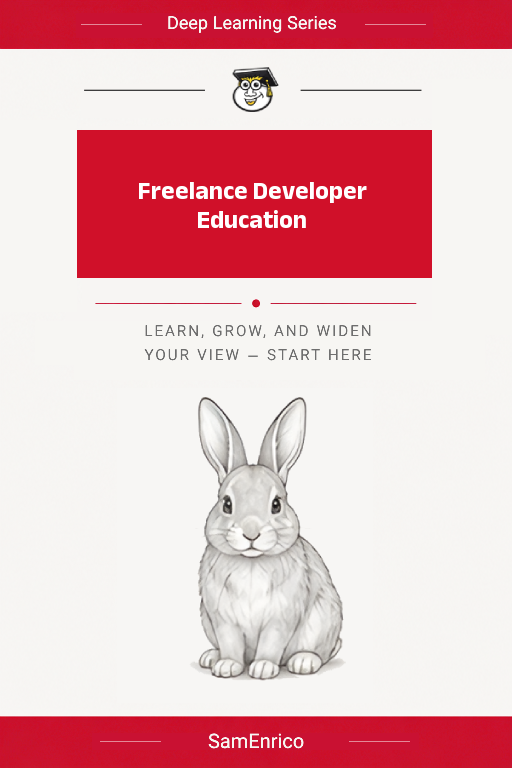
Freelance Developer Education eBook
Compare bootcamp and degree preparation for freela
Compare bootcamp and degree preparation for freelance and contract work. Client acquisition and rates.
Formats
Free sample
Chapter 1: The Credential Paradox...–- When Maya Chen graduated from a top-tier computer science program, she framed her diploma and hung it above her desk, convinced it would open every door. Three months into freelancing, she had landed exactly one client—her cousin’s bakery website for 800.Meanwhile,herfriend Leo,abootcampgraduatewithnodegree,wasbilling800. Meanwhile, her friend Leo, a bootcamp graduate with no degree, was billing 800.Meanwhile,herfriend Leo,abootcampgraduatewithnodegree,wasbilling8,000 per month building Shopify stores for small businesses. Leo couldn’t explain Big-O notation or reverse a binary tree, but he had something Maya didn’t: a portfolio of working websites, a handful of testimonials, and the instinct to lead every conversation with “Here’s how I’ll solve your problem” instead of “I have a degree in computer science.”This chapter dismantles the most expensive assumption new freelance developers make: that clients care about your educational pedigree as much as you do. They don’t.
But the truth is more nuanced than simply declaring credentials worthless. This chapter introduces the credential paradox—the strange reality that while developers obsess over degrees and bootcamp certificates, most clients barely notice them, yet those same credentials can become powerful tools when deployed strategically with the right clients at the right time.By the end of this chapter, you will understand exactly when your education matters, when it doesn’t, and how to stop leading with the wrong signal while amplifying the signals clients actually pay for.The Great Misalignment: What Developers Think Clients Want Walk into any coding bootcamp graduation or university computer science department, and you will hear the same anxieties echoed by soon-to-be freelancers: “Will clients trust me without a degree?” “Does my bootcamp certificate look unprofessional?” “Should I put ‘self-taught’ on my website?”These questions reveal a fundamental misunderstanding of how freelance clients think. Traditional employers—HR departments, recruiting software, corporate hiring managers—use credentials as filtering mechanisms. A degree signals that you can commit to a multi-year endeavor. A bootcamp certificate signals that you’ve completed an intensive, focused program.
These signals help employers reduce the risk of a bad hire when they have hundreds of applicants and no time to assess each one individually.Freelance clients operate in an entirely different universe. The small business owner needs her website to stop crashing. The marketing agency needs a custom integration finished before Friday. The startup founder needs someone who can ship an MVP in two weeks. None of these people care about your data structures midterm grade.
None of them will ask for your transcript. Most of them won’t even notice whether you list a degree or a bootcamp on your website—because they are not reading your resume like an HR person. They are scanning your portfolio, your case studies, and your initial email to answer one question: Can this person fix my problem?This is the first and most important shift in mindset for the freelance developer. You are not applying for a job. You are offering a solution to a specific business problem.
Your education is merely one ingredient in how you became capable of offering that solution. It is not the solution itself.The Two Faces of Credentials: Signal vs. Noise To understand why credentials create such confusion, we must distinguish between signal and noise from a client’s perspective.Signal is information that directly reduces a client’s perceived risk about hiring you. A working demo of a similar project is signal. A testimonial from a past client who had a similar problem is signal.
A clear, specific proposal that describes exactly what you will deliver and when is signal. A live link to a website you built that loads quickly and works on mobile is signal.Noise is information that does not directly address the client’s core concern. Your graduation date is noise. The name of your university is usually noise. The specific technologies you studied in your bootcamp’s third week are noise.
Your GPA is definitely noise.Here is the uncomfortable truth: for most freelance clients, your degree or bootcamp certificate sits somewhere between weak signal and pure noise. A degree signals persistence and the ability to learn abstract concepts—but persistence doesn’t fix a broken checkout flow. A bootcamp certificate signals intensity and rapid skill acquisition—but intensity doesn’t guarantee you can communicate clearly with a nervous client.The credential paradox emerges because developers cannot believe this. You invested years or months and thousands of dollars into your education. You watched your non-freelance peers land jobs based on their degrees or bootcamp alumni networks.
The idea that a client might not care feels almost offensive. So you keep leading with your credential. You put “BS in Computer Science” at the top of your proposal. You mention your bootcamp’s prestigious name in your first email. And you wonder why clients seem unimpressed.They are not unimpressed.
They are confused. You are giving them information they did not ask for and do not know how to use.When Credentials Actually Matter: A Market Segmentation Approach Now for the nuance that most “credentials don’t matter” advice misses. There are specific client segments where your educational background genuinely influences hiring decisions. Pretending otherwise is as naive as overvaluing your diploma.Segment One: Enterprise Subcontracting When you work as a freelancer for a large company—not directly for the business owner, but as a subcontractor to an agency or through a vendor management system—your credentials may be reviewed by non-technical procurement staff or risk-averse managers. These individuals often use credential checklists because they lack the expertise to evaluate your portfolio.
A degree from an accredited university or a bootcamp certificate from a recognized provider can serve as a gatekeeper. In this segment, lacking the “right” credential might exclude you from consideration entirely, regardless of your actual skills.Segment Two: Regulated Industries Finance, healthcare, government, and legal services often have compliance requirements that mandate certain educational backgrounds for anyone touching sensitive systems. A bank may require proof of a degree to satisfy their insurance carrier. A healthcare startup handling patient data may need to demonstrate that all contractors have verifiable technical education. In these cases, your credential is not about trust—it is about liability transfer.
The client needs to show a regulator or auditor that they hired someone with “appropriate qualifications.”Segment Three: High-Budget, High-Complexity Projects When a client is spending $50,000 or more on a single project, they become more risk-averse. They may not care about your degree per se, but they will care about evidence that you can handle complexity. A degree in computer science can serve as a proxy for systems thinking, even if it is an imperfect proxy. In these engagements, your credential becomes one data point among many, alongside your portfolio, your references, and your proposal quality.Everyone Else: The Vast Middle Market For the majority of freelance clients—small to medium businesses, startups, marketing agencies, ecommerce store owners, content creators, local service providers—your credential is almost irrelevant. These clients care about three things, in order:Can you solve my specific problem?
Demonstrated by relevant past work, case studies, or a clear plan.Can you communicate clearly and reliably? Demonstrated by your initial…
This is the end of the free sample. Get the eBook to keep going. Buy now
About this book
Details
- Author
- Bannister Kamilah
- Publisher
- SamEnrico
- Language
- English
- Genre
- Non-Fiction, Career Education, Freelance Guide
- Released
- 2026-06-01
- Pages (approx.)
- 146
- Available as
- eBook, Audiobook

Read better in the ZLOADR app
Your eBooks on your phone or tablet. Sign in with your SamEnrico account and start reading.
More by Bannister Kamilah
 Depression and Cognitive DistortionsBannister Kamilah$11.99
 Archaeology Of Ship FittingsBannister Kamilah$11.99
 Cooperative Coffee Washing StationBannister Kamilah$11.99
 Highway Hypnosis PreventionBannister Kamilah$11.99
 Pomodoro for Public Speaking PrepBannister Kamilah$11.99
 Trollkona's Lament: The Ballad of the Stonehearted BrideBannister Kamilah$11.99
 Citigroup SWOT LibraryBannister Kamilah$12.99
 Understanding Oral Lichen PlanusBannister Kamilah$17.99
 How to Start a Chromium Business (Beginners Guide)Bannister Kamilah$11.99
 Password Hygiene EducatorBannister Kamilah$11.99
You may also like
 Hong Kong Handover 1997Dunn Johnnie$11.99
 Zumba For Postnatal Recovery CourseNeal Christian$11.99
 Zumba for BeginnersLadner Nikia$11.99
 YouTube Comment Mining GuideHumes Pandora$12.99
 Worry Box MeditationCarlin Rudy$11.99
 Workplace Stress MeditationNguyen Lynn$11.99
 Workplace Stress and Sleep RepairHawley Ivory$11.99
 Workplace Perfectionism CureDelaney Jeffry$11.99
 Workplace Injustice Anger GuideWallen Isabelle$11.99
 Work Addiction and Burnout LinkGreenwood Ester$11.99
 Women in Yoga and WellnessBeattie Galina$11.99
 Women in Stand Up ComedyChun Evangeline$11.99