
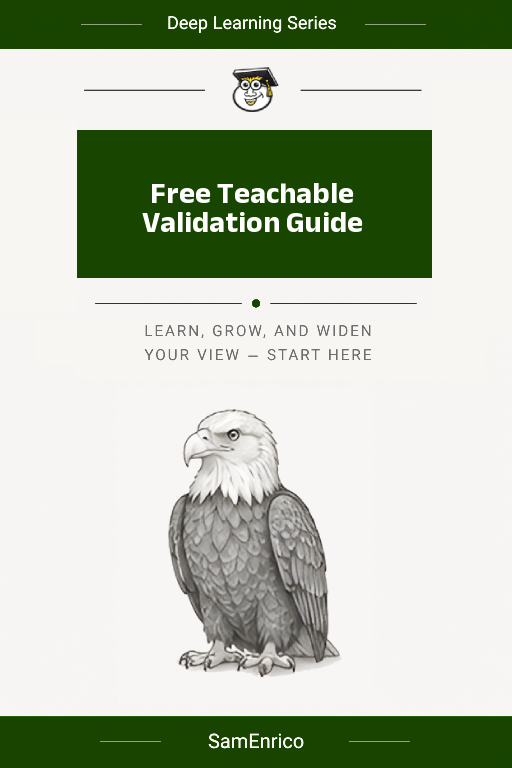
Non-FictionStartup GuideLean Methodology
Free Teachable Validation Guide eBook
Use free Teachable plan to validate course demand.
by Laporte Cruz
Use free Teachable plan to validate course demand. Test with a small cohort.
Formats
Free sample
Chapter 1: The $375,000 Mistake--The email arrived on a Tuesday morning, and Sarah almost deleted it."Congratulations on completing your course! Your students are waiting."She stared at the screen, confused. She hadn't launched anything yet. She had been working on her course—a 47-video "Ultimate Freelance Mastery" program—for eleven months. She had poured $8,400 into software, stock footage, a fancy microphone, and a logo designer on Fiverr.
She had recorded and re-recorded the first three modules six times because the lighting wasn't right, because she stumbled over her words, because she was sure someone would notice the slight echo in her home office.The email was from Teachable. It was an automated notification about her unpublished course.Sarah clicked into her dashboard. There it was: "Ultimate Freelance Mastery" with a big red "Unpublished" banner. Zero students. Zero revenue.
Eleven months of work. Eight thousand dollars. Forty-seven videos that exactly three people had ever watched—her husband, her mother, and the editor she hired to remove her ums and uhs.She closed her laptop and didn't open it again for three weeks.Sarah's story is not unique. It is not even uncommon. It is the default outcome for most first-time course creators.The Graveyard of Good Intentions Let me tell you about the other Sarahs of the world.There is Michael, a corporate trainer who spent his entire Christmas break building a 12-module course on leadership communication.
He launched to his email list of 1,400 people. Four people bought it. Two of them asked for refunds within a week.There is Priya, a nutrition coach who recorded 63 short videos for a "30-Day Metabolic Reset." She bought a 2,000camera.Shehiredavoicecoach.Shebuiltabeautifulsalespagewithcustomillustrations.Shemade2,000 camera. She hired a voice coach. She built a beautiful sales page with custom illustrations.
She made 2,000camera.Shehiredavoicecoach.Shebuiltabeautifulsalespagewithcustomillustrations.Shemade327 in the first month and turned off the ads after losing another $800.There is David, a former software engineer who built a coding bootcamp alternative. He spent eighteen months—eighteen months—creating 200+ lessons, a custom code editor, and a community platform. He launched with a $1,000 price tag. He sold zero copies. Zero.These are not failures of knowledge.
Michael knows leadership. Priya knows nutrition. David knows coding. These are failures of a much deeper, more expensive kind.The $375 Billion Wasteland Here is a number that should stop you cold: $375 billion.That is the estimated value of online courses that have been purchased but never completed, combined with the value of courses that were built and never sold. According to research from the online education industry, the average course completion rate hovers around 12-15 percent.
But that number hides a more painful statistic: the majority of courses created on platforms like Teachable, Thinkific, and Kajabi never make back their production costs.Let me translate that into human terms.For every person who builds a successful six-figure course business, there are roughly 300 people who build a course that sells fewer than ten copies. For every person who quits their job to teach online full-time, there are 500 people who lose money on their course—not just their time, but actual cash spent on software, ads, freelancers, and equipment.The course creation industry has sold us a beautiful dream: you have knowledge, package it into videos, and money flows in while you sleep.The reality is much harsher: you have knowledge, package it into videos, and discover that nobody asked for what you built.The Trap That Catches Almost Everyone Why does this happen? Why do smart, capable, well-intentioned people keep building courses that nobody wants?The answer is simple, uncomfortable, and entirely avoidable. It is a trap called The Build-First Fallacy.The Build-First Fallacy sounds like this: "I need to build a great course first. Then I will market it.
Then people will buy it."This feels logical. It feels responsible. It feels like the adult way to do things. You wouldn't open a restaurant without a menu. You wouldn't publish a book without writing it.
So why would you sell a course before creating it?Here is why: a restaurant menu costs almost nothing to change. A book manuscript can be rewritten. But a 50-video course with slides, worksheets, quizzes, and a community forum? That is a massive investment of time and money that becomes nearly impossible to change once it is built.The Build-First Fallacy convinces you to invest heavily in a product before you have any evidence that anyone wants to buy it.It is the equivalent of building a car factory before you know if anyone wants to drive the car.Validation vs. Polite Interest Let me introduce you to the most important distinction you will learn in this entire book.
It is the difference between Validation and Polite Interest.Polite Interest is what people give you when you ask, "Would you buy this?" They say, "That sounds great!" or "I would definitely sign up for that!" or "You should totally make this!"Polite Interest is free. Polite Interest costs nothing to give. Polite Interest is what your friends, family, and even your email subscribers offer because they want to be nice, because they want to encourage you, because they do not want to hurt your feelings.Polite Interest is a liar.Validation is what people give you when you ask, "Will you buy this for $27 right now?" and they take out their credit card and complete the transaction.Validation costs real money. Validation requires genuine motivation. Validation cannot be faked.Here is the painful truth that most course creators learn too late: Polite Interest and Validation are not correlated.
They are not even on the same spectrum. You can have 1,000 people tell you they would buy your course and end up with zero actual buyers. This happens every single day.I have seen a fitness coach survey her 5,000-person email list. 87% said they would "definitely" buy a course on home workouts. She built the course.
She sold 14 copies.I have seen a B2B consultant ask his Linked In network a simple question: "Anyone want to join a live cohort on sales discovery calls for $47?" He got 3,000 views, 42 comments saying "interested," and 11 actual buyers.The comments were Polite Interest. The buyers were Validation.The only number that matters is the second one.The 10-Student Validation Ladder This brings us to the single most important framework in this book. I call it the 10-Student Validation Ladder.Here is how it works. Instead of building a course for 100 students or 1,000 students or "as many as possible," you focus on one thing and one thing only: getting 10 human beings to pay you money for access to your knowledge.Not 100. Not 50.
Not 20. Ten.Ten is a magic number for three reasons.First, ten is small enough to be achievable. You do not need an audience. You do not need ads. You do not need a launch strategy.
You need ten conversations that end with a credit card. That is it.Second, ten is large enough to be meaningful. If ten strangers give you money for a course you have not fully built yet, you have evidence that your idea has real demand. Ten is not a fluke. Ten is a signal.Third, ten is exactly…
This is the end of the free sample. Get the eBook to keep going. Buy now
About this book
Details
- Author
- Laporte Cruz
- Publisher
- SamEnrico
- Language
- English
- Genre
- Non-Fiction, Startup Guide, Lean Methodology
- Released
- 2026-05-29
- Pages (approx.)
- 145
- Available as
- eBook, Audiobook

Read better in the ZLOADR app
Your eBooks on your phone or tablet. Sign in with your SamEnrico account and start reading.
More by Laporte Cruz
 Medical Resident Imposter SyndromeLaporte Cruz$11.99
 The Self Talk Override MethodLaporte Cruz$11.99
 Incubating Solutions For Fibromyalgia WorkbookLaporte Cruz$11.99
 TM for Wedding Day CalmLaporte Cruz$11.99
 The Sudden Pet Death GuideLaporte Cruz$11.99
 The Great Barrier Bleach: A Coral Reef on the BrinkLaporte Cruz$11.99
 Understanding Tibia Absent Polydactyly Arachnoid CystLaporte Cruz$17.99
 Self-Organizing Map OperatorLaporte Cruz$11.99
 How to Become a Leather StamperLaporte Cruz$11.99
 Bangladesh Invoice FactoringLaporte Cruz$12.99
You may also like
 Hong Kong Handover 1997Dunn Johnnie$11.99
 Zumba For Postnatal Recovery CourseNeal Christian$11.99
 Zumba for BeginnersLadner Nikia$11.99
 YouTube Comment Mining GuideHumes Pandora$12.99
 Worry Box MeditationCarlin Rudy$11.99
 Workplace Stress MeditationNguyen Lynn$11.99
 Workplace Stress and Sleep RepairHawley Ivory$11.99
 Workplace Perfectionism CureDelaney Jeffry$11.99
 Workplace Injustice Anger GuideWallen Isabelle$11.99
 Work Addiction and Burnout LinkGreenwood Ester$11.99
 Women in Yoga and WellnessBeattie Galina$11.99
 Women in Stand Up ComedyChun Evangeline$11.99