
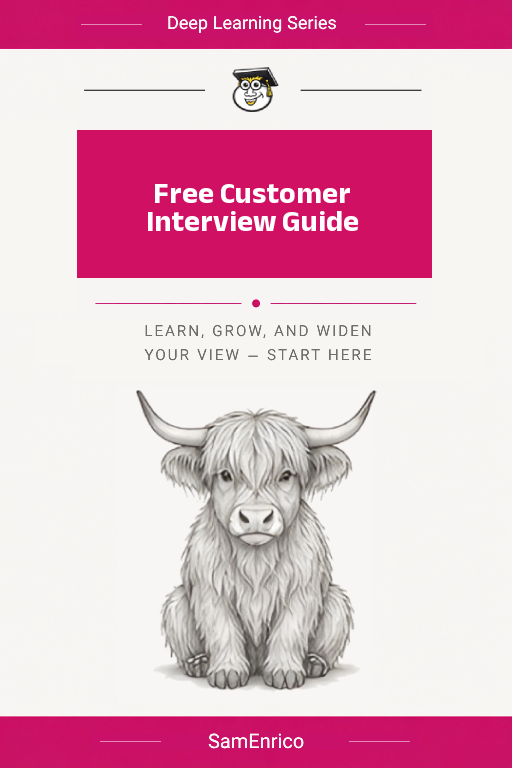
Non-FictionStartup GuideLean Methodology
Free Customer Interview Guide eBook
Conduct customer discovery interviews without spen
by Beaty Leatha
Conduct customer discovery interviews without spending a dime. Find interviewees and ask the right questions.
Formats
Free sample
Chapter 1: The Polite Epidemic--–- The first lie I ever told as an entrepreneur cost me six months of my life and thirty thousand dollars. I was twenty-four, sitting across from my best friend in a coffee shop, holding a prototype that looked like it had been designed by a colorblind raccoon. I asked the question that has launched a thousand failed startups: "Do you think this is a good idea?" He smiled, nodded, and said, "Yeah, man. I love it. I'd definitely use that."He never used it.
Not once. Not even to be polite.I didn't blame him. I blamed myself for asking the wrong question. But it took me three more failed products and two more years to understand why that question was so dangerous. The answer, when I finally found it, changed everything: People would rather lie to your face than hurt your feelings.
And those lies—well-intentioned, gentle, seemingly harmless lies—are the single greatest threat to every entrepreneur, product manager, and innovator on the planet.This book exists because of that lie. Every chapter that follows is a direct response to the moment I realized that compliments are free, hypotheticals are horoscopes, and the only truth worth hearing lives in the past. But before we get to the tactics, the scripts, and the zero-budget systems for finding interviewees, we have to rewire something deeper: your entire understanding of what a "good" conversation looks like.Welcome to Chapter 1. By the time you finish these pages, you will never ask "Do you like my idea?" again. And you will finally understand why that's the best thing that could ever happen to your business.The Anatomy of a Polite Lie Let us define our enemy.
I call it the Polite Epidemic, and it spreads everywhere that human beings care about each other's feelings. Your mother tells you your novel is "really interesting" when it is, in fact, unreadable. Your colleague tells you your presentation was "great" when they spent the entire meeting checking their email. Your potential customer tells you your product idea is "brilliant" when they have already decided, in the privacy of their own mind, that they will never pay a single dollar for it.These are not malicious lies. They are social lubricants.
They are the price of admission to a functional society. And they are absolutely lethal to anyone trying to build something new.Here is the mechanics of how a polite lie works. When you ask someone a question about your idea—"Do you think this would sell?" "Is this problem real?" "Would you use this?"—you are not asking for information. You are asking for a social favor. The person across from you perceives your question as a request for emotional support, not data.
They want to be nice. They want to maintain the relationship. They want to avoid the awkwardness of saying, "Actually, that's a terrible idea and you should feel bad for having it."So they say yes. They say "that sounds cool." They say "I could see that working." And they mean it—in the moment, as a gesture of goodwill. But goodwill does not translate to purchase intent.
Goodwill does not translate to hours saved or problems solved. Goodwill is just warm air.I have interviewed hundreds of founders who fell into this trap. They show me their customer discovery notes with pride. "Everyone loved it," they say. "We got so much positive feedback." And then I ask to see their launch numbers.
The room goes quiet. The product that "everyone loved" attracted exactly three paying customers, two of whom were the founder's parents.This is not a failure of execution. It is a failure of questioning. You cannot get honest answers by asking dishonest questions. And the question "Do you like my idea?" is fundamentally dishonest because it pretends to seek feedback while actually seeking validation.The Mom Test: A Framework for Truth In 2013, a founder named Rob Fitzpatrick published a small, unassuming book that would become the underground bible of customer discovery.
He called it The Mom Test, and the title came from a simple thought experiment: If your own mother will lie to you about your business idea (because she loves you and wants you to be happy), then everyone else will lie to you too. The only way to get the truth is to stop asking questions that your mom can answer with a yes.The Mom Test has one rule. Just one. But it is so powerful that it transforms every conversation you will ever have with a customer. Here it is:Talk about their life, not your idea.Read that again.
Let it land. The rule does not say "also talk about their life" or "ask about their life eventually." It says talk about their life, not your idea. Your idea does not enter the conversation. Your solution does not get described. Your product name is never spoken.
For the entire discovery phase, you are not a founder. You are a detective investigating a crime: the crime of an unsolved problem.When you talk about their life, you ask about specific, recent, past behaviors. You ask about how they solved this problem last week. You ask about the last time they felt frustrated. You ask about the tools they currently use and the money they currently spend.
These are factual questions. They have right and wrong answers. And most importantly, the person you are interviewing cannot lie to you without contradicting their own lived experience.Let me give you an example. Imagine you are building a tool to help freelancers manage their invoices. The wrong question—the polite lie question—is: "Do you struggle with invoicing?" Almost every freelancer will say yes.
Invoicing is annoying. It is universally annoying. But saying yes to that question costs them nothing. It does not mean they will buy your tool. It does not even mean they want a solution.
It just means they are agreeing with a general statement about the human condition.The right question—the Mom Test question—is: "Tell me about the last time you sent an invoice. What was hard about that specific moment?" Now you are in the realm of facts. "I spent forty-five minutes chasing down a client's PO number." "I realized I forgot to include a line item and had to re-send the entire thing." "I got paid two weeks late because my invoice format confused their accounting department." These are not opinions. These are stories. And stories are gold.Why Hypotheticals Are Horoscopes Here is a truth that will save you years of wasted effort: hypothetical questions generate hypothetical answers, and hypothetical answers predict nothing.Ask someone "Would you buy a tool that does X?" and they will say yes.
They always say yes. It costs them zero dollars to say yes. It makes them feel helpful and visionary. It gives them a tiny dopamine hit of being the kind of person who says yes to new things. Then, when you launch your product and put an actual credit card form in front of them, they vanish.
They were never going to buy. They just liked the feeling of being asked.I call hypotheticals "horoscopes for founders" because…
This is the end of the free sample. Get the eBook to keep going. Buy now
About this book
Details
- Author
- Beaty Leatha
- Publisher
- SamEnrico
- Language
- English
- Genre
- Non-Fiction, Startup Guide, Lean Methodology
- Released
- 2026-06-01
- Pages (approx.)
- 137
- Available as
- eBook, Audiobook

Read better in the ZLOADR app
Your eBooks on your phone or tablet. Sign in with your SamEnrico account and start reading.
More by Beaty Leatha
 Envy Transformation HandbookBeaty Leatha$11.99
 DBT Skill Refresher GuideBeaty Leatha$11.99
 Parental Anger at Messy SpacesBeaty Leatha$11.99
 The Gluten and IBS GuideBeaty Leatha$11.99
 The Values And Mission Alignment TurnaroundBeaty Leatha$11.99
 The Vanishing of Flight TE901: New Zealand's Deadliest Air DisasterBeaty Leatha$11.99
 Understanding Thost–unna Palmoplantar KeratodermaBeaty Leatha$17.99
 Recurring Revenue Business ModelsBeaty Leatha$11.99
 Manufactured Export SettlementBeaty Leatha$12.99
 How to Start a Double Glazing Made of Metal Business (Beginners Guide)Beaty Leatha$11.99
You may also like
 Hong Kong Handover 1997Dunn Johnnie$11.99
 Zumba For Postnatal Recovery CourseNeal Christian$11.99
 Zumba for BeginnersLadner Nikia$11.99
 YouTube Comment Mining GuideHumes Pandora$12.99
 Worry Box MeditationCarlin Rudy$11.99
 Workplace Stress MeditationNguyen Lynn$11.99
 Workplace Stress and Sleep RepairHawley Ivory$11.99
 Workplace Perfectionism CureDelaney Jeffry$11.99
 Workplace Injustice Anger GuideWallen Isabelle$11.99
 Work Addiction and Burnout LinkGreenwood Ester$11.99
 Women in Yoga and WellnessBeattie Galina$11.99
 Women in Stand Up ComedyChun Evangeline$11.99