
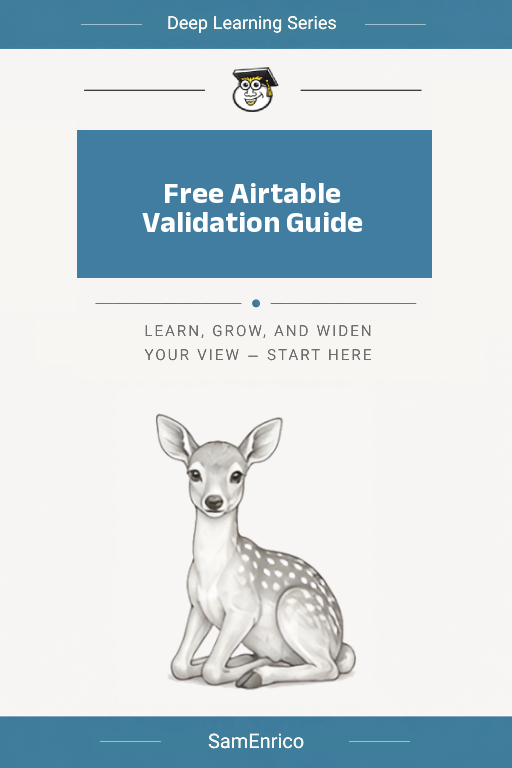
Free Airtable Validation Guide
Use free Airtable bases to validate database deman
Use free Airtable bases to validate database demand. Share templates and measure usage.
Formats
About this book
Free sample
Chapter 1: The $50,000 Mistake--–- Sarah had spent six months of her life and forty-seven thousand dollars of her savings building a meal-prep logistics app. The code was elegant. The database was normalized to third normal form. The mobile interface had been user-tested by eleven friends who all said it looked “really professional.” She launched on Product Hunt on a Tuesday morning. By Friday, she had 847 upvotes, 23 “looks cool” comments, and exactly zero paying customers.
Zero. Not one. A man from Nebraska had created an account, entered a fake email address, and never returned. That was the entire user base.Sarah’s story is not unusual. It is not even remarkable.
It is, in fact, the default outcome for most software projects. According to a comprehensive analysis of startup failures by CB Insights, thirty-five percent of startups fail because there is no market need for their product. That is not a distant second place. That is the number one reason. More than teams falling apart.
More than running out of cash. More than getting outcompeted. The single biggest predictor of failure is building something nobody wants.This chapter dismantles the myth that you need a fully functional Saa S product to test demand. It will show you why the most successful founders and product managers have abandoned the “build it and they will come” fantasy in favor of a radically simpler approach: simulating their product using tools that already exist. You will learn the difference between a hobby and a validation experiment.
And you will understand, before you write a single line of code, why a free spreadsheet is more powerful than a million-dollar engineering team.The Cathedral and the Bazaar (But Backwards)For decades, software development followed a cathedral model. You gathered requirements. You wrote specifications. You hired engineers. You spent months or years building.
And then, finally, you opened the doors and prayed that someone would show up. This model made sense when software was expensive to distribute and impossible to change after launch. It makes no sense today.Eric Ries, in his foundational book The Lean Startup, introduced a…
This is the end of the free sample. Get the eBook to keep going. Buy now
Contents
- Chapter 1
- Chapter 2
- Chapter 3
- Chapter 4
- Chapter 5
- Chapter 6
- Chapter 7
- Chapter 8
- Chapter 9
- Chapter 10
- Chapter 11
- Chapter 12
Details
- Author
- Domingo Albertine
- Publisher
- SamEnrico
- Language
- English
- Genre
- Non-Fiction, Startup Guide, Lean Methodology
- Released
- 2026-05-26
- Pages (approx.)
- 138
- Available as
- eBook, Audiobook

Read better in the ZLOADR app
Your eBooks on your phone or tablet. Sign in with your SamEnrico account and start reading.
More by Domingo Albertine
 The Multiple Pet Loss GuideDomingo Albertine$11.99
 Jealousy for WomenDomingo Albertine$11.99
 Compliance Officer StressDomingo Albertine$11.99
 The Self Talk for RejectionDomingo Albertine$11.99
 TM for Empty Nest GriefDomingo Albertine$11.99
 The Burning of Washington: A Nation in FlamesDomingo Albertine$11.99
 Understanding Tibial Aplasia EctrodactylyDomingo Albertine$17.99
 Morocco Invoice FactoringDomingo Albertine$12.99
 SEO Services Freelance BusinessDomingo Albertine$11.99
 10 Ways to Use Delicata Squash (Recipe Book)Domingo Albertine$11.99
You may also like
 Lean Business Plan TemplateSwart Jannette$11.99
 No Money Idea Validation GuideLevy Joel$12.99
 Zero Cost Pivot GuideJoyner Cammie$12.99
 Solution Interview TechniqueCreech Blythe$12.99
 Reddit Validation MethodBarnette Ellie$12.99
 Quora Question ValidationMcmanus Jenifer$12.99
 Problem Interview TechniqueCordero Mafalda$12.99
 MVP Without Coding GuideRoche Alejandra$12.99
 LinkedIn Poll ValidationMojica Gavin$12.99
 Google Forms Survey GuidePuente Micah$12.99
 Free YouTube Channel GuideNixon Odette$12.99
 Free Video Validation GuideMcallister Tosha$12.99