
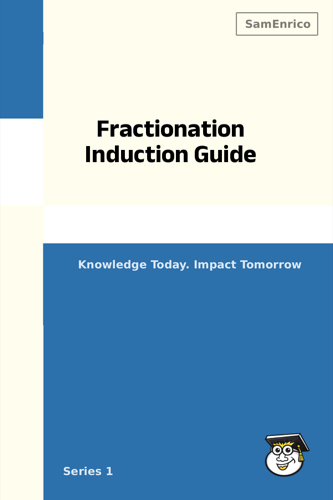
Non-FictionSelf-HelpDeepening Techniques
Fractionation Induction Guide eBook
Deepen trance by alternating in and out of hypnosi
Deepen trance by alternating in and out of hypnosis using this advanced method.
Formats
Free sample
Chapter 1: The Digestion Paradox...--–- It begins with a failure. Not your failure, necessarily, but a failure of imagination that has been passed down through generations of hypnotherapists, self-hypnosis enthusiasts, and even well-meaning clinical psychologists. The failure is this: we have been taught that trance is a destination. We speak of "going under," "dropping down," "falling asleep." The language is linear, descending, static. You start here, you go there, and then you stay.
The staircase has steps. The elevator has floors. The escalator never stops moving in the same direction.But trance is not a destination. Trance is a rhythm.This distinction is not semantic. It is the single most important concept you will learn in this book, and it is the reason fractionation works when static deepening fails.
The entire premise of the fractionation induction method rests on a counterintuitive truth: to go deeper, you must first come up. To enter trance more fully, you must first leave it. To access the subconscious more directly, you must first return to the conscious mind.This is the Digestion Paradox.The False Promise of Linear Deepening Most hypnotic inductions are linear. The therapist says, "Close your eyes. Take a deep breath.
Relax your shoulders. Now let that relaxation flow down to your hands... down to your legs... down to your feet. And now, from 10 to 1, you will go deeper and deeper.
Ten... more relaxed... nine... sinking down... eight..." The assumption is that depth is a function of duration and direction.
Stay on the path long enough, moving steadily downward, and you will eventually arrive at a deep trance.This works for some people. For highly hypnotizable subjects, almost anything works. They can close their eyes and enter somnambulism in thirty seconds regardless of the induction method. But for the majority of clients—the anxious overthinkers, the skeptical analytical types, the trauma survivors who cannot tolerate the vulnerability of "going under"—linear deepening often fails. It fails not because the technique is wrong but because the premise is incomplete.Consider the client with generalized anxiety disorder.
When you ask her to relax, her mind races. "Am I relaxing correctly? Is my shoulder supposed to feel this way? I think I'm doing it wrong. Oh no, I'm not relaxed at all.
Now I'm anxious about being anxious." The more you tell her to go down, the more she resists. Not because she wants to resist, but because her nervous system interprets "going down" as loss of control. For her, depth equals danger.Now consider the same client with a fractionation induction. You say, "Close your eyes. Good.
Now open them. Close them again, deeper. Open them. Close them, even deeper." Within three cycles, something remarkable happens. She is no longer trying to relax.
She is simply following instructions. The oscillations—in, out, in, out—create a rhythm that bypasses her analytical mind. Each time she opens her eyes, she proves to herself that she is in control. Each time she closes them again, she chooses to return. The awake phase is not a failure; it is a reassurance.
And because she feels safe, she goes deeper than any linear induction ever achieved with her.This is the Digestion Paradox in action.The Digestion Metaphor The term "digestion" is borrowed from the physiology of learning. When you eat a meal, you do not simply swallow and immediately absorb all nutrients. The food must be broken down, processed, partially assimilated, and then further broken down. The digestive system works in cycles—peristaltic waves that move food forward, then pause, then move again. If you forced food through the digestive tract at a constant speed, you would vomit.
The body requires oscillation to process.The subconscious mind operates similarly. When you induce trance, you are not pouring the client into a static container. You are offering an experience that must be digested. A brief awakening—a partial return to beta consciousness—allows the subconscious to process what just happened. It recognizes the path, files it away, and prepares for the next descent.
The second induction finds a mind that already knows the way. The third induction finds a mind that anticipates the drop. By the fourth or fifth cycle, the subconscious is leading the process while the conscious mind simply watches.This is why fractionation deepens trance more effectively than continuous deepening. The interruptions are not setbacks; they are catalysts.The Clinical Vignette: Sarah and the Climbing Walls Let me tell you about Sarah. She came to my practice with a diagnosis of generalized anxiety disorder and a long history of failed meditation and self-hypnosis attempts.
"I climb the walls," she told me. "The moment I try to relax, my brain says, 'Oh, we're relaxing? Let me think of everything I've ever worried about.' I've tried headspace, calm, binaural beats, everything. Nothing works."I asked her to close her eyes and take a deep breath. Her shoulders immediately rose toward her ears.
Her forehead wrinkled. Her breathing became shallow and rapid. She was in a state of hyperarousal within five seconds."Open your eyes," I said.She opened them, looking relieved."Close them again."She did."Open them."She did."Close them, and this time, notice what happens."We repeated this cycle of opening and closing for about two minutes. I did not ask her to relax. I did not ask her to go deep.
I simply asked her to follow the rhythm. By the fifth cycle, something shifted. Her shoulders dropped. Her breathing slowed. When she closed her eyes, she kept them closed for a few extra seconds without being asked."What's happening?" she whispered."Your subconscious is learning the rhythm," I said.
"And it likes it."By the tenth cycle, she was in a medium trance without ever having "tried" to relax. The awake phases—brief moments of orientation—had proven to her anxious mind that she was in control. She could open her eyes whenever she wanted. She could leave whenever she wanted. And because she knew she could leave, she no longer needed to fight to stay.This is the paradox that gives fractionation its power.
Resistance is not overcome; it is bypassed. The critical factor is not broken; it is outrun.The Fractionation Readiness Scale Not every client is a candidate for fractionation. Some clients thrive on linear deepening. Others require the oscillation method. The Fractionation Readiness Scale is a simple three-question tool that helps you determine which approach to use.
Ask the client these questions before the first induction:Question One: "When you try to relax or meditate, do you notice that your mind races or that you become more aware of your thoughts rather than less?"A yes answer suggests that static relaxation creates hyperarousal for this client. Fractionation is likely to help because the awake phases provide reassurance.Question Two: "Do you have a history of panic attacks, claustrophobia, or a strong need to feel in control of your body and environment?"A yes answer indicates that the client may experience "going under" as a threat. Fractionation's built-in exits can reduce that threat.Question Three: "When someone interrupts you during a focused task, do you find it easy to return to…
This is the end of the free sample. Get the eBook to keep going. Buy now
About this book
Details
- Author
- Whitcomb Jackqueline
- Publisher
- SamEnrico
- Language
- English
- Genre
- Non-Fiction, Self-Help, Deepening Techniques
- Released
- 2026-06-06
- Pages (approx.)
- 138
- Available as
- eBook, Audiobook

Read better in the ZLOADR app
Your eBooks on your phone or tablet. Sign in with your SamEnrico account and start reading.
More by Whitcomb Jackqueline
 Senior Life Insurance GuideWhitcomb Jackqueline$11.99
 Partner Support for Menopause InsomniaWhitcomb Jackqueline$11.99
 Committed OKRs HandbookWhitcomb Jackqueline$11.99
 The Military Mom PPD GuideWhitcomb Jackqueline$11.99
 Self Hypnosis Workbook for HabitsWhitcomb Jackqueline$11.99
 Body Language for PoliceWhitcomb Jackqueline$11.99
 Mwindo's Epic: The Trickster King of the MoonWhitcomb Jackqueline$11.99
 The Green Visionary: Robert Hooke and the Birth of Sustainable DesignWhitcomb Jackqueline$11.99
 How to Produce CrossbowsWhitcomb Jackqueline$11.99
 Amazon Brand Registry vs Jumia BrandWhitcomb Jackqueline$12.99
 Amazon FBA Storage OptimizationWhitcomb Jackqueline$12.99
 A Collector's Handbook to the Vauxhall Twenty FiveWhitcomb Jackqueline$11.99
You may also like
 Hong Kong Handover 1997Dunn Johnnie$11.99
 Zumba For Postnatal Recovery CourseNeal Christian$11.99
 Zumba for BeginnersLadner Nikia$11.99
 YouTube Comment Mining GuideHumes Pandora$12.99
 Worry Box MeditationCarlin Rudy$11.99
 Workplace Stress MeditationNguyen Lynn$11.99
 Workplace Stress and Sleep RepairHawley Ivory$11.99
 Workplace Perfectionism CureDelaney Jeffry$11.99
 Workplace Injustice Anger GuideWallen Isabelle$11.99
 Work Addiction and Burnout LinkGreenwood Ester$11.99
 Women in Yoga and WellnessBeattie Galina$11.99
 Women in Stand Up ComedyChun Evangeline$11.99