
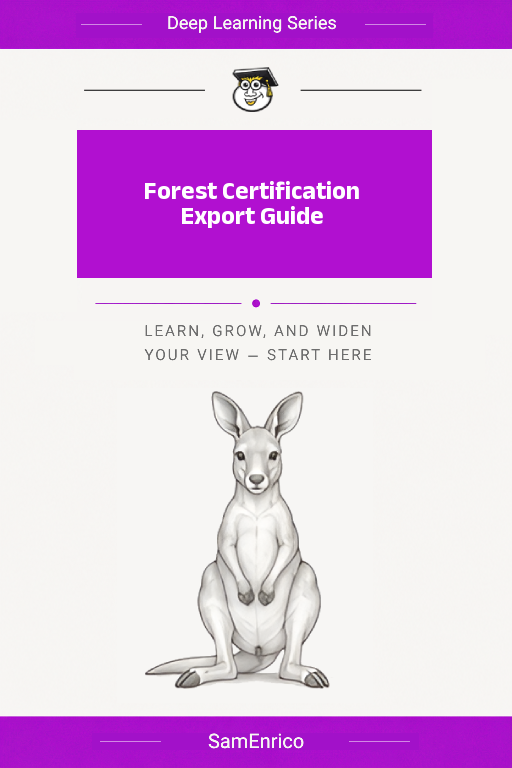
Forest Certification Export Guide eBook
Export wood and paper products with FSC, PEFC, and
Export wood and paper products with FSC, PEFC, and SFI certifications to 50 markets requiring legal timber documentation.
Formats
Free sample
Chapter 1: The Green Wall--In 2019, a midsize plywood mill in southern Brazil received what seemed like a routine order from a German furniture manufacturer: twelve containers of 18-millimeter birch plywood, FSC Mix labeled, shipped CIF to Hamburg. The mill had exported to Europe before. They had their FSC Chain of Custody certificate displayed prominently on their website. The price was agreed. The containers were loaded.When the shipment arrived in Hamburg sixty-three days later, German customs flagged it for a random inspection.
The inspector opened one container, examined the plywood panels, and then asked for three documents: the harvest permit for the birch logs, the FSC transaction certificate linking the logs to the mill, and the invoice showing the correct FSC claim.The mill could produce the invoice. The transaction certificate was in order. But the harvest permit had been issued to a supplier three links up the supply chain, and the mill had not kept a copy. Under the EU Timber Regulation then in force, that missing link was enough. The containers were held for 147 days.
The German buyer canceled the contract. The plywood, by then discolored from humidity inside the containers, was sold at a sixty-two percent loss on the spot market.The mill lost its largest customer and, within eleven months, went out of business.This is not a story about fraud or corruption. It is a story about the gap between having a certificate and understanding the compliance system that certificate represents. The mill had done everything required by FSC. They had passed their annual audit.
Their paperwork was in order for the certificates themselves. But they did not understand that the regulatory environment had shifted beneath their feet, turning a voluntary certification into a mandatory documentary chain that extended from the forest floor to the customs dock.That shift is what this chapter calls the Green Wall.The Green Wall Defined The Green Wall is not a single law or a single buyer requirement. It is the convergence of three separate forces that together block non-certified wood and paper products from the most lucrative markets on earth. Those three forces are regulatory mandates, private sector procurement policies, and voluntary certification standards that have become effectively mandatory through market pressure.Consider the numbers. The global trade in forest products exceeds four hundred billion dollars annually.
Of that total, approximately one hundred eighty billion dollars flows through markets that require some form of certification for entry. The European Union alone accounts for forty-three percent of global wood product imports, and since the introduction of the EU Timber Regulation in 2013, followed by the EU Deforestation Regulation in 2023, uncertified wood has become virtually impossible to land at Rotterdam, Hamburg, or Antwerp.The United States, through the Lacey Act amendments of 2008, has banned the import of illegally harvested wood products. While the Lacey Act does not explicitly require third-party certification, in practice, importers have found that certification is the only cost-effective way to demonstrate due diligence. Japan’s Clean Wood Act, Australia’s Illegal Logging Prohibition Act, and the United Kingdom’s Timber Regulation post-Brexit have created a patchwork of requirements that, taken together, cover every major economy except China, India, and Brazil—and those three are rapidly moving in the same direction.But regulation is only one layer of the wall. Private sector procurement policies are often stricter than the law.
IKEA, the world’s largest furniture retailer, requires all solid wood products to be FSC-certified. Home Depot in North America requires certification for all wood products sold in its stores. B&Q in the United Kingdom, Leroy Merlin in France, and Bauhaus in Germany have similar requirements. These companies did not adopt these policies out of altruism. They adopted them because their customers demanded it and because their shareholders recognized that deforestation risk is financial risk.The third layer of the wall is the certification system itself.
FSC, PEFC, and SFI have created standards that go beyond mere legality. An FSC certification requires not only that timber was legally harvested but that the harvest did not convert natural forests to plantations, that indigenous peoples’ rights were respected, that high conservation value forests were protected, and that the chain of custody from forest to final product is unbroken.When these three layers work together, the result is a barrier that no non-certified exporter can penetrate. The German furniture buyer who canceled that Brazilian mill’s contract was not being unreasonable. Their own compliance system required that every link in their supply chain be documented. Without the harvest permit, they could not prove legality.
Without proof of legality, they could not sell the plywood to their own customers. The missing paper cost the Brazilian mill its future.The Three Certifications: FSC, PEFC, and SFIBefore we go further, we need to understand the three major certification systems that form the backbone of the Green Wall. Each has a different history, a different governance structure, and different levels of recognition in different markets.Forest Stewardship Council The Forest Stewardship Council was founded in 1993 by a coalition of environmental organizations, including the World Wildlife Fund and Greenpeace, along with social justice groups and some progressive businesses. FSC was designed from the beginning to be the most stringent certification system, with a strong emphasis on biodiversity conservation, indigenous rights, and the prohibition of natural forest conversion.FSC certifications come in three types for products: FSC 100 percent, which means all wood fiber comes from FSC-certified forests; FSC Mix, which means at least seventy percent comes from FSC-certified forests and the remainder from controlled wood sources that meet FSC’s minimum standards; and FSC Recycled, which means one hundred percent reclaimed fiber.As of 2024, FSC has certified more than two hundred thirty million hectares of forest in eighty-seven countries, making it the largest single certification system by area. Its strength is its brand recognition: consumers in Europe and North America recognize the FSC checkmark and tree logo as the gold standard.
Its weakness is its cost and complexity. FSC audits are more frequent and more detailed than those of its competitors, and FSC’s controlled wood standards require extensive documentation that smaller operators struggle to maintain.Programme for the Endorsement of Forest Certification PEFC was founded in 1999 as an industry response to FSC. European forest owners, particularly in Scandinavia and the Baltic states, felt that FSC’s standards were too rigid and did not account for regional differences in forest management practices. PEFC takes a different approach: instead of setting a single global standard, PEFC endorses national forest certification systems that meet its minimum requirements.PEFC’s governance is dominated by forest owners and industry associations rather than environmental NGOs. Its standards are generally less stringent than FSC’s on biodiversity and natural forest conversion.
For example, PEFC allows certified forests to be converted to plantations under certain conditions, whereas FSC forbids conversion entirely.However, PEFC has one critical advantage: it has endorsed more than sixty national systems, covering more than three hundred million hectares of forest—more than FSC. PEFC certification is widely accepted in Europe, particularly in Germany, the United Kingdom, and the Nordic countries. It is the dominant system in Japan, where PEFC has endorsed the…
This is the end of the free sample. Get the eBook to keep going. Buy now
About this book
Details
- Author
- Felix Eusebio
- Publisher
- SamEnrico
- Language
- English
- Genre
- Non-Fiction, Business Brief
- Released
- 2026-06-01
- Pages (approx.)
- 139
- Available as
- eBook, Audiobook

Read better in the ZLOADR app
Your eBooks on your phone or tablet. Sign in with your SamEnrico account and start reading.
More by Felix Eusebio
 Purpose Discovery WorkbookFelix Eusebio$11.99
 Printer Jam Anger PreventionFelix Eusebio$11.99
 Harm Reduction PrinciplesFelix Eusebio$11.99
 Savings Over Spending WorkbookFelix Eusebio$11.99
 The Golden Scalpel: How Western Medicine Conquered DiseaseFelix Eusebio$11.99
 The Fear of Bees GuideFelix Eusebio$11.99
 Founder Stock Pool GuideFelix Eusebio$12.99
 Understanding Uniparental Disomy of 14Felix Eusebio$17.99
 Facilities Maintenance TechnicianFelix Eusebio$11.99
 How to Start a Petroleum Drilling Equipment Business (Beginners Guide)Felix Eusebio$11.99
You may also like
 Hong Kong Handover 1997Dunn Johnnie$11.99
 Zumba For Postnatal Recovery CourseNeal Christian$11.99
 Zumba for BeginnersLadner Nikia$11.99
 YouTube Comment Mining GuideHumes Pandora$12.99
 Worry Box MeditationCarlin Rudy$11.99
 Workplace Stress MeditationNguyen Lynn$11.99
 Workplace Stress and Sleep RepairHawley Ivory$11.99
 Workplace Perfectionism CureDelaney Jeffry$11.99
 Workplace Injustice Anger GuideWallen Isabelle$11.99
 Work Addiction and Burnout LinkGreenwood Ester$11.99
 Women in Yoga and WellnessBeattie Galina$11.99
 Women in Stand Up ComedyChun Evangeline$11.99