
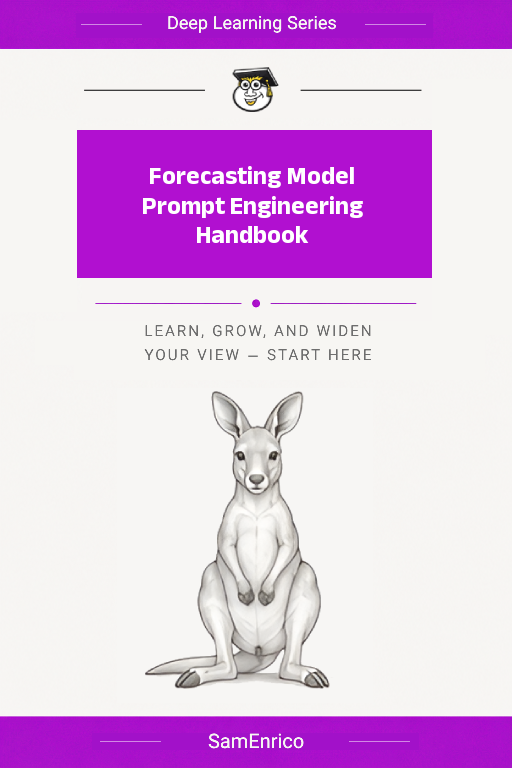
Forecasting Model Prompt Engineering Handbook
Generate rolling forecasts, variance explanations,
by Gilbert Mack
Generate rolling forecasts, variance explanations, and scenario analyses using natural language prompts. Connect AI to ERP and CRM data sources seamlessly.
Formats
About this book
Free sample
Chapter 1: The Forecast Fiasco--–- The email arrived at 11:47 PM on a Friday. Maria Chen, VP of Financial Planning & Analysis at a $2.4 billion consumer electronics company, stared at her screen. The subject line read: "Q3 Forecast Update – PLEASE REVIEW." Attached was the fifteenth version of the quarterly forecast spreadsheet, a 87-megabyte Excel file with 23 interconnected tabs, 1,400 named ranges, and exactly four people in the entire organization who understood how it worked. One of them was on paternity leave. Another had just quit.The problem was not the spreadsheet’s complexity.
The problem was that the forecast it contained was already wrong.Two weeks ago, when the FP&A team had locked in the Q3 projection, they had assumed steady component pricing, normal seasonal demand, and no supply chain disruptions. Since then, a factory fire in Taiwan had spiked memory chip prices by 34 percent, a competitor had launched a surprise early Black Friday promotion that stole eight points of market share overnight, and the company’s own CRM system showed a sudden 22 percent drop in pipeline velocity that no one had noticed because nobody had thought to connect the CRM to the forecasting process.Maria’s team would spend the next three weeks reconciling these discrepancies, manually typing variance explanations into Power Point slides, and presenting a forecast that would be obsolete by the time the board reviewed it. Then they would do it all again next quarter.This is not an edge case. This is the state of corporate forecasting in the 2020s. And it is failing.The Silent Crisis in Financial Planning & Analysis Traditional Financial Planning & Analysis—FP&A for short—operates on a rhythm that belongs to a slower century.
The monthly or quarterly cycle: extract data from ERP systems (SAP, Oracle, Net Suite), pull pipeline data from CRM platforms (Salesforce, Hub Spot), wrestle everything into Excel or a dedicated planning tool like Anaplan or Hyperion, run statistical models that few people understand, argue about the assumptions in long email threads, lock the forecast, present to leadership, and then immediately begin the process again because the first actual…
This is the end of the free sample. Get the eBook to keep going. Buy now
Contents
- Chapter 1
- Chapter 2
- Chapter 3
- Chapter 4
- Chapter 5
- Chapter 6
- Chapter 7
- Chapter 8
- Chapter 9
- Chapter 10
- Chapter 11
- Chapter 12
Details
- Author
- Gilbert Mack
- Publisher
- SamEnrico
- Language
- English
- Genre
- Non-Fiction, AI Operator, Financial Planning, Predictive Analytics
- Released
- 2026-06-01
- Pages (approx.)
- 137
- Available as
- eBook, Audiobook

Read better in the ZLOADR app
Your eBooks on your phone or tablet. Sign in with your SamEnrico account and start reading.
More by Gilbert Mack
 Market Sizing Early Idea GuideGilbert Mack$11.99
 Living at Home Student StressGilbert Mack$11.99
 Intermittent Fasting for AthletesGilbert Mack$11.99
 Nicotine Free Workplace InitiativeGilbert Mack$11.99
 John McCain MaverickGilbert Mack$11.99
 HGH Black Market DangersGilbert Mack$11.99
 TM for MathematiciansGilbert Mack$11.99
 The Team Creative TriggersGilbert Mack$11.99
 Teen Body Positivity GuideGilbert Mack$11.99
 Pets.com: The Dot-Com Puppy That Never BarkedGilbert Mack$11.99
 Frozen Shadows: The X-Ray Expedition That Lit Up AntarcticaGilbert Mack$11.99
 The Sky’s Silent Witness: How Weather Balloons Uncovered a Cold War ConspiracyGilbert Mack$11.99