
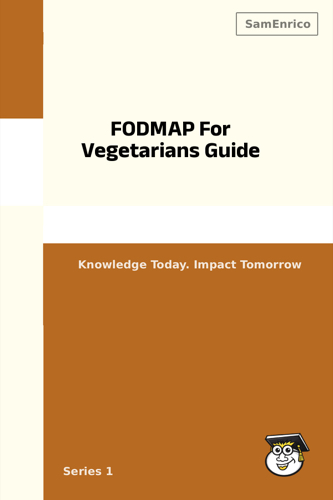
Non-FictionHealth & WellnessVegetarian
FODMAP For Vegetarians Guide eBook
Adapts plant based diet to low FODMAP.
Adapts plant based diet to low FODMAP.
Formats
Free sample
Chapter 1: The Vegetarian Paradox...--–- You switched to a vegetarian diet to feel better—more energetic, more aligned with your values, lighter on the planet. Instead, you find yourself bloated by 2 PM, clutching your stomach after dinner, and wondering if your body is broken. You are not broken. You are experiencing the vegetarian paradox: the harder you try to eat "clean" with beans, lentils, cauliflower, apples, and whole wheat, the worse your digestive system behaves. This chapter will validate your frustration, explain why healthy plant foods can trigger IBS symptoms, and introduce you to the low-FODMAP solution designed specifically for meat-free eaters.
By the end, you will understand that the problem is not vegetarianism—it is a mismatch between your gut's biology and certain carbohydrate chains found in otherwise nutritious plants.The Confession That Started This Book Let me tell you about the worst lunch of my life. I had been vegetarian for three years. Proud of it. I packed what any nutritionist would call a perfect meal: a generous bowl of lentil soup (homemade, organic, with plenty of garlic and onion), a side of roasted cauliflower, a sliced apple, and a handful of almonds for crunch. I sat down at my desk at noon.
By 12:45, my abdomen had distended so noticeably that a colleague asked if I was pregnant. I am not pregnant. By 1:30, I was lying on the bathroom floor of my office, sweat on my forehead, convinced I had developed a sudden allergy to food itself.That evening, I did what any desperate person does: I searched the internet. I found the low-FODMAP diet. I also found a community of vegetarians who had the exact same story.
One woman wrote, "I became vegan to save the animals, but my own gut became a war zone." Another said, "Every time I eat beans, I look six months pregnant within an hour." A third described bringing her own rice cakes to a vegetarian potluck because she was too afraid to eat anyone else's cooking.These stories share a common thread. You switch to a plant-based diet for noble reasons. You increase your intake of fiber-rich legumes, cruciferous vegetables, and whole grains. Your conscience feels clearer. Your body feels worse.
And then comes the cruelest twist: when you mention this to a doctor, they often suggest eating less fiber or going back to meat. Neither is an acceptable answer.This chapter is for the vegetarian who has been told, "Maybe your body just needs chicken." It is for the vegan who cried over a bowl of chickpeas because they hurt so much afterward. It is for everyone who loves plants but has started to fear them.Defining the Vegetarian Paradox The vegetarian paradox can be stated simply: among people with IBS and related digestive disorders, those who follow vegetarian or vegan diets often report more severe bloating, gas, and abdominal pain than those who eat meat—not less. This runs counter to everything we believe about plant-based eating. We assume more plants equal better digestion.
For many, the opposite is true.Let me be precise about what the paradox is not. It is not an argument against vegetarianism. The ethical, environmental, and health benefits of reducing meat consumption are well-established. The paradox is not a condemnation of plants. Vegetables, fruits, grains, and legumes are nutrient-dense foods that most people should eat more of.
The paradox is specific to a subset of plant foods that contain high levels of fermentable carbohydrates called FODMAPs.Here is the mechanism. Your small intestine is designed to absorb most nutrients. But FODMAPs are small, poorly absorbed carbohydrate chains. They travel through your small intestine largely intact. When they reach your large intestine, gut bacteria ferment them rapidly.
This fermentation produces gas. The gas stretches your intestinal walls. Simultaneously, the osmotic pressure from unabsorbed FODMAPs pulls water into your intestine. The combination of gas distension and excess water creates the symptoms you know too well: bloating, pain, urgent diarrhea, or constipation.Now consider the typical vegetarian plate. Beans and lentils are high in GOS (galacto-oligosaccharides), one of the most fermentable FODMAP groups.
Wheat-based pasta and bread are high in fructans. Cauliflower and Brussels sprouts are high in mannitol and fructans. Apples and pears are high in excess fructose and sorbitol. Garlic and onion—the flavor foundation of countless vegetarian recipes—are extremely high in fructans. A vegetarian diet, done without FODMAP awareness, can be a perfect storm of fermentable carbohydrates.This does not mean you must stop eating these foods forever.
It means you must learn which ones your specific gut tolerates, in which quantities, and in which combinations. The vegetarian paradox exists because most dietary advice treats all plants as equally digestible. They are not.Real Stories from Real Vegetarians Let me introduce you to three people whose experiences shaped the approach of this book. Their names have been changed, but their stories are true.*Sarah, 34, lacto-vegetarian for six years.* Sarah switched to vegetarianism after watching a documentary about factory farming. She felt morally liberated.
She also felt physically terrible. Her typical lunch was lentil soup or a bean burrito. By 3 PM each day, she could not button her pants. Her doctor suggested she might have developed a gluten intolerance, so she cut out bread. No improvement.
Then she cut out dairy. No improvement. She was about to give up on vegetarianism entirely when she discovered FODMAPs. Within two weeks of low-FODMAP eating, her bloating dropped by 80 percent. She now eats vegetarian successfully but avoids large servings of beans and instead relies on tofu and tempeh.
She can eat lentil soup again—but only a half-cup serving of rinsed canned lentils, not the two-cup bowl she used to enjoy.Marcus, 28, vegan for four years. Marcus became vegan for athletic performance. He believed a plant-based diet would reduce inflammation and speed recovery. Instead, he developed debilitating gas during long runs. He would have to stop mid-race to find a bathroom.
He tried eliminating different foods one by one—first gluten, then soy, then nuts—with no clarity. His breaking point came during a half-marathon when he had to duck behind a port-a-potty at mile 9. A sports dietitian eventually introduced him to low-FODMAP. Marcus learned that his pre-run smoothie (banana, oat milk, almond butter, and spinach) was a FODMAP bomb. The banana was overripe (high in fructans), the oat milk exceeded the safe half-cup serving, and the almond butter added GOS.
He now uses firm bananas, rice milk, and a smaller portion of almond butter. He runs symptom-free.Elena, 52, vegetarian for twenty years. Elena had managed mild IBS for decades with over-the-counter medications. After menopause, her symptoms worsened dramatically. She became afraid to eat in restaurants or at social gatherings.
Her vegetarianism made her feel isolated—she was already the "difficult eater" for being meat-free, and now she had to ask about garlic and onion too. She told me, "I felt like a burden to everyone who ever invited me to dinner." Low-FODMAP gave her back her social life. She learned that she tolerates small amounts of garlic-infused oil but cannot handle any onion. She carries chef cards (see Appendix D) and has developed a script for…
This is the end of the free sample. Get the eBook to keep going. Buy now
About this book
Details
- Author
- Jackson Kerry
- Publisher
- SamEnrico
- Language
- English
- Genre
- Non-Fiction, Health & Wellness, Vegetarian
- Released
- 2026-06-10
- Pages (approx.)
- 139
- Available as
- eBook, Audiobook

Read better in the ZLOADR app
Your eBooks on your phone or tablet. Sign in with your SamEnrico account and start reading.
More by Jackson Kerry
 Kitchen Chemical Safety HandbookJackson Kerry$11.99
 Sam Sheppard Prison YearsJackson Kerry$11.99
 TM and the Relaxation ResponseJackson Kerry$11.99
 The MBSR Workbook SpanishJackson Kerry$11.99
 Breath in HospiceJackson Kerry$11.99
 Rockefeller Success LessonsJackson Kerry$11.99
 Juvenile Idiopathic Arthritis GuideJackson Kerry$11.99
 Sleep Grief Insomnia GuideJackson Kerry$11.99
 The Last Voyage of the SS Andrea Doria: A Titanic of the 1950sJackson Kerry$11.99
 The Iron Titans: How Isambard Kingdom Brunel and George Stephenson Forged the Modern AgeJackson Kerry$11.99
 The Carthaginian Deep: Hannon's Lost Voyage and the Birth of OceanographyJackson Kerry$11.99
 Growing SymphyandraJackson Kerry$11.99
You may also like
 Hong Kong Handover 1997Dunn Johnnie$11.99
 Zumba For Postnatal Recovery CourseNeal Christian$11.99
 Zumba for BeginnersLadner Nikia$11.99
 YouTube Comment Mining GuideHumes Pandora$12.99
 Worry Box MeditationCarlin Rudy$11.99
 Workplace Stress MeditationNguyen Lynn$11.99
 Workplace Stress and Sleep RepairHawley Ivory$11.99
 Workplace Perfectionism CureDelaney Jeffry$11.99
 Workplace Injustice Anger GuideWallen Isabelle$11.99
 Work Addiction and Burnout LinkGreenwood Ester$11.99
 Women in Yoga and WellnessBeattie Galina$11.99
 Women in Stand Up ComedyChun Evangeline$11.99